An FRP grating datasheet packs resin type, bar geometry, mesh size, panel mass, load capacity and deflection limits onto one page. Engineering buyers who read the bar code, the load table and the deflection limit together will not over-specify or under-design.
- Bar code: 38 mm depth × 50 mm mesh pitch × 50 mm crossbar spacing is the most common molded configuration.
- Load table: p38 25/12/6.5 kN/m² at 600/900/1200 mm span is the standard pedestrian-grade molded panel.
- Deflection: L/200 is the default walkway limit; L/360 is specified for rolling loads and aesthetics.
- Quality: Barcol hardness ≥40, resin content 25–35 %, density 1.5–2.0 g/cm³ are the three QC numbers to check first.
How to Read FRP Grating Datasheet: Engineering Guide
A datasheet is a negotiation document. On one side it tells the factory exactly what to pull from stock; on the other it tells the engineer what the panel will survive. This guide walks through every field on a standard pultruded FRP grating and molded FRP grating datasheet, with the numbers Zeall uses on its own production drawings.
We assume the reader has a datasheet in hand or will download one from the catalogue section. The goal is not to memorize every number but to learn which three fields decide whether the panel will survive the project.
Anatomy of a Datasheet: The 9 Fields
Every FRP grating datasheet on the market contains the same nine fields. The order changes between manufacturers, but the data behind them is interchangeable.
| # | Field | Unit | Why it matters |
|---|---|---|---|
| 1 | Resin system | Ortho / Iso / VE / Phenolic | Drives chemical resistance and max service temperature |
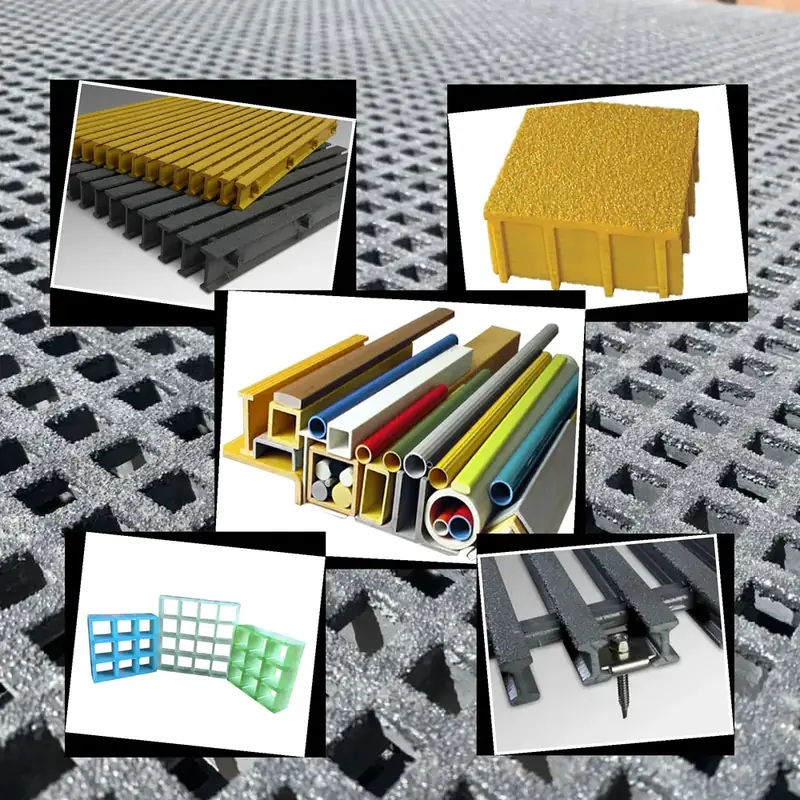
| 2 | Bar type | Molded / T-bar / I-bar / Square | Drives span-to-depth ratio and cost |
| 3 | Bar depth | mm (25/30/38/50) | Drives load capacity |
| 4 | Mesh pitch | mm (38×38, 50×50) | Drives open area and slip resistance |
| 5 | Panel size | mm (1220×3660 standard) | Drives transport and cutting waste |
| 6 | Mass per area | kg/m² | Drives dead load and support design |
| 7 | Load capacity | kN/m² at span | Drives structural adequacy |
| 8 | Deflection limit | L/200 or L/360 | Drives user comfort and cracking risk |
| 9 | QC numbers | Barcol, resin %, density | Drives whether the panel you receive matches the one quoted |
The table above is the minimum you should find on any credible datasheet. If any of these nine fields is missing, ask the factory to fill it before placing the order.
Decoding the Bar Code
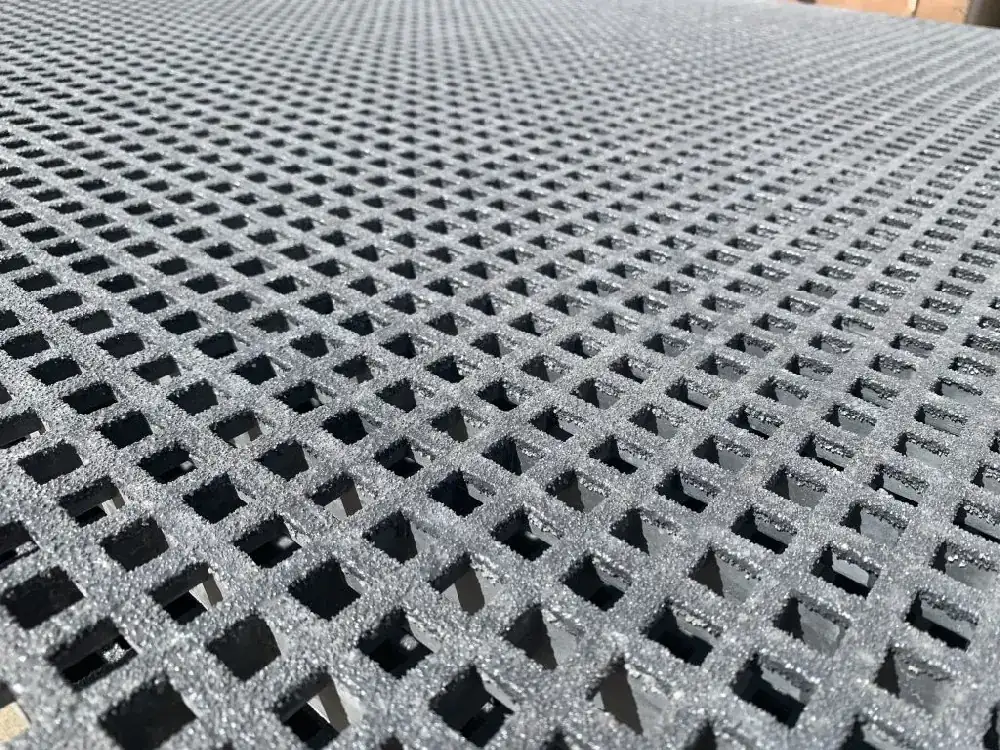
The bar code is the most misread field on the page. A notation like M38/50×50 does not mean '38 mm bar, 50 mm everything'. It means: molded process, 38 mm bar depth, 50 mm mesh pitch between bearing bars, 50 mm crossbar spacing.
| Code | Process | Bar depth | Mesh pitch | Typical use |
|---|---|---|---|---|
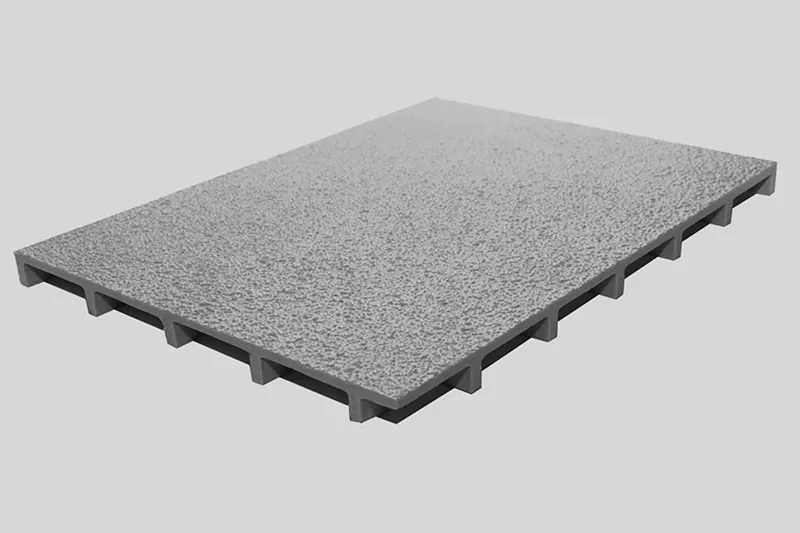
| M25/38×38 | Molded | 25 mm | 38×38 mm | Light walkways, foot traffic only |
| M30/50×50 | Molded | 30 mm | 50×50 mm | General pedestrian platforms |
| M38/50×50 | Molded | 38 mm | 50×50 mm | Standard industrial walkway |
| M50/50×50 | Molded | 50 mm | 50×50 mm | Heavy duty, trolleys, pallet trucks |
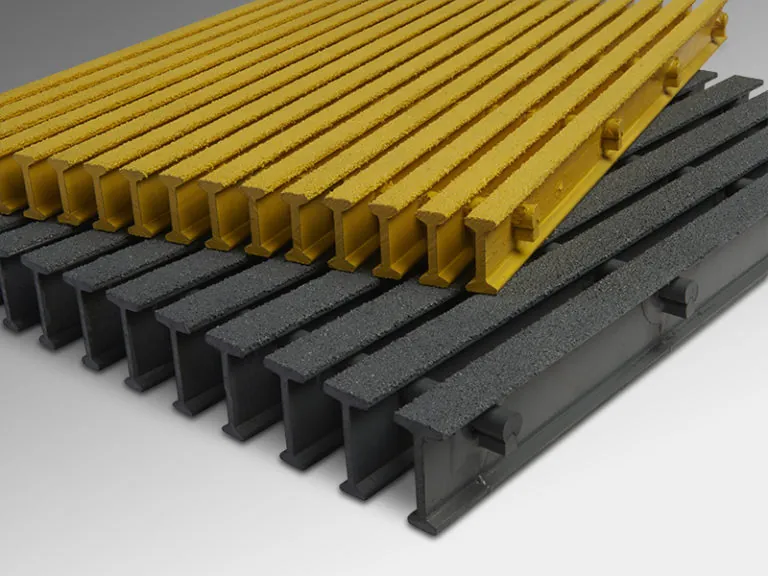
| P38-T | Pultruded T-bar | 38 mm | 15–40 mm crossbar | Long span bridges, platforms |
| P38-I | Pultruded I-bar | 38 mm | 40–60 mm crossbar | Maximum span-to-depth ratio |
See the dedicated guide on T-bar vs I-bar pultruded grating span selection for how the bar profile changes the allowable span.
Reading the Load Table
The load table is the heart of the datasheet. It tells you, for a given panel at a given span, what uniformly distributed load (UDL) it will carry without exceeding the deflection limit.
| Panel | 600 mm span | 900 mm span | 1200 mm span | Application |
|---|---|---|---|---|
| m38 molded | 25 kN/m² | 12 kN/m² | 6.5 kN/m² | Pedestrian walkway |
| p38 T-bar | 35 kN/m² | 18 kN/m² | 9 kN/m² | Pedestrian + light trolley |
| p50 I-bar | 48 kN/m² | 26 kN/m² | 14 kN/m² | Heavy trolley, pallet jack |
These numbers assume a uniformly distributed load at the L/200 deflection limit. For point loads, handcart wheels or pallet jacks, ask the factory for the point-load table — the UDL table alone is not conservative enough.
Note: Always confirm the deflection assumption the load table was calculated against. A 25 kN/m² number at L/200 is not the same panel as 25 kN/m² at L/360.
Deflection Limits L/200 vs L/360
Deflection limit is the maximum allowable sag, expressed as a fraction of the span. L/200 means the panel may sag 1 mm for every 200 mm of span. L/360 is tighter: 1 mm per 360 mm.
| Limit | 1 m span sag | 1.5 m span sag | Feels like | Use when |
|---|---|---|---|---|
| L/200 | 5.0 mm | 7.5 mm | Noticeable bounce | Industrial walkways, plant floors |
| L/250 | 4.0 mm | 6.0 mm | Subtle flex | Public platforms, view areas |
| L/360 | 2.8 mm | 4.2 mm | Rigid, steel-like | Rolling loads, aesthetics, offshore |
For a deeper treatment, see FRP grating deflection limit L/200 vs L/360 selection. The short rule of thumb: if people will stand on it for hours, L/250 or tighter; if trolleys or pallets roll over it, L/360.
QC Numbers: Barcol, Resin, Density
The last three fields on the datasheet tell you whether the panel you receive will match the one quoted. They are also the three easiest fields for a factory to fudge — which is why you should ask for a mill test report.
| Number | Unit | Typical range | Fail when |
|---|---|---|---|
| Barcol hardness | — | ≥ 40 | Below 38 (under-cured resin) |
| Resin content | % by weight | 25–35 % | Below 22 % (glass too high, brittle) |
| Density | g/cm³ | 1.5–2.0 | Below 1.4 (voids) |
| Fire retardancy | Class | ASTM E84 Class B | No fire test report |
| Service temp | °C | Up to 80 (ortho), 120 (VE) | Above rated, resin softens |
See Barcol hardness test for FRP grating QC for the test method and what a passing Barcol actually tells you about the laminate.
Mass per Area and Panel Weight
Mass per area is the field that surprises most buyers. A 38 mm molded panel is not 'the same weight as steel grating' — it is roughly one third the mass, which changes support design, shipping cost and installation labor.
| Panel | Depth | Mass per area | Standard panel mass (1220×3660) |
|---|---|---|---|
| Molded 25 | 25 mm | 12.5 kg/m² | ~56 kg |
| Molded 30 | 30 mm | 15.0 kg/m² | ~67 kg |
| Molded 38 | 38 mm | 19.5 kg/m² | ~87 kg |
| Molded 50 | 50 mm | 27.0 kg/m² | ~120 kg |
| Pultruded T-bar 38 | 38 mm | 11.5–13.0 kg/m² | ~55–60 kg |
| Pultruded I-bar 38 | 38 mm | 12.5–14.5 kg/m² | ~60–65 kg |
Conversion: 1 kg/m² = 0.2048 lb/ft². A 38 mm molded panel at 19.5 kg/m² is about 4.0 lb/ft². See how much does FRP grating weigh for the full conversion table.
Turning a Datasheet into an RFQ
Once you can read the datasheet, writing the RFQ is straightforward. Include the nine fields above, add the project conditions (chemical list, temperature, span, load), and ask for the mill test report.
| RFQ item | What to specify | Why |
|---|---|---|
| Resin | Ortho / Iso / VE / Phenolic | Chemical + temperature |
| Bar type | Molded / T-bar / I-bar | Span + cost |
| Depth | 25 / 30 / 38 / 50 mm | Load |
| Mesh | 38×38 / 50×50 | Slip + open area |
| Deflection | L/200 / L/250 / L/360 | Comfort + rolling load |
| Surface | Smooth / Concave / Grit | Slip resistance |
| Panel size | 1220×3660 or cut pieces | Cutting waste |
| QC | Barcol ≥40, MTR required | Receiving inspection |
| MOQ / Lead | MOQ 10 m², lead 12–36 working days | Project schedule |
Use the RFQ specification checklist as a template. Minimum order is 10 m²; standard lead time is 12–36 working days depending on resin and surface.
Five Datasheet Pitfalls to Avoid
- Comparing apples to oranges. A 25 kN/m² number at L/200 is not the same as 25 kN/m² at L/360. Always check the deflection assumption.
- Ignoring the resin. The same 38 mm panel in ortho resin will fail in strong acid; in vinyl ester it will last 20 years.
- Using UDL for point loads. A pallet jack puts 5 kN on two small wheels. The UDL table will overstate the capacity.
- Forgetting panel weight. A 38 mm panel is 87 kg. Two installers can lift it; one cannot.
- Ordering without MTR. Without a mill test report you cannot reject a batch that arrived with Barcol 35.
These five pitfalls account for the majority of FRP grating rejections and warranty claims we see on retrofit projects.
Next Steps: Get a Datasheet Matched to Your Project
| Item | Standard value | Note |
|---|---|---|
| Panel size | 1220 × 3660 mm | Cut pieces available on request |
| MOQ | 10 m² | Sample panels 2–5 m² by negotiation |
| Lead time | 12–36 working days | Depends on resin and surface |
| MTR | Included | Mill test report with Barcol record |
Send us the span, the chemical list, the maximum load and the required deflection limit. We will return a datasheet excerpt matched to your project, with the load table calculated at your specified deflection — not a generic stock sheet.
All quotes come with the mill test report and Barcol hardness record. We do not issue third-party certification claims; the MTR is our own production record.
| Parameter | Value | Unit |
|---|---|---|
| Standard panel size | 1220 × 3660 | mm |
| Bar depths available | 25 / 30 / 38 / 50 | mm |
| Density range | 1.5 – 2.0 | g/cm³ |
| Barcol hardness minimum | 40 | — |
| MOQ | 10 | m² |
| Lead time | 12 – 36 | working days |
| Conversion | Factor | Example |
|---|---|---|
| 1 kg/m² to lb/ft² | × 0.2048 | 19.5 kg/m² = 4.0 lb/ft² |
| 1 mm to inch | ÷ 25.4 | 38 mm ≈ 1.5 inch |
| 1 kN/m² to psf | × 20.885 | 25 kN/m² ≈ 522 psf |
| QC Check | Method | Acceptance |
|---|---|---|
| Barcol hardness | Barcol impressor | ≥ 40 across panel |
| Resin content | Burn-off / Ash | 25 – 35 % by weight |
| Density | Cut section | 1.5 – 2.0 g/cm³ |
| Dimensions | Tape measure | ± 3 mm on panel |
| Item | Standard | Note |
|---|---|---|
| Panel thicknesses | 25 / 30 / 38 / 50 mm | Molded and pultruded |
| Standard width | 1220 mm | Other widths by order |
| Standard length | 3660 mm | Cut pieces available |
| Surface finishes | Smooth / concave / grit | Grit adds ~0.5 kg/m² |
| Resin options | Ortho / Iso / VE / Phenolic | VE for strong acids |
Frequently Asked Questions
What does M38/50×50 mean on a datasheet?
Molded process, 38 mm bar depth, 50 mm mesh pitch between bearing bars, 50 mm crossbar spacing. It is the standard industrial walkway configuration.
How do I read the load table? Is 25 kN/m² enough for a walkway?
25 kN/m² at 600 mm span is the standard pedestrian walkway rating. For a 900 mm span the same panel drops to 12 kN/m². Always read the load together with the span and the deflection limit.
What Barcol hardness should I expect on FRP grating?
Barcol hardness ≥40 is the industry minimum. Below 38 the resin is likely under-cured and the panel will chalk and craze within a few years.
How heavy is a 38 mm FRP grating panel?
A standard 1220×3660 mm molded 38 mm panel weighs about 87 kg (19.5 kg/m²). A pultruded T-bar 38 mm panel weighs about 55–60 kg.
What is the minimum order quantity?
MOQ is 10 m². Standard lead time is 12–36 working days depending on resin system and surface finish.