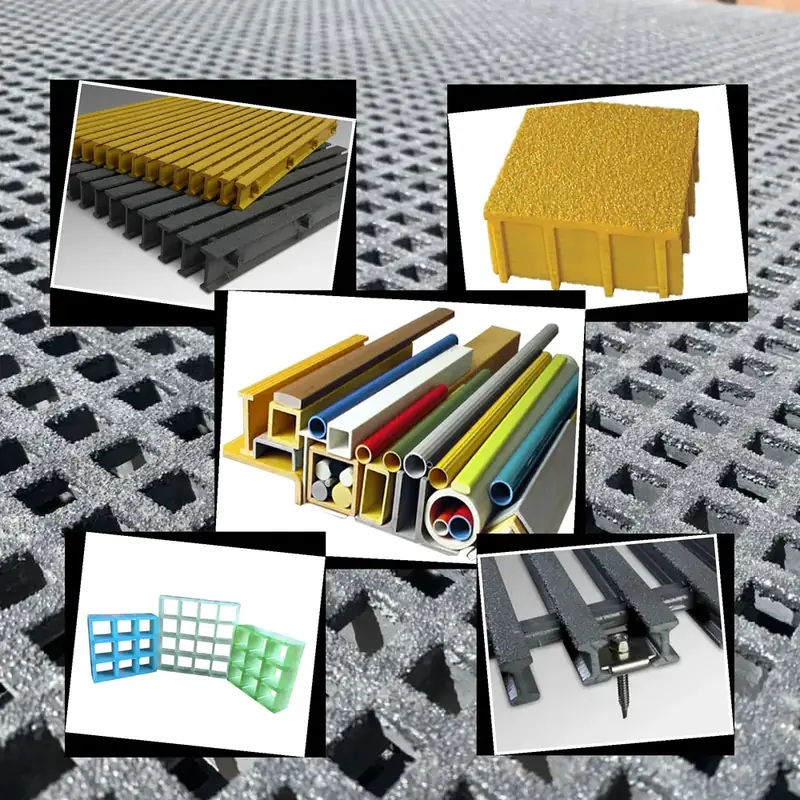
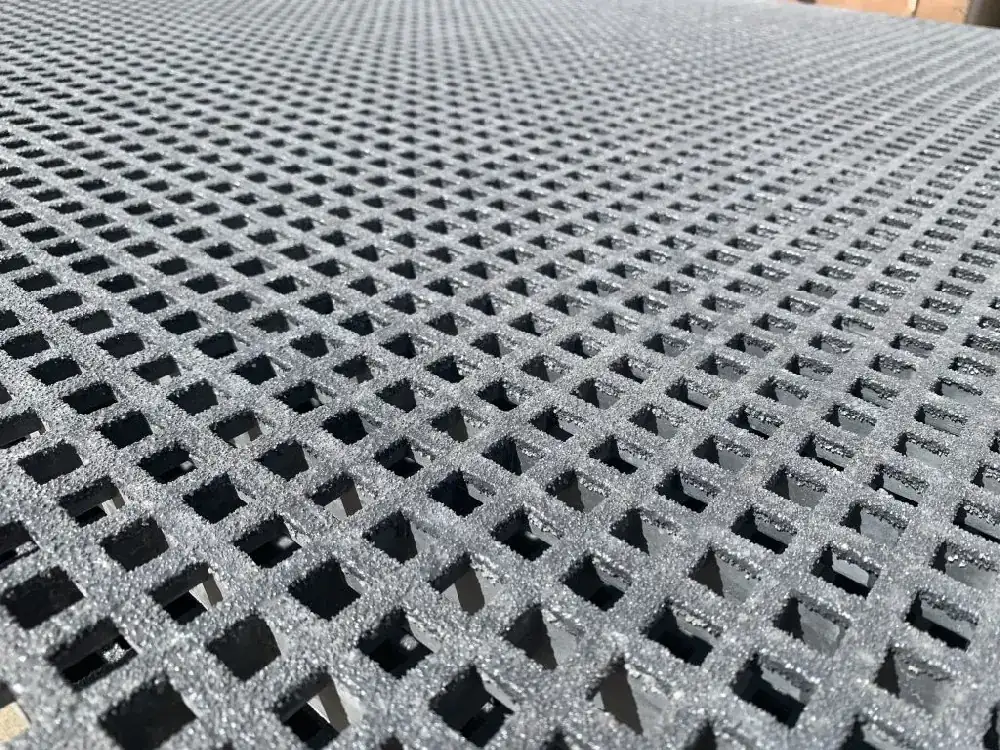
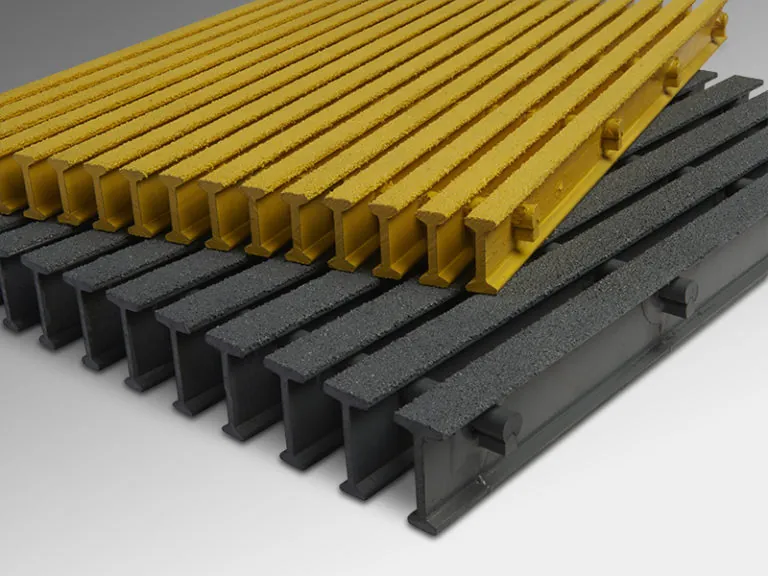
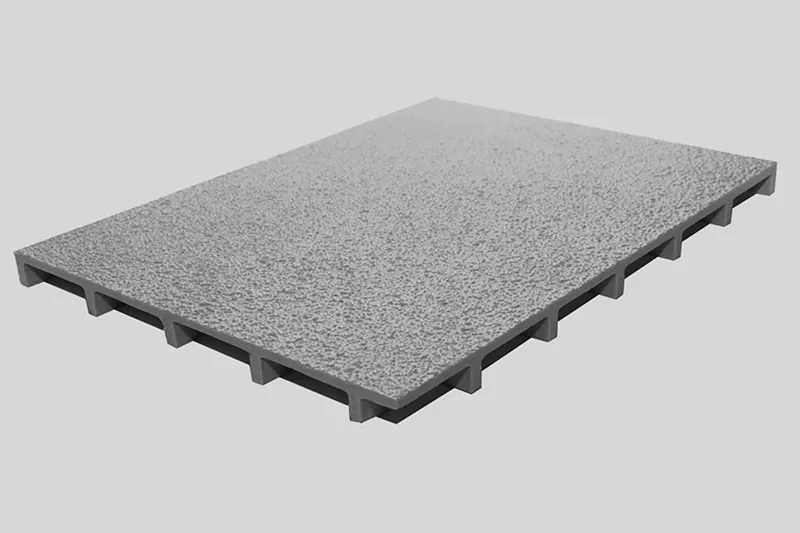
Vinyl-ester FRP grating resists hot acids and solvents far better than polyester — the resin of choice for the harshest chemical, offshore and oil/gas service.
- Best for: harshest chemical and hydrocarbon environments
- Choose vinyl ester when: hot acids/solvents exceed polyester limits
- Key spec: vinyl-ester resin, ASTM chemical tests, FR option
1. Vinyl Ester Resin Chemistry & Why It Resists Chemicals
Vinyl ester resin is a hybrid between polyester and epoxy, combining the ease of processing of polyester with the chemical resistance of epoxy. The chemical structure features ester groups only at the ends of the molecular chain (not along the backbone like polyester), making it much less susceptible to hydrolysis and chemical attack. Bisphenol-A vinyl ester is the standard grade, while novolac vinyl ester offers higher temperature and oxidizing acid resistance. Key properties: tensile 70-90 MPa, flexural 100-130 MPa, HDT 90-105°C (bisphenol-A) or 120-140°C (novolac), excellent adhesion to glass fiber, low shrinkage, good mechanical retention in chemical environments.
2. Acid Resistance Data
Sulfuric Acid (H2SO4): 10% — excellent (weight loss <1% after 90 days), 30% — excellent (<2%), 50% — excellent (<2%), 70% — good (<5%), 98% — fair (surface attack). Hydrochloric Acid (HCl): 10% — excellent, 37% (concentrated) — excellent (<2% weight loss). Nitric Acid (HNO3): 10% — good, 30% — fair (oxidizing), 50%+ — not recommended (use novolac VE). Phosphoric Acid (H3PO4): all concentrations — excellent. Acetic Acid: all concentrations — excellent. Citric Acid, Lactic Acid: excellent. Hydrofluoric Acid (HF): 10% — good, 40% — fair (specialty resin recommended). Chromic Acid: 10% — fair, 30%+ — not recommended (strong oxidizer).
3. Alkali & Base Resistance
Sodium Hydroxide (NaOH): 10% — excellent, 20% — excellent (<1.5% weight loss), 50% — excellent (<2%), 73% (caustic soda) — good. Potassium Hydroxide (KOH): similar to NaOH, excellent up to 50%. Ammonium Hydroxide: all concentrations — excellent. Sodium Carbonate (soda ash): all concentrations — excellent. Sodium Hypochlorite (Bleach, NaOCl): 5% — excellent, 12% — excellent, 15% — good (<3% weight loss), important for pulp & paper and water treatment. Hydrogen Peroxide (H2O2): 10% — good, 30% — fair (oxidizing). Chlorine Gas / Chlorinated Water: excellent (key advantage over polyester).
4. Solvent & Organic Chemical Resistance
Alcohols (methanol, ethanol, isopropanol): excellent. Ketones (acetone, MEK): fair to good (some swelling, not recommended for continuous immersion). Aromatics (benzene, toluene, xylene): fair (swelling possible). Chlorinated solvents (dichloromethane, trichloroethylene): poor (not recommended for immersion). Esters (ethyl acetate): fair. Gasoline / Diesel: good (minor swelling). Oil & Grease: excellent. Turpentine: good. Note: Vinyl ester is generally resistant to most organic solvents at room temperature, but prolonged immersion in strong solvents can cause swelling. For critical solvent applications, request sample immersion testing.
5. Temperature & Combined Effects
Chemical resistance decreases as temperature increases. As a general rule: at 25°C — use data as stated. At 50°C — reduce concentration by 25% (e.g., if 50% H2SO4 is rated excellent at 25°C, use 37% at 50°C). At 80°C — reduce concentration by 50%. At 100°C+ — consult factory, only novolac VE recommended. Combined effects: mixtures of chemicals can be more aggressive than individual chemicals. For example, acid + oxidizer combinations require novolac vinyl ester. Always provide full chemical composition, concentrations, temperatures, and cycle times (continuous vs intermittent) for proper resin selection.
6. Resin Selection Decision Tree for Chemical Plants
Step 1: Identify all chemicals present (list each with concentration %). Step 2: Determine operating temperature range (continuous and maximum). Step 3: Classify environment: Mild (dilute acids, water, room temp) → Isophthalic Polyester. Moderate (acids up to 30%, alkalis up to 20%, up to 60°C) → Isophthalic or Bisphenol-A Vinyl Ester. Severe (strong acids >30%, strong alkalis >20%, solvents, >60°C) → Bisphenol-A Vinyl Ester. Extreme (oxidizing acids, >80°C, mixed chemicals) → Novolac Vinyl Ester. Fire-critical (mining, tunnels, offshore) → Phenolic. Step 4: Request sample immersion testing for critical applications (7-day or 30-day immersion in actual chemical at operating temperature). Step 5: Specify surface veil (20-30 g/m²) for enhanced corrosion barrier. Step 6: Consider post-cure for maximum chemical resistance (100°C for 4 hours).
Frequently Asked Questions
FRP (Fiberglass Reinforced Plastic) grating is a molded or pultruded fiberglass composite grid used for corrosion-resistant walkways, platforms and floorings. It combines glass fiber reinforcement with thermoset resin (polyester, vinyl ester, epoxy) for superior strength-to-weight ratio, zero rust and 20+ year service life.