
A complete FRP grating RFQ states eight things: panel size, thickness and mesh, resin, surface, span and load, fixings, documents and delivery terms. Miss one and the price comes back wrong.
- Best for: first-time buyers and EPC procurement packages
- Most missed field: clear span and deflection limit, which decide feasibility
- Key spec: MOQ 10 m2, lead time 12-36 working days from confirmed drawing. Oversized panels, custom colours, new moulds and specialty resins are quoted with a separately confirmed schedule.
Most quotations that cannot be compared were not a pricing problem. They were an RFQ that left out the four or five facts that change the price.
What Must an FRP Grating RFQ State to Be Comparable?
A complete FRP grating RFQ states eight things: panel size, thickness and mesh, resin, surface, span and load, fixings, documents and delivery terms. Miss one and the price comes back wrong. Most quotations that cannot be compared were not a pricing problem. They were an RFQ that left out the four or five facts that change the price.
Two quotations for "1,000 m2 of FRP grating" can differ by forty percent and both be honest. One is a 25 mm molded panel in isophthalic polyester with no clips and no cutouts; the other is a 38 mm pultruded vinyl ester deck with grit surface, sealed edges, a clip layout and crates. The buyer compares the totals and concludes the second supplier is expensive, when in fact the two quotations are for different products. The fix is not more negotiation. It is an RFQ that fixes the variables so every supplier quotes the same thing, and so the differences that remain are real differences in price, lead time and capability.
In this guide: resin and environment, section and bar depth, load case, open area, clip layout, edges and cutouts, tolerances, surface, packaging, documentation, Incoterm, acceptance and payment.
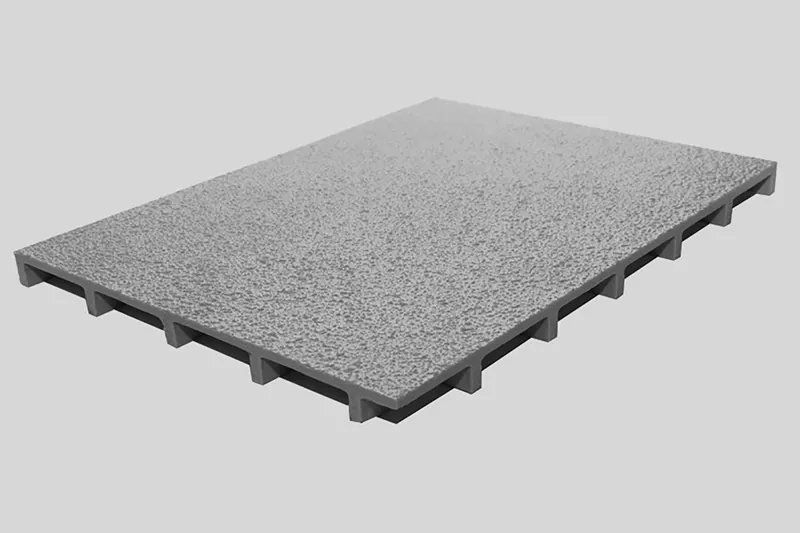
The Eight RFQ Fields, Line by Line
Written in this order, an RFQ produces quotations that can be compared line by line: project and destination, resin and exposure, section type with depth and pitch and open area, span and load case with deflection limit, panel schedule with cutouts and edges, fixing method and clip quantity basis, surface and colour, tolerance and inspection basis, packaging and marking, Incoterm and delivery point, documents required, acceptance and payment terms. Send the same document to every supplier, and ask each one to state deviations rather than to re-interpret.
The table below is the eight-field checklist in the form a procurement team can paste into an RFQ. The third column is why the field matters; if a supplier cannot answer it, the quotation is missing a variable, not missing a discount. Treat any quote that arrives without a deviation list as a quote that has assumed the variables rather than fixed them, and price the assumption before you award the order.
| RFQ field | What to state | Why it matters |
|---|---|---|
| Panel size | 1220 x 3660 mm or cut-to-size drawing | Sets mould, waste and price |
| Thickness and mesh | 25/30/38/50 mm, 19x19 / 38x38 / 50x50 | Load capacity and weight |
| Resin system | Iso / vinyl ester / phenolic | Chemical and fire performance |
| Surface | Smooth, concave or grit top | Slip resistance |
| Span and load | Clear span, kN/m2, point load, L/200 | Deflection check |
| Fixings | Clip type, SS304 or SS316, count | Installation and corrosion |
| Documents | Datasheet, test reports, packing list | Customs and QA |
| Delivery | Incoterm, port, required date | Freight and lead time |
Resin and Environment: The First Variable to Fix
State the chemical and atmospheric exposure, not just "corrosion resistant". Isophthalic polyester covers water, neutral salts and general weathering. Vinyl ester is the specification for acids, hypochlorite, solvents and chloride-rich marine air. Phenolic is used where a fire performance class is mandatory, such as offshore modules and enclosed transport areas. If the RFQ says "chemical plant" without naming the chemicals, the supplier will quote the cheapest resin that could plausibly survive and you will discover the difference in year three, when the deck starts to chalk and the bars lose stiffness.
Name the chemical, its concentration and the temperature. Resin selection depends on all three, and "chemical resistant" is a claim rather than a specification. For fresh water, neutral salts and general weathering, specify UV-stabilised isophthalic; for acids, alkalis, hypochlorite and solvents, specify vinyl ester with the chemical named; for marine air and de-icing splash, specify vinyl ester plus SS316 fixings; for a fire class in offshore or tunnel service, specify phenolic with the class and test standard written in. Food and potable water contact needs a resin with the relevant contact statement, which is a separate line in the RFQ.
Section, Depth, Pitch and the Load Case
Say molded or pultruded, then give the depth and the pitch. "38 mm grating" is ambiguous: it can mean a 38 mm molded square mesh, a 38 mm pultruded T-bar, or a 38 mm I-bar, and those three have different weights, different spans and different fixing details. Open area belongs here too. A 40% deck and a 60% deck of the same depth differ by about 15% in weight and by more in what can fall through them.
A span with no load case is a guess. Give the span in millimetres, the imposed load in kg/m2, whether the load is uniform or a point load (and the wheel or footprint if it is a trolley), and the deflection limit the client expects. L/200 is common for walkways; L/300 is often asked for on platforms carrying instrumentation. Snow, wind uplift and ice are separate cases and are added, not chosen between. On an exposed jetty the uplift case frequently sets the clip pattern rather than the foot traffic. Give a panel schedule or a drawing: overall dimensions, where the bearers are, where panels are cut around pipes, posts and openings, and whether edges need a nosing or a frame. Cutouts matter more than buyers expect, and if the RFQ omits them the fabricator prices the plain version and re-quotes later at a premium.
Cutouts matter more than buyers expect. A panel with six penetrations costs more to fabricate than a plain panel, and if the RFQ omits them the fabricator prices the plain version and re-quotes later at a premium.
Tolerances, Surface, Colour and the Inspection Basis
Dimensional tolerance is a commercial term, not a technical nicety. If the deck has to fit an existing frame, say so and give the frame tolerance. If it does not, the fabricator will work to its own standard and the panels may not drop in. Name the inspection basis as well: a dimensional report with photos of each bundle, a mill certificate for the resin and glass, or a third-party inspection. Each adds cost, and each is easier to price when it is written in the RFQ than when it is requested after production.
Concave, grit or smooth changes both the price and the slip resistance. Grit is specified on ramps and on any deck with spillage or ice. Colour is usually a pigment choice with a minimum order quantity, and a non-standard RAL will move the MOQ up. State the UV expectation too. A standard UV-stabilised surface will chalk after years in strong sun; if the deck is architectural and visible to the public, say so, because a heavier UV package is a different product. We ship with the Intertek ASTM F3059 report 211122012SHF-001 and the ISO 9001 certificate 01708Q11888R0S on request, and we will name the resin batch certificates for the production window of the order.
Packaging, Delivery Point and Installation Reality
Grating is bulky and light, so freight is often quoted per cubic metre rather than per tonne. Say whether panels ship loose, in bundles, or crated, and whether they need to be marked per panel for installation sequence. Name the delivery point exactly and the Incoterm with it: FOB port, CIF port, DAP site. "Delivered" without an address is not a price, and a DAP quotation to a site with no forklift can leave the buyer paying for a crane that was never in the budget.
On site, a 1220 x 3660 mm panel at 38 mm weighs about 87 kg and is a two-person lift; a 6 m panel needs a spreader and a machine. Cut edges and drilled holes are sealed with matching resin putty before handover, and stainless clips are fixed at every edge: SS304 inland, SS316 on coastal or chloride service. Keep the approved sample panel on site so the installer can compare colour, grit and bar geometry. Walk the deck before handover: a cured panel feels hard, does not smell of styrene, and grit does not rub off into a hand.
Documents, Acceptance, Payment and Lead Time
List the documents you need: packing list, commercial invoice, certificate of origin, resin certificates, load table for the supplied section, installation instructions, and any declaration the destination customs requires. Then state acceptance: a pre-shipment inspection, a sample approval, or an arrival inspection within a defined window. Payment terms belong in the same paragraph, because a supplier pricing a 30-day balance after arrival carries a cost that a 30% deposit quotation does not.
Send the same document to every supplier, and ask each one to state deviations rather than to re-interpret. The quotation that comes back with three deviations is more useful than the one that looks cheapest and hides four assumptions. We manufacture at a 20,000 m2+ plant with 200+ staff, export to 40+ countries, hold MOQ 10 m2 and a 12-36 working day lead time from a confirmed drawing. Send us the eight fields and we will come back with a line-by-line quotation that another supplier can be compared against, rather than a single number that hides the variables that decide the deck.
