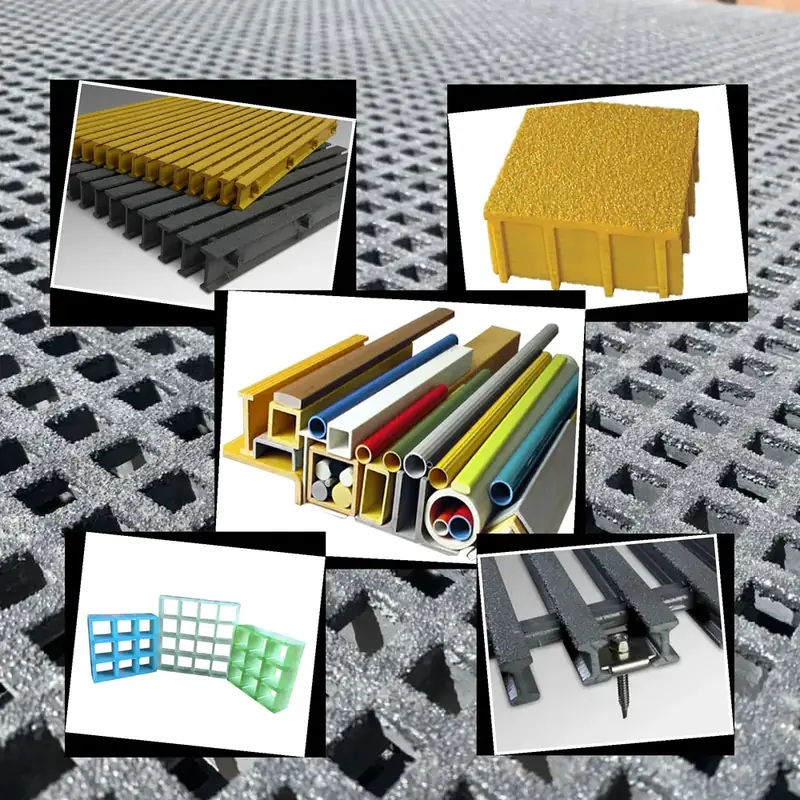
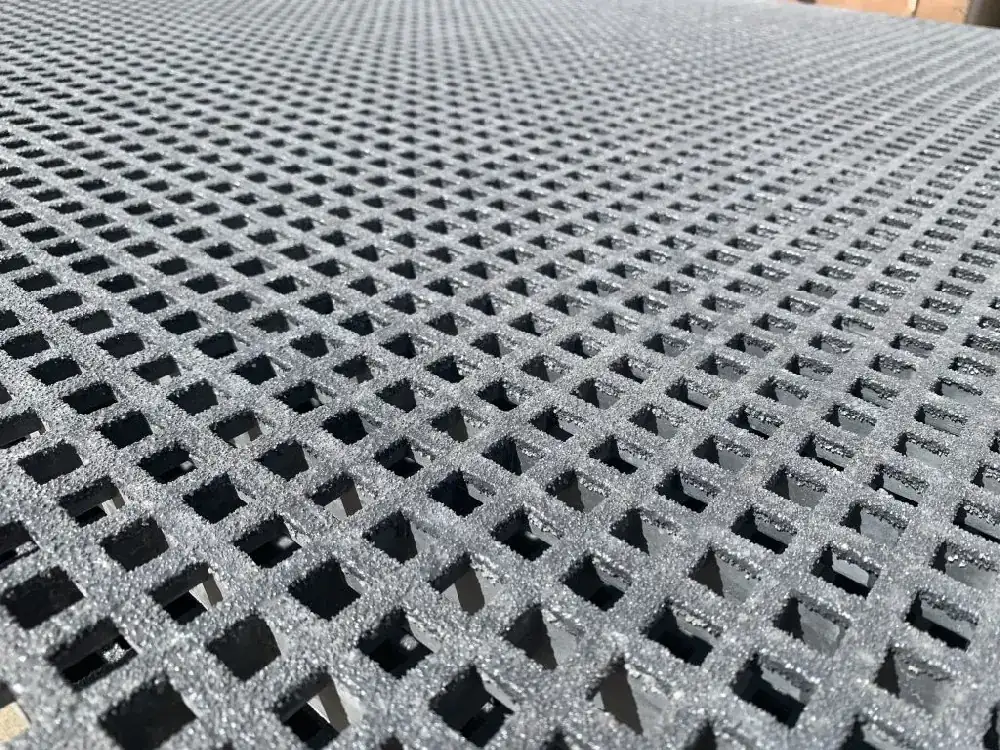
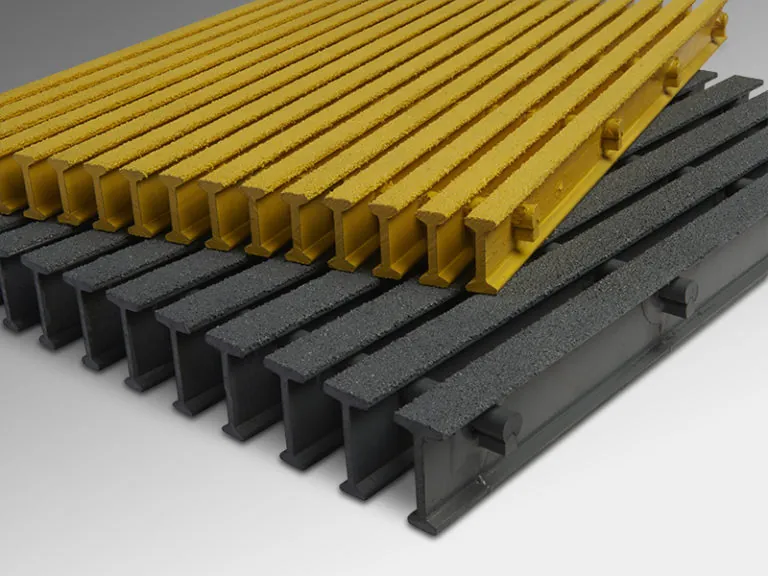
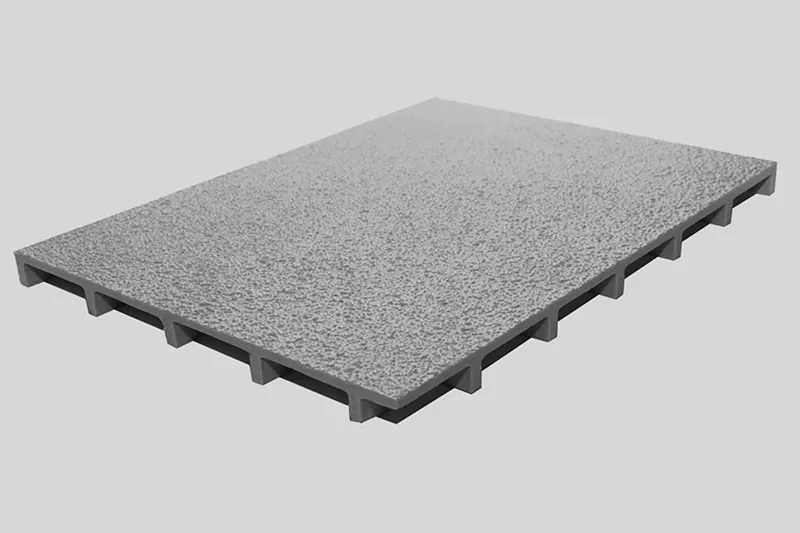
FRP grating has the lowest 20-year total lifecycle cost in corrosive and humid environments: ~10 kg/m² weight (vs steel ~35 kg/m²), zero painting and rust maintenance for 20+ years, while still meeting most walkway and platform load classes. Steel only wins on raw load capacity at minimal depth; pultruded FRP closes the span gap with a lower lifetime cost.
- Best for: chemical plants, offshore platforms, wastewater — where corrosion and lifecycle cost matter
- Choose steel when: very high point load at minimal depth on a tightest first-cost budget
- Key spec: molded 25–50 mm / pultruded 25–100 mm · ASTM E-84 Class B · EN 13706
1. Initial Material Cost Comparison (2026 Prices)
FRP Molded Grating (38mm, isophthalic): USD 45-65/m². FRP Pultruded Grating (50mm, vinyl ester): USD 65-95/m². Hot-Dip Galvanized Steel Grating (30×3mm bars): USD 35-50/m². Stainless Steel Grating (SS304): USD 110-160/m². Aluminum Grating (6063-T5): USD 70-100/m². Note: FRP initial cost is 20-40% higher than galvanized steel, but 30-50% lower than stainless steel. In corrosive environments where stainless steel is required, FRP offers significant initial cost savings. Price trends 2026: steel prices volatile (±15% due to energy costs), aluminum stable, FRP resin prices declining 3-5% due to overcapacity.
2. Installation Cost & Time
FRP Grating: 70-80% lighter than steel, 2-3 workers can install manually, no heavy equipment required, cutting with standard hand tools (jigsaw, circular saw with carbide blade), installation time 30-40% faster than steel. Steel Grating: requires lifting equipment (crane, forklift) for large panels, cutting requires torch or abrasive saw, heavier labor, installation time baseline 100%. Aluminum Grating: lighter than steel but heavier than FRP, can be cut with power tools, installation time 80-90% of steel. Installation cost comparison (per 100m²): FRP USD 800-1,200, Steel USD 1,500-2,200, Aluminum USD 1,200-1,800. FRP saves 30-50% on installation labor and equipment costs.
3. Maintenance Cost Analysis (15-Year Period)
FRP Grating: zero maintenance required, no painting, no rust treatment, periodic cleaning with water only, maintenance cost USD 0-50/m² over 15 years. Galvanized Steel: requires inspection every 6 months, touch-up painting of damaged galvanizing every 2-3 years, full repainting every 5-7 years in corrosive environments, maintenance cost USD 150-300/m² over 15 years. Stainless Steel: minimal maintenance, but requires passivation and cleaning in chloride environments to prevent pitting, maintenance cost USD 50-100/m² over 15 years. Aluminum: requires periodic cleaning, anodized coating may need rework after 8-10 years, maintenance cost USD 80-150/m² over 15 years. In severe corrosion (coastal, chemical), steel maintenance costs can be 2-3x higher due to accelerated rusting.
4. Lifecycle Cost (LCC) Analysis — 20 Year Period
Total Cost of Ownership (TCO) per m² over 20 years, corrosive environment (coastal/chemical): FRP (vinyl ester): Initial 80 + Installation 10 + Maintenance 3 + Replacement 0 = USD 93/m². Galvanized Steel: Initial 45 + Installation 18 + Maintenance 45 + Replacement 60 (replaced at 10 years) = USD 168/m². Stainless Steel (SS304): Initial 135 + Installation 15 + Maintenance 8 + Replacement 0 = USD 158/m². Aluminum: Initial 85 + Installation 12 + Maintenance 18 + Replacement 40 (replaced at 15 years) = USD 155/m². FRP offers 40-45% lower TCO vs galvanized steel, and 40% lower vs stainless steel in corrosive environments. Payback period for FRP vs steel: 4-6 years through maintenance savings alone. ROI over 20 years: 150-200% for FRP in corrosive applications.
5. Performance Comparison & Application Recommendations
Corrosion Resistance: FRP (vinyl ester) > Stainless Steel > FRP (polyester) > Aluminum > Galvanized Steel. Weight: FRP (3-5 kg/m²) < Aluminum (8-12 kg/m²) < Steel (20-30 kg/m²). Load Capacity: Steel > Aluminum > FRP (pultruded) > FRP (molded). Fire Performance: Steel (non-combustible) > Aluminum (melts at 660°C) > FRP (phenolic fire-retardant, self-extinguishing). Electrical Insulation: FRP (excellent, non-conductive) > Aluminum (conductive) > Steel (conductive). Application Recommendations: Chemical plants, wastewater, coastal — FRP (vinyl ester) best value. Indoor, dry, non-corrosive — galvanized steel lowest initial cost. Food/pharma, clean rooms — stainless steel or FRP (smooth surface). High load, heavy traffic — steel or pultruded FRP (heavy-duty). Electrical substations — FRP (non-conductive, safety advantage).
Frequently Asked Questions
FRP (Fiberglass Reinforced Plastic) grating is a molded or pultruded fiberglass composite grid used for corrosion-resistant walkways, platforms and floorings. It combines glass fiber reinforcement with thermoset resin (polyester, vinyl ester, epoxy) for superior strength-to-weight ratio, zero rust and 20+ year service life.