The deflection limit is the maximum allowable sag of the panel, expressed as a fraction of the span. L/200 is the default for industrial walkways; L/360 is specified for rolling loads, public platforms and aesthetics. The limit you choose changes which panel size is adequate — and the price.
- L/200: 5 mm sag on a 1 m span — noticeable bounce, acceptable for plant floors.
- L/250: 4 mm sag — subtle flex, for public platforms and view areas.
- L/360: 2.8 mm sag — rigid, steel-like, for rolling loads and offshore.
- Choosing L/360 instead of L/200 can move you from a 38 mm to a 50 mm panel — about 40% more mass and cost.
- Always specify the deflection limit on the RFQ, not just the panel depth.
FRP Grating Deflection Limit: L/200 vs L/360
Two engineers can look at the same 38 mm pultruded panel and disagree on whether it is adequate — because one assumes L/200 and the other L/360. This guide explains what the numbers mean, how they feel underfoot, and how to choose the right limit for your project.
What Deflection Actually Feels Like
Deflection is the sag you feel when you step on the panel. On a stiff panel (L/360) you feel nothing; on a flexible panel (L/200) you feel a soft bounce. Neither is unsafe — the question is what the user expects.
| Limit | 1 m span sag | 1.5 m span sag | Underfoot feel | Typical use |
|---|---|---|---|---|
| L/150 | 6.7 mm | 10 mm | Soft, bouncy | Rarely used on walkways |
| L/200 | 5.0 mm | 7.5 mm | Noticeable bounce | Industrial plant floors |
| L/250 | 4.0 mm | 6.0 mm | Subtle flex | Public platforms |
| L/300 | 3.3 mm | 5.0 mm | Rigid, minimal | Viewing areas, offices |
| L/360 | 2.8 mm | 4.2 mm | Steel-like, no flex | Rolling loads, offshore |
The Common Limits Compared
Three limits dominate FRP grating specifications: L/200, L/250 and L/360. L/200 is the default; L/360 is the premium.
| Limit | Where it comes from | Typical project |
|---|---|---|
| L/200 | Common in industrial FRP specs | Wastewater, chemical plants |
| L/250 | Public-access platforms | Walkways at fairs, parks |
| L/360 | Offshore, rolling loads | Trolleys, pallet jacks, offshore |
Note: The load tables in our datasheets are calculated at L/200 by default. If you need L/360, ask us to recalculate — the numbers drop by roughly 30–40%.
How the Limit Changes Panel Choice
This is the engineering trade-off. The same load at a tighter deflection limit needs a deeper panel — which costs more and weighs more.
| Load, span | At L/200 | At L/360 | Mass increase |
|---|---|---|---|
| 5 kN/m², 900 mm | p38 T-bar (12 kg/m²) | p38 I-bar (13.5 kg/m²) | + 12 % |
| 10 kN/m², 900 mm | p38 I-bar | p50 T-bar (16 kg/m²) | + 25 % |
| 5 kN/m², 1200 mm | p38 I-bar | p50 I-bar (18 kg/m²) | + 35 % |
| 15 kN/m², 900 mm | p50 T-bar | p50 I-bar (17.5 kg/m²) | + 10 % |
Deflection by Load Case
Different load cases call for different limits. A person standing still expects comfort; a trolley rolling across expects no spring.
| Load case | Recommended limit | Why |
|---|---|---|
| Pedestrian, standing | L/250 | Comfort over hours of standing |
| Pedestrian, walking | L/200 | Brief contact, bounce acceptable |
| Handcart / trolley | L/360 | Wheel loads amplify deflection |
| Pallet jack | L/360 | Point load on small wheels |
| Maintenance crew, tools | L/250 | Comfort + tool stability |
How to Specify on an RFQ
The single most common RFQ mistake is specifying panel depth (38 mm) without the deflection limit. A 38 mm panel at L/200 is not the same as at L/360.
| Clause | What to write | Why |
|---|---|---|
| Deflection | 'Panel deflection ≤ L/250 under design load' | Sets the comfort bar |
| Load | 'Design UDL 5 kN/m² at 900 mm span' | Sets the structural bar |
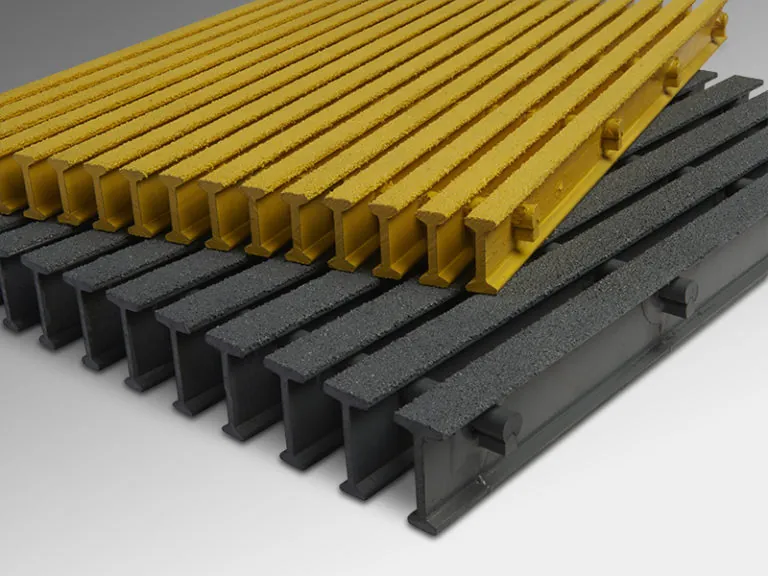
| Profile | 'Pultruded I-bar, 38 mm depth' | Ties to the table |
| Surface | 'Grit-coated top' | Slip resistance |
| QC | 'Barcol ≥40, MTR required' | Receiving inspection |
Standard panel 1220×3660 mm. MOQ 10 m². Lead time 12–36 working days. Send us the deflection limit and we will recalculate the load table for free.
How FRP Compares to Steel Grating
Steel grating is stiffer per kg than FRP, so a steel panel at the same span feels more rigid. But FRP at L/360 is stiff enough for almost all pedestrian and light-trolley applications.
| Material | Typical deflection, 900 mm | Mass per m² (similar load) |
|---|---|---|
| Steel bar grating, 30 mm | ~2 mm | ~25 kg/m² |
| FRP I-bar, 38 mm, L/360 | ~4 mm | ~13.5 kg/m² |
| FRP I-bar, 50 mm, L/360 | ~2.5 mm | ~17.5 kg/m² |
Does Deflection Cause Cracking?
FRP is not brittle like concrete. A panel deflected within its L/200 or L/360 limit will not crack. Cracking happens when the panel is overloaded beyond the limit, or when the resin has aged and become brittle.
| Sign | Cause | Action |
|---|---|---|
| Hairline cracks on top | Overload or aged resin | Inspect; reduce load |
| Cracks at clip points | Loose clips | Retighten |
| Cracks along bars | Impact damage | Replace panel |
| Chalking on surface | UV exposure | Normal after 5+ years |
Next Steps
Send us your span, design load and the deflection limit your engineer requires. We will return a panel recommendation and a load table calculated at your specified limit.
| Parameter | Value | Unit |
|---|---|---|
| Standard panel size | 1220 × 3660 | mm |
| Bar depths available | 25 / 30 / 38 / 50 | mm |
| Density range | 1.5 – 2.0 | g/cm³ |
| Barcol hardness minimum | 40 | — |
| MOQ | 10 | m² |
| Lead time | 12 – 36 | working days |
| Conversion | Factor | Example |
|---|---|---|
| 1 kg/m² to lb/ft² | × 0.2048 | 19.5 kg/m² = 4.0 lb/ft² |
| 1 mm to inch | ÷ 25.4 | 38 mm ≈ 1.5 inch |
| 1 kN/m² to psf | × 20.885 | 25 kN/m² ≈ 522 psf |
| QC Check | Method | Acceptance |
|---|---|---|
| Barcol hardness | Barcol impressor | ≥ 40 across panel |
| Resin content | Burn-off / Ash | 25 – 35 % by weight |
| Density | Cut section | 1.5 – 2.0 g/cm³ |
| Dimensions | Tape measure | ± 3 mm on panel |
| Item | Standard | Note |
|---|---|---|
| Panel thicknesses | 25 / 30 / 38 / 50 mm | Molded and pultruded |
| Standard width | 1220 mm | Other widths by order |
| Standard length | 3660 mm | Cut pieces available |
| Surface finishes | Smooth / concave / grit | Grit adds ~0.5 kg/m² |
| Resin options | Ortho / Iso / VE / Phenolic | VE for strong acids |
Frequently Asked Questions
What is the default deflection limit for FRP grating?
L/200 is the default in most industrial specifications. It allows 5 mm of sag on a 1 m span — noticeable but acceptable.
When should I use L/360 instead of L/200?
Use L/360 for rolling loads (trolleys, pallet jacks), public platforms where people stand for hours, or offshore environments where rigidity is expected.
Does a tighter deflection limit cost more?
Yes. L/360 often requires a deeper panel — moving from 38 mm to 50 mm adds about 35–40% in mass and cost.
Is deflection the same as strength?
No. A panel can be strong (high ultimate load) but flexible (large deflection at working load). The deflection limit controls the service feel, not the failure load.
What is the MOQ and lead time?
MOQ 10 m². Lead time 12–36 working days. We recalculate the load table at your specified deflection at no extra cost.