The Barcol hardness test is the fastest field check on a cured FRP/GRP panel. A reading of 40 or above means the resin has cured properly; below 38 the panel is likely under-cured and will chalk and craze within a few years.
- Instrument: Barber-Colman impressor, Model 934-1 (or equivalent digital Barcol).
- Acceptance threshold: Barcol ≥40 on the top surface, measured at 5 points per panel.
- What it measures: surface micro-hardness of the resin layer, not overall laminate strength.
- Under-cured: 35–39 (marginal); below 35 the batch should be rejected.
- Over-cured: above 50 can indicate brittle resin — also worth flagging.
Barcol Hardness Test for FRP Grating QC
On a construction site or at a receiving dock, you cannot run a flexural test or burn off resin content in five minutes. You can press a Barcol impressor onto the panel and read a number in ten seconds. That number tells you whether the resin has cured. This guide covers the procedure we use on every batch of pultruded FRP grating we ship.
What Barcol Actually Measures
The Barcol impressor pushes a hardened steel stylus into the surface under a defined spring load. The depth of penetration converts to a hardness number. On FRP it measures the resin-rich surface layer — not the glass fiber beneath.
| Reading | Resin state | Laminate implication |
|---|---|---|
| ≥ 45 | Well-cured, dense resin | Accept, no action |
| 40 – 44 | Acceptable cure | Accept with record |
| 35 – 39 | Marginal, possibly under-cured | Retest 5 points; reject if still low |
| 30 – 34 | Under-cured resin | Reject batch; chalk risk |
| < 30 | Severely under-cured | Reject; safety risk |
Note: Barcol is not a strength test. A panel with Barcol 45 can still fail in flexure if the glass content is wrong. Use Barcol as a first-pass screen, not a substitute for load testing.
Test Procedure Step by Step
The procedure is deliberately simple, which is why it works in the field. Follow the five steps and record the readings.
| Step | Action | Detail |
|---|---|---|
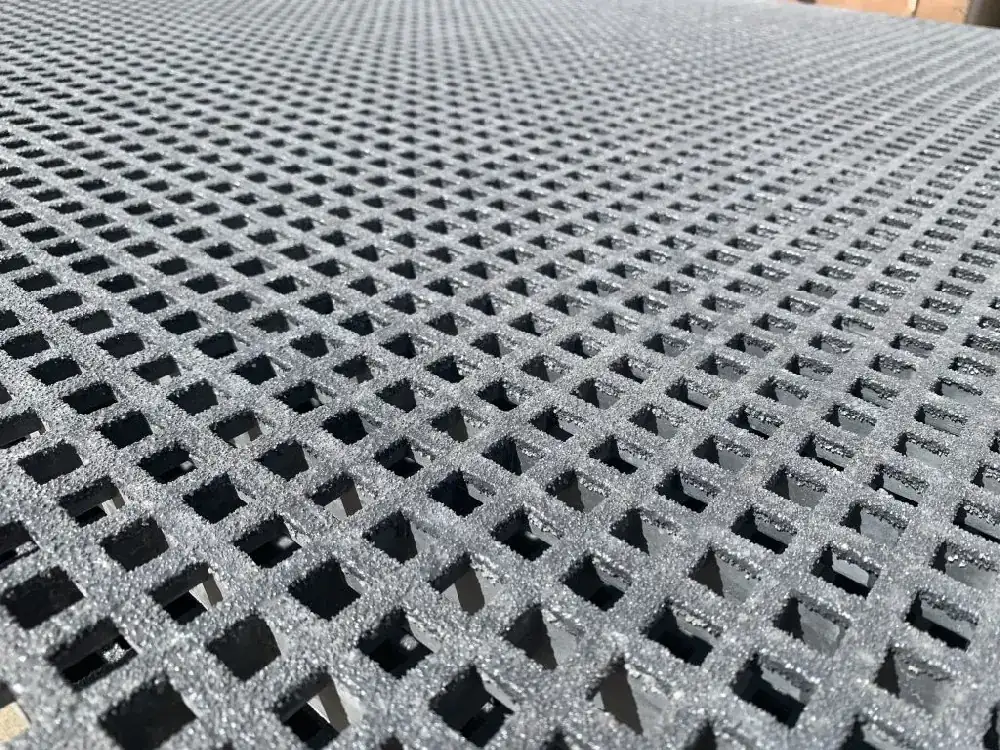
| 1 | Prepare surface | Wipe the grit or concave top; test on a flat resin-rich area |
| 2 | Zero the instrument | On the glass reference plate before each session |
| 3 | Apply perpendicularly | Press straight down, do not rock |
| 4 | Hold 3 seconds | Read the dial when the needle stabilizes |
| 5 | Record 5 points | One per 0.5 m²; average and minimum |
Acceptance Thresholds
Our internal acceptance for molded and pultruded FRP grating is Barcol ≥40 at every point, with no reading below 38. This aligns with the F3059 pedestrian surface expectations.
| Panel type | Typical reading | Acceptance minimum |
|---|---|---|
| Molded 25/30/38/50 | 42 – 48 | 40 |
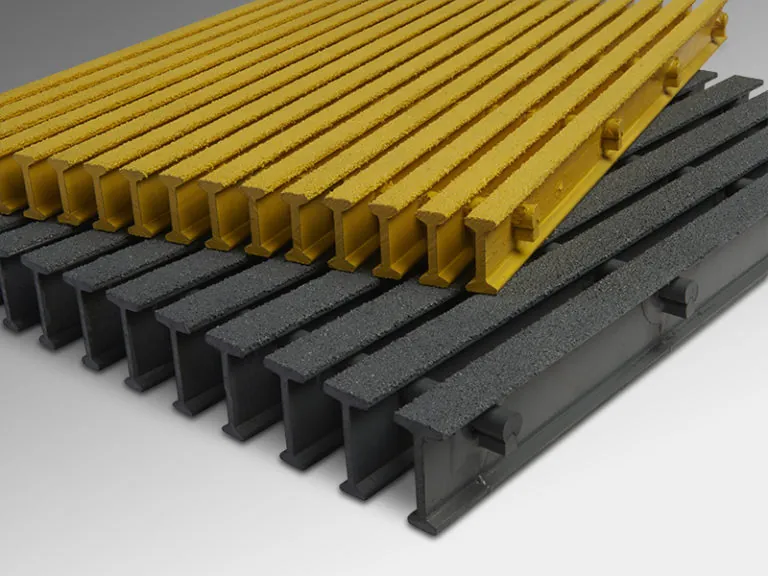
| Pultruded T-bar 25/38/50 | 40 – 46 | 40 |
| Pultruded I-bar 25/38/50 | 41 – 47 | 40 |
| Phenolic resin surface | 38 – 42 | 38 (phenolic runs softer) |
Common Reading Errors
- Testing on grit. The stylus sinks between grit particles and reads low. Test on a smooth resin-rich area.
- Not zeroing. The instrument drifts. Zero on the reference plate every 20 readings.
- Rocking the stylus. A tilted press gives a false low reading. Keep it perpendicular.
- Testing the edge. The edge is a cut, sanded surface — not representative. Test at least 50 mm from the edge.
- Ignoring the average. One low reading out of five can be a local defect; the average is what matters.
When to Ask for a Barcol Report
If you are specifying FRP grating for a corrosive or regulated environment, ask for the Barcol record on the mill test report. It is a one-line entry; a good factory will have it on file.
| Project type | Ask for Barcol? | Why |
|---|---|---|
| Wastewater plant | Yes | Resin must resist acid mist |
| Offshore platform | Yes | UV + salt spray |
| Food & beverage | Yes | Cleaning chemicals |
| Solar rooftop walkway | Recommended | UV exposure |
| General pedestrian walkway | Optional | Baseline QC |
Standard panel size 1220×3660 mm. MOQ 10 m². Lead time 12–36 working days. Every shipment includes the mill test report with Barcol record.
What Barcol Tells You About the Laminate
A low Barcol on a panel that looks fine usually means one of three things: under-cured resin, too much glass (resin-starved surface), or contamination at the surface. Each has a different fix.
| Diagnosis | Barcol pattern | Likely cause | Action |
|---|---|---|---|
| Uniform low | All points 35–38 | Under-cured resin | Reject batch |
| Spotty low | Some 45, some 35 | Resin-starved patches | Visual inspect; reject if >10% |
| Very high | All >50 | Brittle resin | Check flexural |
| Increasing | Higher on edges | Post-cure in warehouse | Accept; monitor |
Barcol vs Other Hardness Tests
On FRP, Barcol is the standard because it is light, field-portable and non-destructive. Shore D and Rockwell are possible but less common in the grating industry.
| Test | Device size | Field use | Typical FRP value |
|---|---|---|---|
| Barcol 934-1 | Palm-sized | Yes | 40 – 48 |
| Shore D | Palm-sized | Yes | 80 – 88 |
| Rockwell | Bench | No | Not common on grating |
| Vickers | Microscope | No | Lab only |
Next Steps
Ask us for the mill test report on your next quotation. The Barcol record is included at no extra cost — it is our routine QC on every panel.
| Parameter | Value | Unit |
|---|---|---|
| Standard panel size | 1220 × 3660 | mm |
| Bar depths available | 25 / 30 / 38 / 50 | mm |
| Density range | 1.5 – 2.0 | g/cm³ |
| Barcol hardness minimum | 40 | — |
| MOQ | 10 | m² |
| Lead time | 12 – 36 | working days |
| Conversion | Factor | Example |
|---|---|---|
| 1 kg/m² to lb/ft² | × 0.2048 | 19.5 kg/m² = 4.0 lb/ft² |
| 1 mm to inch | ÷ 25.4 | 38 mm ≈ 1.5 inch |
| 1 kN/m² to psf | × 20.885 | 25 kN/m² ≈ 522 psf |
| QC Check | Method | Acceptance |
|---|---|---|
| Barcol hardness | Barcol impressor | ≥ 40 across panel |
| Resin content | Burn-off / Ash | 25 – 35 % by weight |
| Density | Cut section | 1.5 – 2.0 g/cm³ |
| Dimensions | Tape measure | ± 3 mm on panel |
| Item | Standard | Note |
|---|---|---|
| Panel thicknesses | 25 / 30 / 38 / 50 mm | Molded and pultruded |
| Standard width | 1220 mm | Other widths by order |
| Standard length | 3660 mm | Cut pieces available |
| Surface finishes | Smooth / concave / grit | Grit adds ~0.5 kg/m² |
| Resin options | Ortho / Iso / VE / Phenolic | VE for strong acids |
Frequently Asked Questions
What is a good Barcol hardness for FRP grating?
Barcol ≥40 is the industry minimum. A well-cured panel reads 42–48. Below 38 the resin is likely under-cured.
Is Barcol hardness the same as tensile strength?
No. Barcol measures surface micro-hardness of the resin. It does not tell you the tensile or flexural strength of the laminate. Use it as a cure screen.
Can I test Barcol on site?
Yes. The Barcol impressor is palm-sized and battery-free. You zero it on the reference plate and press on the panel.
What if one reading is 35 but the rest are 45?
Retest the same spot. If it stays low, inspect visually for a resin-starved patch. One bad point out of five is not a batch rejection.
Does Zeall include Barcol in the mill test report?
Yes. Every shipment includes the MTR with the Barcol record. MOQ 10 m², lead time 12–36 working days.