
GRP Grating — Glass Reinforced Plastic (GRP) Grating Panels
Molded & Pultruded GRP Grating · Vinyl Ester · Custom Sizes · Engineering Support — ISO 9001 certified factory with 20+ years experience, exported to Australia, the UK and 45+ countries.
As an experienced GRP grating exporter and GRP grating supplier, we ship anti-slip GRP grating panels and GRP walkway grating solutions to 45+ countries. Every shipment is backed by a clear GRP grating load table, and our molded GRP grid and pultruded GRP gratings are engineered for industrial walkways, platforms and flooring.
Whether you source a single GRP walkway grating panel for a maintenance project or a bulk order of anti-slip GRP grating for a new platform, our engineering team — as a trusted GRP grating supplier and GRP grating exporter — will confirm the right profile, resin and surface finish and provide the matching GRP grating load table for your design loads.
What Is GRP Grating?
GRP (Glass Reinforced Plastic) grating — also known as fibreglass grating or FRP grating — is a lightweight, high-strength composite flooring panel made from fibreglass reinforcement and corrosion-resistant thermoset resin. It is the standard term used across the UK, Ireland, Australia and Commonwealth markets.
GRP grating combines the strength of fibreglass with the corrosion resistance of resin, giving you a flooring, walkway and platform solution that will not rust, rot or corrode — even in aggressive chemical, marine and wastewater environments. Unlike steel, GRP grating is non-conductive, low-maintenance and weighs only about one-quarter of equivalent steel panels, making it dramatically easier to handle and install.
GRP vs FRP: They are the same material. GRP (Glass Reinforced Plastic) is the British and Commonwealth term; FRP (Fiber Reinforced Plastic) is the US term. FRP Grating Master supplies both, in molded and pultruded construction.
GRP Grate: Same Product, Different Word
GRP grate and GRP grating are alternate spellings used interchangeably in the glass-reinforced plastics industry. A grate is the same anti-slip, open-mesh GRP composite panel described on this page. If a specification, drawing or quotation says "GRP grate", it refers to this GRP grating — the open, grid-like glass reinforced plastic flooring we supply.Molded and Pultruded GRP Grating
Molded GRP Grating
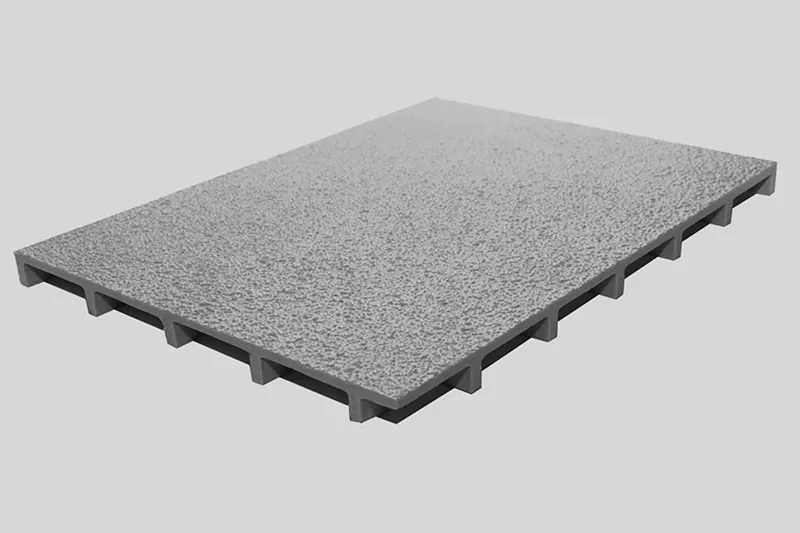
Continuous glass fibre mat and resin compression-molded into a strong, uniform open-mesh panel. Ideal for general walkways, platforms and heavy pedestrian and light vehicle traffic. Grit-top anti-slip surface available.
Pultruded GRP Grating
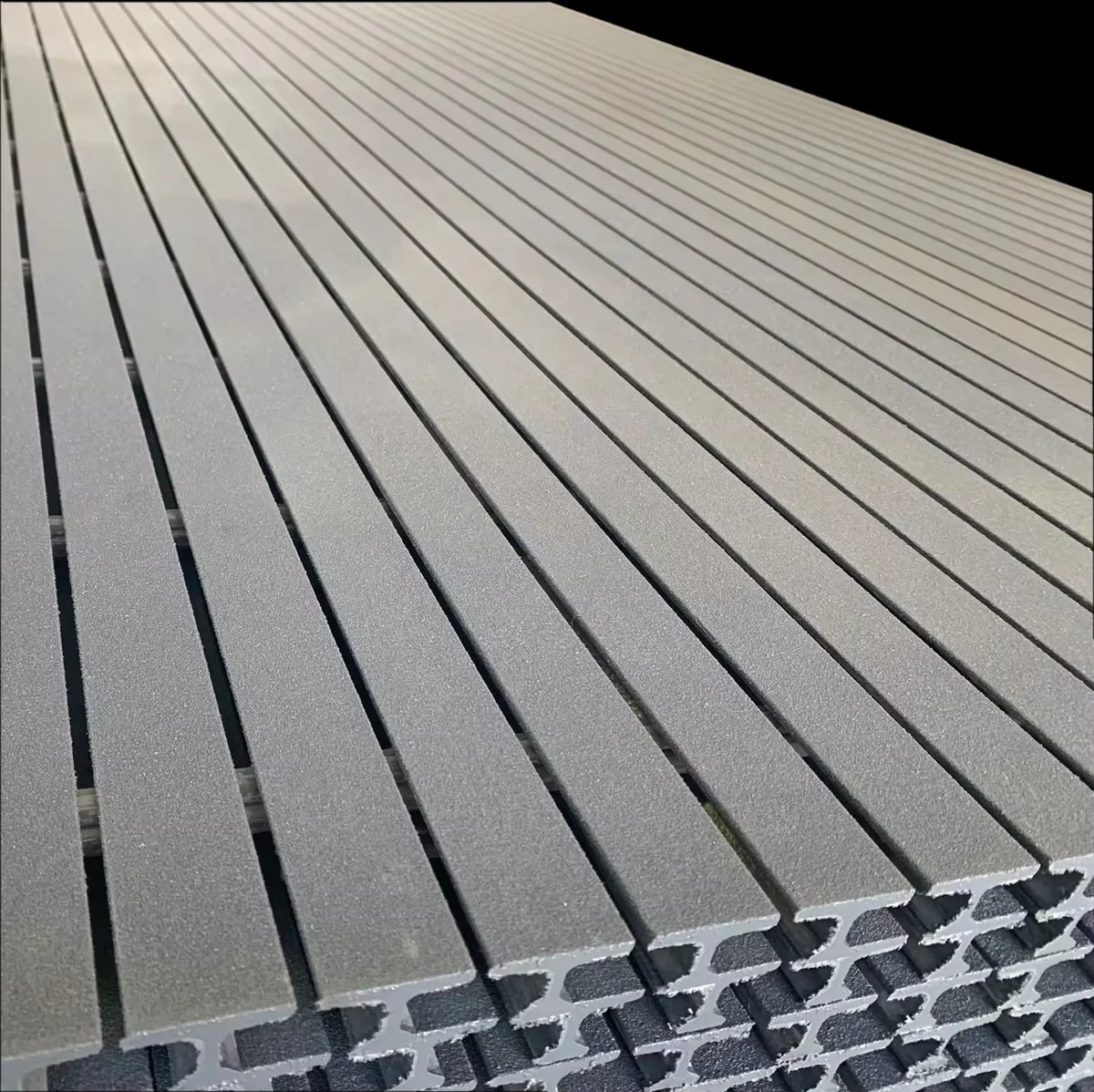
High-strength I-bar and T-bar pultruded construction for large spans and heavy industrial loads. Excellent for offshore, chemical plant and long-span platforms.
GRP Grating Clips
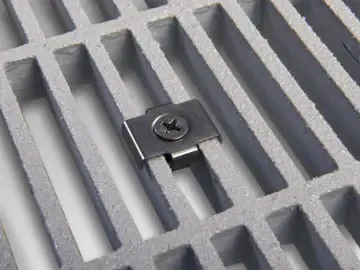
Stainless steel M, C, L and Z clips to secure GRP grating panels quickly and safely, available in SS304 and SS316.
Why Choose GRP Grating
Corrosion Resistant
Impervious to rust, rot and chemical attack. Ideal for wastewater, chemical plants, marine and offshore.
Anti-Slip Surface
Grit-top and concave surfaces give reliable slip resistance in wet, oily and greasy conditions.
Lightweight
About a quarter the weight of steel — faster, cheaper installation with no heavy lifting equipment.
Non-Conductive
Electrically insulating and non-magnetic — safe for electrical rooms and live-plant environments.
Fire Retardant
Fire-retardant resin grades meet relevant flame-spread ratings for industrial safety.
UV Stable
UV-stabilized resin systems resist sunlight degradation for long outdoor service life.
GRP Grating Specifications
GRP Grating Applications
Trusted by engineers, contractors and distributors across Australia, the UK, the Middle East and beyond for corrosion-proof flooring and access systems.
Walkways & Platforms
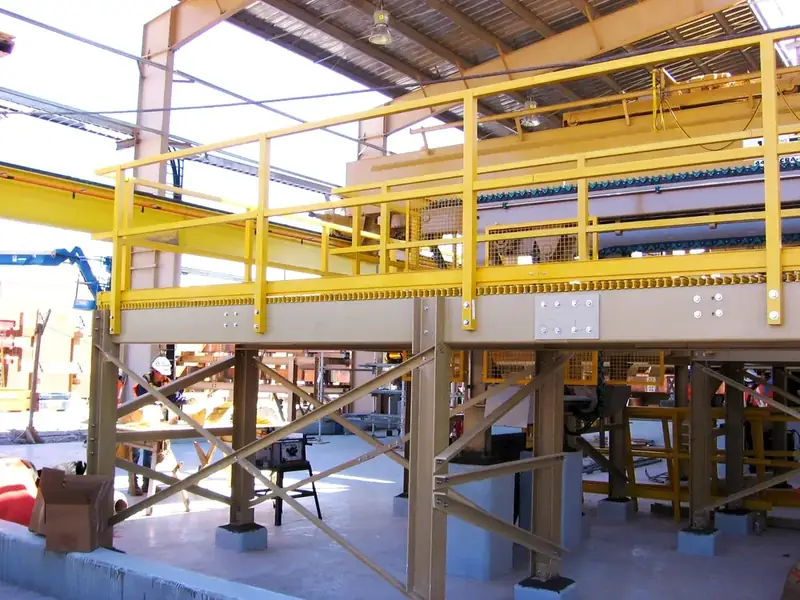
Industrial walkway and platform grating for plants, refineries and factories.
Trench & Drain Covers
GRP trench cover grating and drainage grating for municipal and industrial works.
Stair Treads
Anti-slip GRP stair tread grating for safe vertical access.
Marine & Offshore
Dock, deck and offshore GRP grating in corrosive salt environments.
Water & Wastewater
Treatment plant walkways and covers that never corrode.
Food & Beverage
Food-grade, easy-to-clean GRP flooring for processing areas.
Direct Manufacturer, First-Class Quality, Competitive Price
FRP Grating Master is a real GRP grating factory — not a trading company. In-house molding and pultrusion give us full control over quality, pricing and lead times, so you get first-class GRP grating at factory-direct prices.
Factory Direct Pricing
Buy straight from the manufacturer — no middleman markup.
Full Quality Control
Incoming material inspection, in-process checks, load testing and traceable records.
Custom Engineering
Custom sizes, colors, surface treatments and tooling from CAD to production.
Global Shipping
FOB, CIF or DDP worldwide with full documentation: COA, MSDS and load test reports.
GRP Grating FAQ
Request Your GRP Grating Quote
UV Resistant GRP Grating for Outdoor and Coastal Use
GRP grating left outdoors degrades under sunlight unless the resin carries UV inhibitors. FRP Grating Master’s UV resistant GRP grating is formulated with light-stabilized resin, so colour and mechanical strength hold up on coastal walkways, offshore platforms and roof-top decks, year after year.Manufacturer & Certifications
Manufactured by NANTONG ZEALL NEW MATERIALS CO., LTD. in Nantong, Jiangsu, China. Contact our export team at [email protected] or +86 513 6681 9918. Every panel is produced under an ISO 9001 quality system, CE marked, fire-rated to ASTM E-84 Class B, and independently tested to Intertek and ABS standards. We supply direct from our own production factory to customers in 45+ countries.Keyword Reference: English, Español, Deutsch, Français
- UV resistant GRP grating = ES: rejilla GRP resistente a los rayos UV · DE: UV-beständiger GFK-Rost · FR: caillebotis GRP résistant aux UV
- GRP grate = ES: rejilla GRP (grate) · DE: GRP-Rost (grate) · FR: grille GRP (grate)
- GRP grating factory = ES: fábrica de rejilla GRP · DE: GFK-Rost-Fabrik · FR: usine de caillebotis GRP
GRP Grating Panel Types
GRP grating panels are made in several standard families — moulded square-mesh, pultruded structural profiles and special-purpose panels. Each family has its own mesh, bar profile, load capacity and surface finish.
Standard grating panels — the standard moulded square-mesh panel for walkways, platforms and mezzanines, in 25–50 mm thicknesses. GRP moulded grating panels
Antistatic grating panels — carbon-loaded conductive panels that dissipate static charge, used in chemical, paint and electronics plants. anti-slip GRP grating
Heavy-duty grating panels — pultruded I-bar and T-bar panels engineered for high loads and long spans. pultruded GRP grating panels
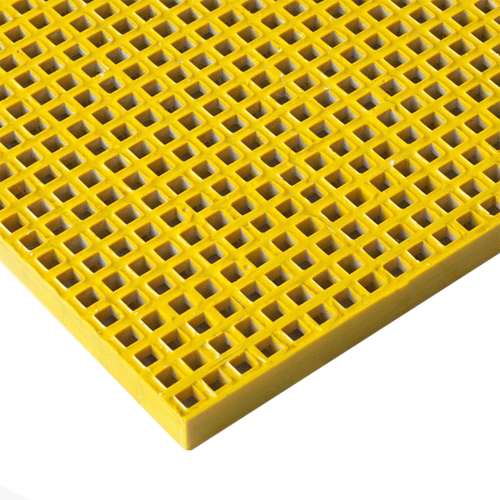
Micro-grating panels — mini-mesh and micro-mesh panels with 19×19 mm or finer openings for covers, screens and particle-sensitive zones. micro-mesh GRP panels
Profile gratings — pultruded structural profiles — I-bar, T-bar and square bar — for engineered flooring and framed platforms. GRP profile gratings
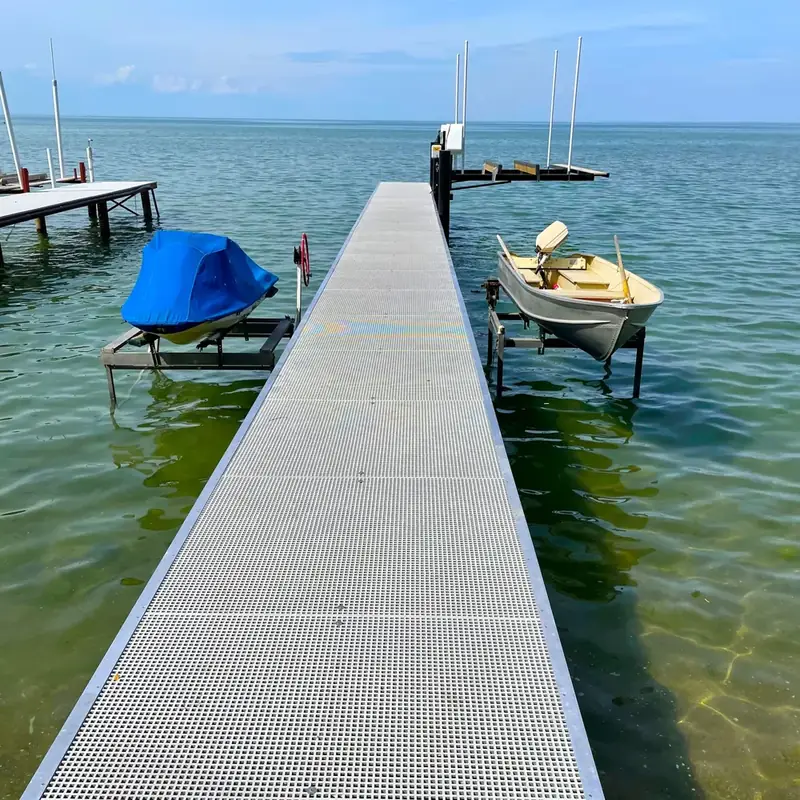
Boat jetty grating — marine-grade panels for boat jetties, piers and floating walkways in saltwater environments. marine GRP grating
Mesh grid mats — interlocking moulded mats for portable walkways, machine surrounds and temporary access. GRP mesh grid mats
Grating panel fences — GRP panels mounted vertically as perimeter screens, safety enclosures and windbreaks.
Safety floors — anti-slip, fire-rated panels for permanent working platforms and access floors. GRP safety flooring
Stair treads — moulded and pultruded tread panels with anti-slip nosing for stairs and step-over access.
Flaps — small hinged or screw-down cover panels for cable trays, pipe runs and inspection openings.
Surfaces — plain, gritted, antistatic and phenolic surface finishes to match slip, spark and fire requirements. GRP surface options
Panel profile — standard 38×38 mm square mesh and custom pultruded profiles with matching panel dimensions. GRP panel profiles
Accessories for grating panels — grating clips, clamps and fixing kits that lock panels to steelwork without welding. GRP grating clips and accessories
Advantages of GRP Grating Panels
GRP grating panels are specified wherever steel corrodes, aluminium conducts and wood rots:
High strength and load capacity — GRP grating panels compete with steel on load-bearing performance while weighing about a quarter as much, which cuts structural and installation cost.
Corrosion resistance — the fibreglass composite will not rust, so GRP panels keep working in chemical plants, offshore platforms, cooling towers and sewage treatment plants without painting or cathodic protection.
Weather resistance — UV-stabilised resins tolerate sun, rain, frost and extreme temperatures, making GRP grating panels a reliable alternative to steel for outdoor walkways and stairs near bridges and wind turbines.
Non-conductive and safe — GRP is electrically insulating and non-magnetic, so panels are specified near live equipment, electrical rooms and sensitive electronics.
GRP Grating Applications and Projects
FRP Grating Master has delivered GRP grating for walkways, platforms and access systems across industry. Typical applications include:
Steel manufacturing — GRP grating walkways and access platforms for steel mills and rolling plants, where vibration, chemicals and washdown demand corrosion-proof flooring.
GRP bridge grating — lightweight, non-corroding grating panels for footbridges, inspection walkways and bridge maintenance access.
Anti-slip walkway and stairs — gritted-surface panels and stair treads for public and industrial anti-slip walkways. anti-slip GRP walkways
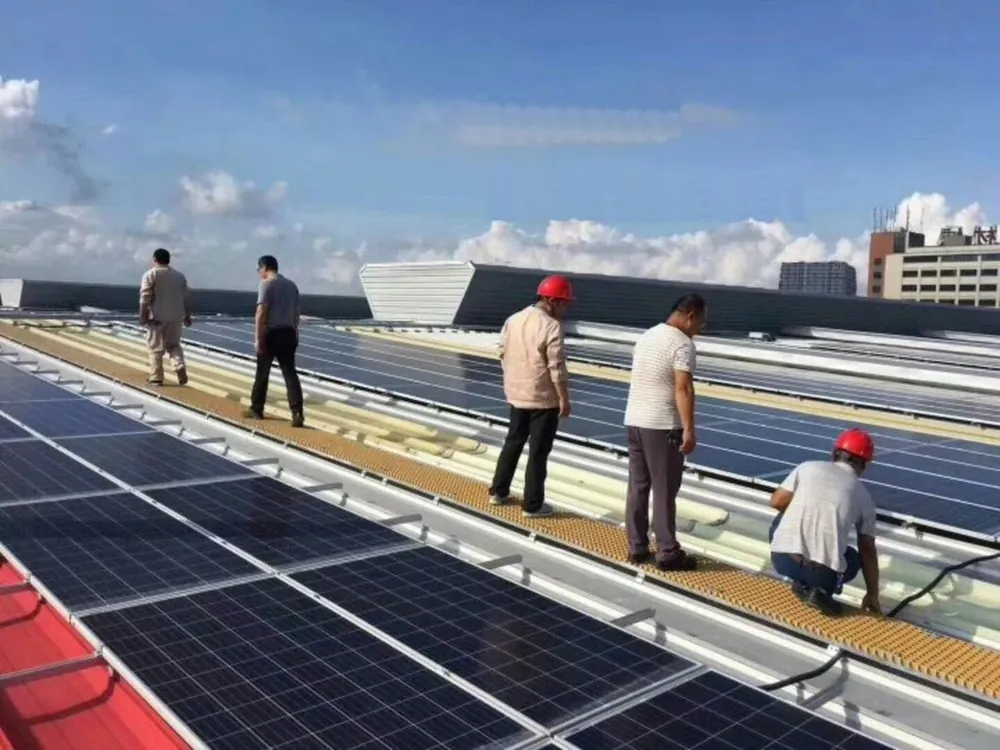
Rooftop GRP service raceway — UV-stable panels and raceway covers for rooftop plant rooms, HVAC service routes and solar service walkways. GRP solar rooftop walkways
University campuses — durable, low-maintenance grating for campus walkways, laboratories and plant rooms.
Shopping centres — anti-slip, aesthetically clean grating for service corridors, plant decks and rooftop access in retail buildings.
GRP mammal ledges — bonded and framed ledge panels for zoo and aquarium habitats, where steel and treated timber are unacceptable.
Delivery references span chemical plants, offshore platforms, wastewater treatment, mining, marine jetties, power and solar plants — see our project portfolio for representative cases.
Request a GRP grating panel quote — email [email protected] or call +86-513-6681-9918 for specifications, samples and factory pricing.
Specifications
| Parameter | Value |
|---|---|
| Thickness | 25 / 30 / 38 / 50 mm |
| Mesh size | 38×38 mm / 19×19 mm / 12×12 mm |
| Panel size | 1220×3660 mm (standard) |
| Surface options | Grit-top / Concave / Smooth / Covered |
| Resin system | Isophthalic / Vinyl Ester / Phenolic |
| Color | Grey / Green / Yellow / Custom |
Installation & Selection Guide
Step 1: Choose your application. Walkways, platforms, trench covers, stair treads, and marine jetties each require different panel thickness and surface finish. Anti-slip gritted surface is recommended for wet or oily environments; smooth surface for light-duty walkways.
Step 2: Select mesh and thickness. 25mm thickness suits pedestrian walkways; 38–50mm for heavy-duty vehicle or long-span applications. 38×38mm mesh is standard; 19×19mm for small-part containment or anti-fall protection.
Step 3: Pick the right resin. Isophthalic resin for general industrial use; vinyl ester for chemical plants and offshore; phenolic for fire-rated environments.
FRP vs Steel vs Aluminum
| Feature | FRP Grating | Steel Grating | Aluminum |
|---|---|---|---|
| Weight | Light (1/4 of steel) | Heavy | Medium |
| Corrosion | Never rusts | Rusts without paint | Resists oxidation |
| Electrical | Insulating, non-magnetic | Conductive | Conductive |
| Maintenance | Zero painting | Paint / galvanize | Low |
| Cost | Medium (long-term ROI) | Low upfront | High |
Why This Terminology Matters
GRP (Glass Reinforced Plastic) is the British and European standard term for what US buyers call FRP. UK building and industrial-floor standards such as BS EN 13501 (fire performance of construction products) and BS 4592 (industrial type flooring and stair treads) are written around GRP terminology, and British, Irish, Australian and New Zealand engineers specify GRP grating by default. If your project is quoted against a British Standard, a UK or Commonwealth tender, or a Dublin, Sydney or Auckland specification, this is the page and the term your buyer is actually searching. Choosing GRP grating wording on drawings, datasheets and RFQs keeps you aligned with how UK procurement teams read tenders, BS 4592 compliance notes and British construction documentation, and avoids terminology mismatch at the approval stage.
FAQ
What is GRP Grating — Glass Reinforced Plastic (GRP) Grating Panels?
GRP Grating — Glass Reinforced Plastic (GRP) Grating Panels is a fiberglass-reinforced composite panel used for walkways, platforms, trench covers and anti-slip flooring. It is lightweight, corrosion-proof and electrically insulating.
How strong is GRP Grating — Glass Reinforced Plastic (GRP) Grating Panels compared to steel?
FRP grating panels compete with steel on load-bearing while weighing about 75% less, reducing structural and installation cost. Heavy-duty pultruded panels match steel for long spans.
Can GRP Grating — Glass Reinforced Plastic (GRP) Grating Panels be cut to size?
Yes. FRP panels are cut on-site with standard power tools. Custom sizes, openings and notches are available factory-direct.
What surface finish is best for outdoor use?
Grit-top (anti-slip) surface is recommended for outdoor walkways, stair treads and wet areas. UV-stabilized resin prevents fading in direct sunlight.
How long does FRP grating last?
Typical service life is 20+ years in industrial environments with no painting or maintenance. ISO 9001 manufacturing ensures consistent quality.
Is GRP Grating — Glass Reinforced Plastic (GRP) Grating Panels fire-resistant?
Phenolic resin panels achieve fire-rated performance for enclosed plant rooms. Standard isophthalic and vinyl ester resins are self-extinguishing.
Buyer's Checklist
- Application: walkway / platform / trench / stair / marine
- Required thickness (25 / 38 / 50 mm)
- Mesh size (38×38 / 19×19 mm)
- Surface finish (grit-top / smooth / concave)
- Resin system (iso / vinyl ester / phenolic)
- Color and custom dimensions
- Clips and fixing hardware (M / C / L / Z type)
GRP Grating Resin Systems: How to Choose the Right One
The glass reinforcement provides strength, while the resin matrix determines corrosion resistance, temperature performance and fire behavior. Selecting the correct resin is the key engineering decision for the operating environment.
Orthophthalic (General Purpose)
The standard economy resin for mild, non-corrosive settings such as pedestrian walkways and light industrial platforms where chemical exposure is limited.
Isophthalic (Corrosion Resistant)
Offers better corrosion and moisture resistance and is the common choice for wastewater, marine, chemical processing and outdoor environments with intermittent exposure.
Vinyl Ester (High Chemical Resistance)
Provides superior resistance to acids, alkalis and solvents, and is specified for aggressive chemical plants, pulp and paper, and continuous immersion service.
Phenolic (Fire and Low Smoke)
Selected where low flame spread and low smoke emission are critical, including offshore platforms, transit and enclosed infrastructure; it is often used for fire-retardant specifications.
Understanding Span, Load and Deflection
FRP grating load tables relate three variables: the clear span between supports, the applied uniform or concentrated load, and the resulting deflection. For safe design, the panel span is kept short enough that deflection stays within the limit set by the applicable standard while retaining a safety factor against the ultimate load.
- Bearing bars should run perpendicular to the supporting members so loads transfer directly onto the supports.
- Uniform load is expressed over an area; concentrated (point) loads such as a wheel or foot require a separate check.
- Increasing panel thickness or reducing the support spacing lowers deflection for the same load.
- Always confirm the design against the project standard (ASTM, OSHA, BS EN ISO or equivalent) and the published load table for the selected panel.
GRP Grating Standards Across Major Markets
FRP grating projects around the world reference different national and international standards. The table below summarizes the frameworks most commonly specified in each market; the underlying performance requirements for access and walkway systems are closely aligned.
| Market | Commonly Referenced Standards |
|---|---|
| United States | ASTM, OSHA, ANSI, NFPA (including ASTM E84 and FRP grating load standards) |
| United Kingdom | BS EN ISO 14122, BS 4592, EN 13501, UKCA |
| Germany / EU | DIN, EN, ISO, CE |
| Australia | AS, EN |
| Canada | CSA, ASTM, NBC |
| Middle East | ISO, ASTM, local civil defense fire rules |
| Singapore | SS, ISO, ASTM, CE |
See the dedicated standards reference and specifications hub for detailed technical guidance.
Care, Maintenance and Service Life
FRP grating requires minimal maintenance compared with steel, which must be painted or galvanized to prevent rust. A few simple practices keep panels safe and extend service life.
- Clean surfaces periodically with water and a mild detergent to remove buildup that could reduce slip resistance; high-pressure washing is generally acceptable.
- Inspect clips and fixings after installation and at routine intervals, retightening or replacing any that are loose or damaged.
- Check panels after impact or overload events for cracks or delamination and replace affected sections rather than loading them further.
- Keep weld or heat work away from the resin surface, as prolonged high temperature can damage FRP even though it performs well in normal operating heat.
With correct resin selection and basic care, fiberglass grating commonly delivers decades of corrosion-free service, with no ongoing painting or rust treatment.
GRP Grating for Germany, France, Spain, Sweden and Norway
Across Western Europe and the Nordics, access and walkway requirements are closely aligned through EN and ISO standards, while each market keeps its own national references and marking rules.
Germany
German projects commonly reference DIN, EN and ISO standards with CE marking for access and walkway systems. Panels are shipped through major ports such as Hamburg and Bremerhaven. See the Germany supplier guide and the markets hub.
France
French specifications use NF EN ISO 14122 for access systems and EN standards, with CE marking and REACH material requirements. Delivery typically routes through Le Havre and Marseille-Fos. See the France supplier guide and the markets hub.
Spain
Spanish projects reference UNE and EN standards with CE marking. FRP grating is widely used in coastal and chemical plants, with shipments via Valencia and Algeciras. See the markets overview and the markets hub.
Sweden
Swedish industrial and marine projects apply SS and EN standards with CE marking, often in corrosive coastal and pulp-and-paper environments. Goods commonly enter through Gothenburg. See the Sweden supplier guide and the markets hub.
Norway
Norwegian offshore and process projects follow NS/EN and ISO standards; CE-marked FRP is widely accepted even though Norway is outside the EU. The non-conductive, low-smoke properties suit North Sea platforms, with shipping via Oslo and Bergen. See the Norway offshore guide and the markets hub.
GRP Grating for the United Kingdom: Standards and Compliance
GRP (glass reinforced polymer) grating delivered to UK projects is manufactured to meet the British and European standards UK engineers specify for safe access. Platforms, walkways and stair systems commonly reference BS EN ISO 14122 and BS 4592, with EN 13501 covering fire performance. We support the UKCA marking and can provide CE documentation where required.
GRP grating resists corrosion in coastal, chemical and wastewater environments and is widely deployed across offshore, marine, industrial and port applications across Britain. UK shipments are typically routed through Felixstowe and Southampton, followed by inland transport to site.
- Standards: BS EN ISO 14122, BS 4592, EN 13501, with UKCA and CE support
- Resin options: isophthalic, vinyl ester and phenolic, including fire-retardant grades
- Panel thickness: 25 / 38 / 50 mm in molded and pultruded constructions
- Surface options: grit-top anti-slip, concave and smooth finishes
See our United Kingdom market overview for local standards and shipping, or contact us for a project-specific GRP grating quotation.
Explore GRP Grating by Topic
By Type
- Molded FRP Grating
- Pultruded FRP Grating
- Mini Mesh Grating
- Heavy Duty Grating
- Anti-Slip Grating
- Phenolic Grating
- Composite Grating
- Covered Grating
- Chequered Plate Grating
- Boardwalk Plank
- Transparent Grating
- Conductive Grating
- Custom Grating
- Grating Panels
By Application
- Walkway Grating
- Platform Grating
- Stair Tread Grating
- Trench Cover Grating
- Marine Grating
- Oil & Gas Grating
- Food & Beverage Grating
- Cooling Tower Grating
- Mining Grating
- Power Plant Grating
- Solar Grating
- Rooftop Safety
Related Systems
- FRP Handrail
- FRP Ladder
- Grating Clips
- Structural Profiles
- FRP Fence
- Manhole Cover
- Crossover Stairs
- Grating Price
Resources
Related Pages
FRP Grating · GRP Grating · GRP Grating Manufacturer · GRP Grating Supplier · GRP Grating Panels · Fiberglass Grating · Anti-slip FRP Grating · Molded FRP Grating · Pultruded FRP Grating · GRP Platform Grating · GRP Channel Grating · GRP Catwalk · GRP Grating Suppliers · GRP Structural Profiles · GRP Grating Price · GRP Grating Clips · GRP Walkway Grating · GRP Trench Cover Grating · GRP Stair Tread Grating
Related terms: GFRP Grating · Glass Reinforced Plastic Grating · Fiberglass Reinforced Plastic Grating
Local Standards: GFK, PRV, PRFV and Why GRP Is the English Trade Name
GRP, GFRP and FRP describe the same material: glass fibres embedded in a thermoset resin matrix. GRP is the term standardised by British and Commonwealth engineers; GFRP is the American engineering shorthand; FRP is the broader US industry term that also covers carbon-fibre and aramid composites. When a procurement desk across four European markets writes an RFQ, the acronym changes with the destination country but the resin, the fibre and the moulding process do not. A Stuttgart drawing office writes GFK-Rost (Glasfaserverstärkter Kunststoff); a Barcelona specification writes rejilla PRFV (plástico reforzado con fibra de vidrio); a Lyon engineering firm writes caillebotis PRV (plastique renforcé de verre). On the factory floor in Nantong, all three arrive as the same 38 mm moulded panel line, and the only paperwork that changes is the label on the packing list.
For buyers who have standardised on a single English acronym across all markets, the practical habit is to quote the local term first and add the English slug in parentheses on the invoice. A German customs officer reading GFK-Rost on the commercial invoice needs no further explanation; a French warehouse receiver reading caillebotis PRV likewise. The four gel-coat colours we hold in stock — light grey, dark grey, safety yellow, forest green — are the same across all four language zones. The 1220×3660 mm panel size and the 38 mm standard thickness are likewise universal; only the local spec sheet language and the local acceptance-form checklist differ. A Spanish buyer rarely asks for Barcol readings on delivery; a German buyer will not release payment until the mill certificate for the resin batch arrives. We prepare both document sets from the same production record, because the resin batch number, the gel-coat batch and the press run date are identical regardless of which acronym travels on the box.
The common spec preferences by market are worth noting for first-time buyers. German projects lean toward the 38 mm and 50 mm grades with a grit top surface, because German rail and municipal specs have called for anti-slip performance since the 1990s. French distributors order more 30 mm panels than any other market, because two decades of French walkway frame detail have been dimensioned around 30 mm thickness. Spanish and Italian buyers split evenly between 25 mm and 38 mm, and they almost always specify grey gel coat. British and Irish buyers order the full range, and they are the only market that regularly requests forest green for coastal boardwalks. None of these preferences changes the material; they change which grade we pull from the warehouse shelf and which language the accompanying datasheet is printed in.
Installation and Acceptance: Gaps, Clips, Deflection and Edge Sealing
A GRP walkway on site fails more often at the fixing details than at the panel itself. The four details that every installation checklist should cover are: the expansion gap between panels, the number and spacing of fixing clips, the deflection acceptance under live load, and the sealing of cut edges. Get these four right and the panel will outlast the steel frame it sits on; get any one wrong and the maintenance crew will be back within two years.
The expansion gap between panel ends on a steel support should be a minimum of 3 mm and a maximum of 5 mm per 1220 mm panel width. GRP expands at roughly 2.5×10
Fixing clips on a 1220×3660 mm panel should be a minimum of four: one at each corner, through the web and into the steel angle below. On walkways that see pallet-truck traffic, we recommend six clips — four corners plus one at mid-span on each long side. The clip torque should be hand-tight plus a quarter turn; over-torquing crushes the GRP web at the clip hole, and under-torquing lets the panel walk under foot traffic. The supplied stainless-steel clips are pre-punched to the hole pattern on our panels; drilling extra holes on site weakens the web and voids the batch certificate.
Deflection acceptance under live load is the L/200 or L/360 limit set by the structural engineer on the drawings. On site, the acceptance test is simple: load the mid-span with the design live load (usually 5 kN/m² for a pedestrian walkway) and measure the residual deflection after 15 minutes. If the reading exceeds L/200, the panel grade is wrong and the installer should not sign off. The walkway should not feel springy underfoot; a visible bounce at mid-span is the first sign that the panel has been under-specified for the span.
Cut edges are the fourth detail. Any panel cut on site — to fit around a pipe, a column or a stair opening — must have the cut edge sealed with the supplied polyester edge-gel within four hours of cutting. Exposed glass fibres at a cut edge wick moisture into the laminate, and within a coastal winter the edge will delaminate. The supplied gel is chemically the same resin as the panel, so it bonds rather than sticks; it cures at ambient temperature and does not require a hot gun. Silicone sealant is the wrong product on GRP: it does not wet the polyester surface, it peels off in one winter, and it traps moisture between itself and the cut glass bundle. One tube of edge-gel ships with every order, enough for roughly forty cut edges on a 10 m² walkway.
GRP Grating in British English: Fibreglass and Glass Fibre Reinforced Grating
UK, Irish, Australian and South African specifications favour British spelling, which is why this page is also found as fibreglass reinforced grating and glass fibre reinforced grating, alongside the US forms fiberglass reinforced grating and glass fiber reinforced grating. The abbreviated name GRP grating covers all four; the panel, resin system, mesh pitch and load class do not change with the spelling.
We quote UK projects against BS EN 13706 and issue documents in British English — fibre, metre, kilogram — while keeping US customary conversions on the same datasheet for transatlantic buyers.
Glass Fibre Reinforced Grating and Fibreglass Grating: Same Order, Same Panel
A UK buyer writes glass fibre reinforced grating or fibreglass grating; a US buyer writes glass fiber reinforced grating or glass fiber reinforced plastic grating. GRP grating, glass reinforced plastic grating and all four of those spellings describe one product, so the order does not need re-briefing when the wording changes: the mesh, the bar depth, the resin grade and the fixing detail stay exactly as specified. Send the drawing and we quote against it under whichever name your procurement system prints.
| Term | Where buyers use it | What it means |
|---|---|---|
| FRP grating | US catalogues, datasheets, RFQs | Fibre-reinforced plastic grating — the moulded or pultruded panel itself |
| Fiberglass grating | US search terms and email enquiries | Short form of fiberglass reinforced grating |
| fiberglass reinforced grating | US drawings and purchase orders | Full form: glass fibres laid in a resin matrix, plastic omitted from the phrase |
| Fibreglass grating | UK, Ireland, Australia, India | British spelling of fiberglass grating |
| fibreglass reinforced grating | UK and Commonwealth tender documents | British spelling of fiberglass reinforced grating |
| Glass fiber reinforced grating | US engineering specifications | fibre placed before resin — same construction, same load table |
| glass fibre reinforced grating | UK and EU engineering specifications | British spelling of glass fiber reinforced grating |
| Glass reinforced plastic grating | ISO-style specifications | The spelled-out GRP; identical panel to FRP grating |
| GRP grating | UK, EU and Asia catalogues | Acronym of glass reinforced plastic grating |
| GFRP grating | Some US spec sheets | glass fibre reinforced plastic — the same product under a fourth acronym |
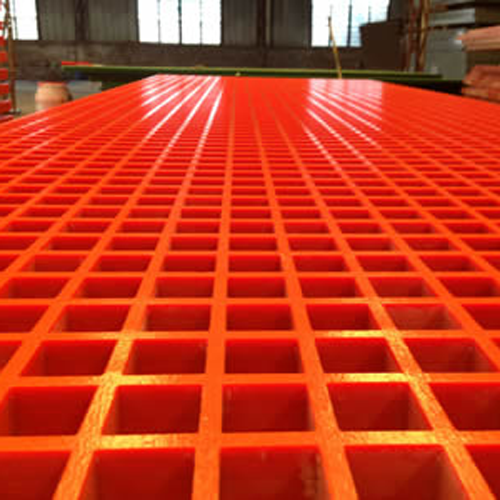
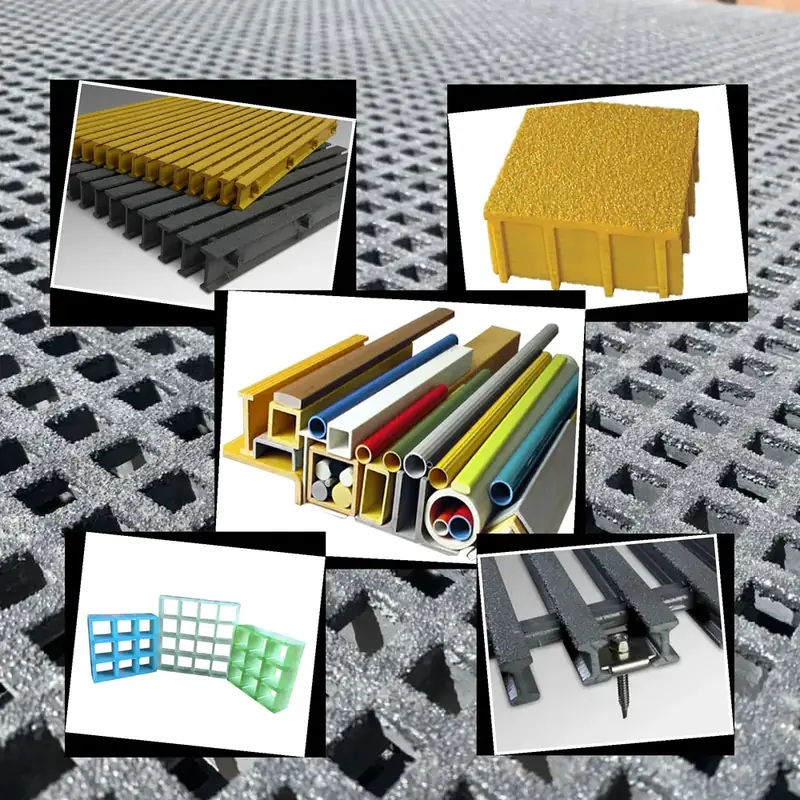
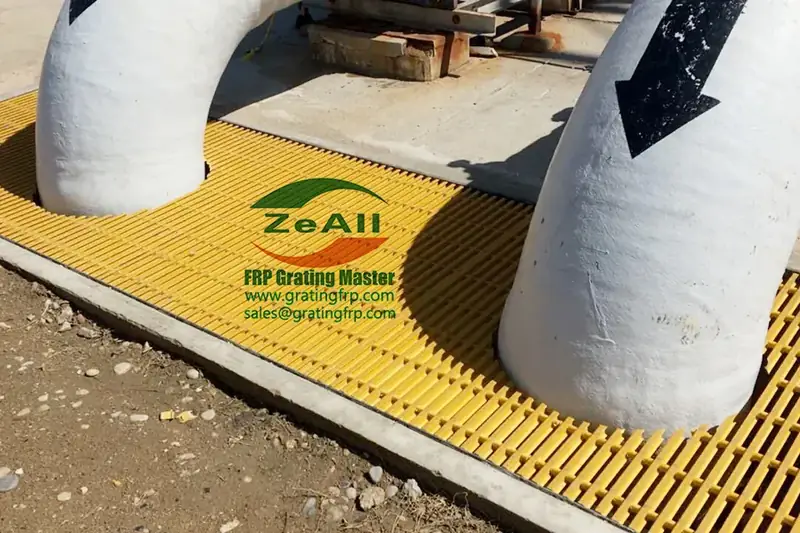
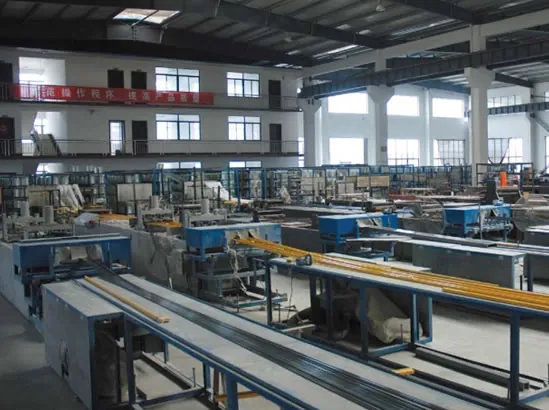
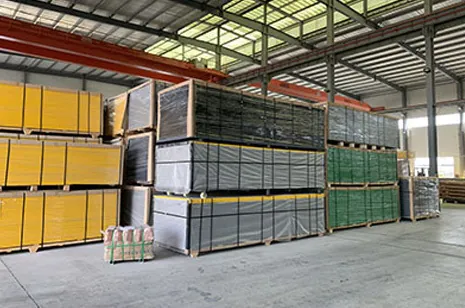
Product and factory gallery
Buyer feedback — 4.9 / 5 from 541 verified buyers
“Planted 480 m² of moulded grating on our acid tank platform — no corrosion after two winters of service.”
“We replaced the steel walkway covers on the quay; the crew was walking on the new panels the same week they arrived.”
“Cut-to-size panels fitted our trench covers exactly, so there was no site trimming and no wasted material.”
“The gritted surface still grips in wet weather, and our safety auditors signed off on the walkway.”
“Easy to wash down between production runs — that was the main reason we moved from steel to FRP.”
“The quotation with drawings came back in a day, and the phenolic panels met our low-smoke specification.”
GRP Grating Supply for Canadian Energy, Mining & Industrial Projects
In Canada the same composite is called FRP or GRP grating interchangeably. It is widely used on Alberta oil-sands and mining sites, in refineries and upgraders, and across municipal water and pulp facilities. Heavy-duty 50 mm pultruded panels and vinyl-ester molded grating handle sour service, brine and abrasion while remaining non-conductive and roughly one quarter the weight of steel.
Shipments reach Alberta through the Port of Vancouver and intermodal rail, with cold-weather-formulated, gritted panels that retain traction under snow and ice. See the location and application guides: GRP grating Calgary, GRP grating Edmonton and oil-sands and mining grating.