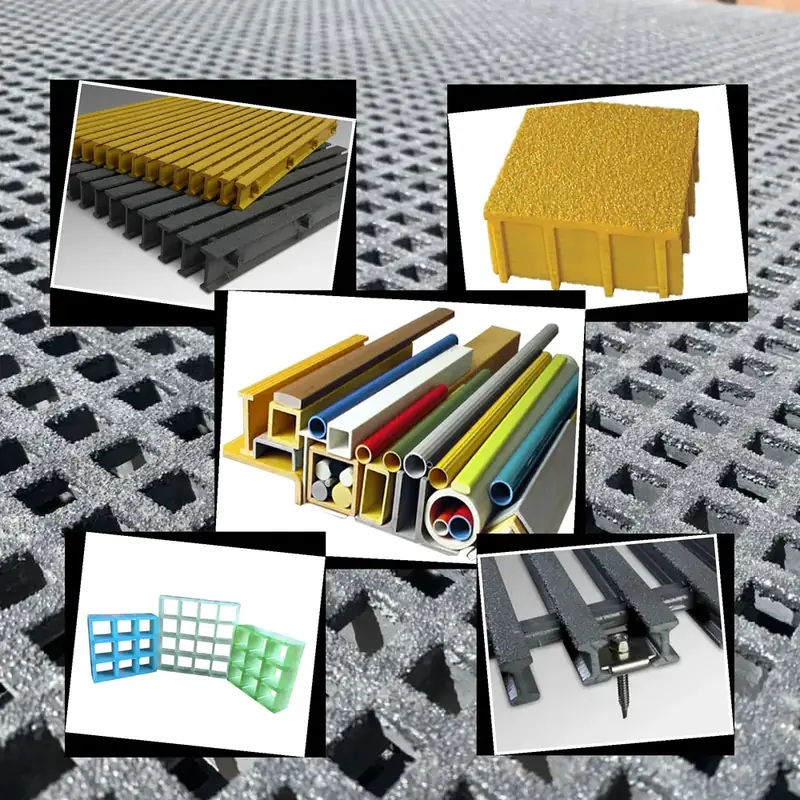
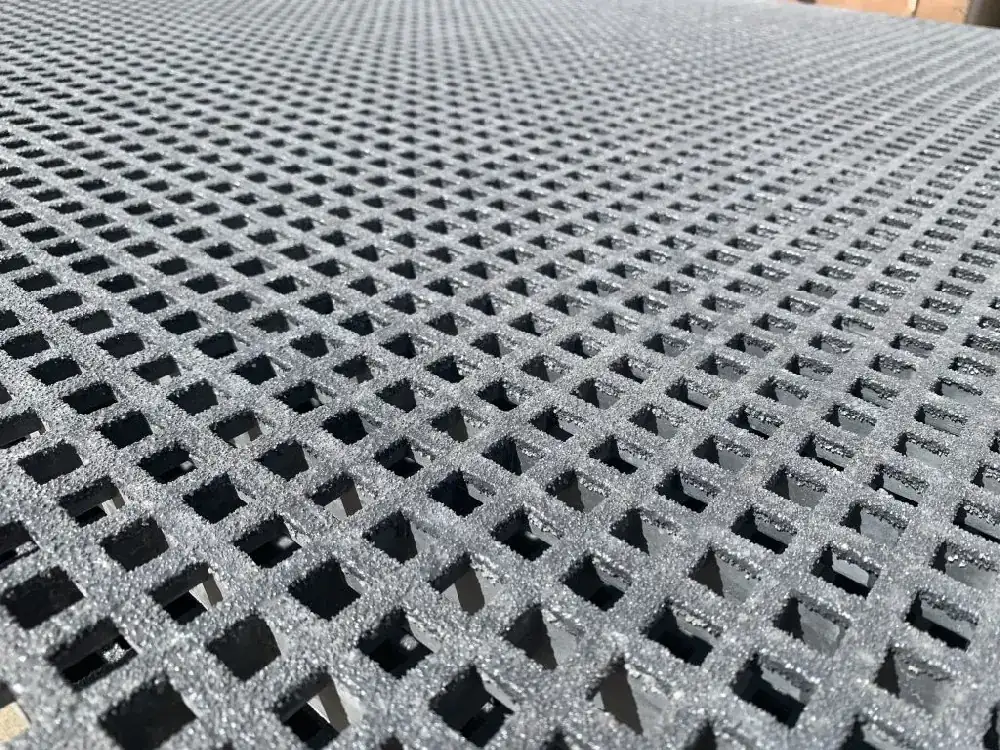
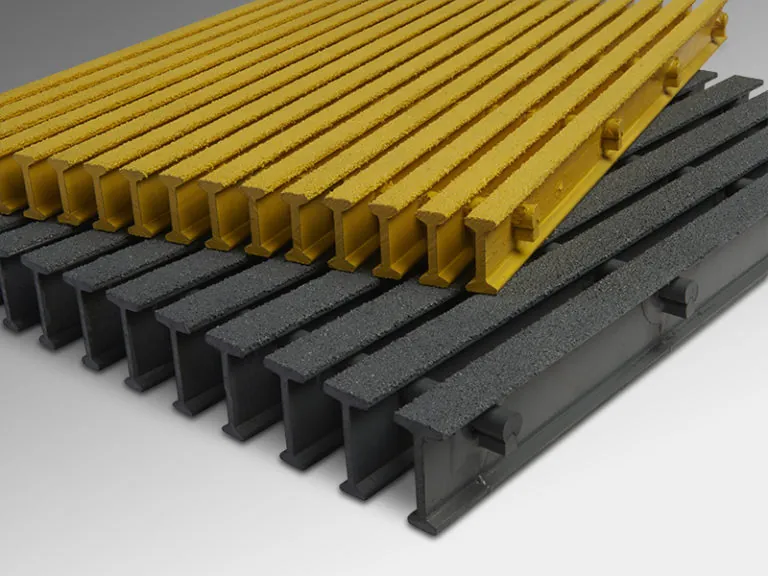
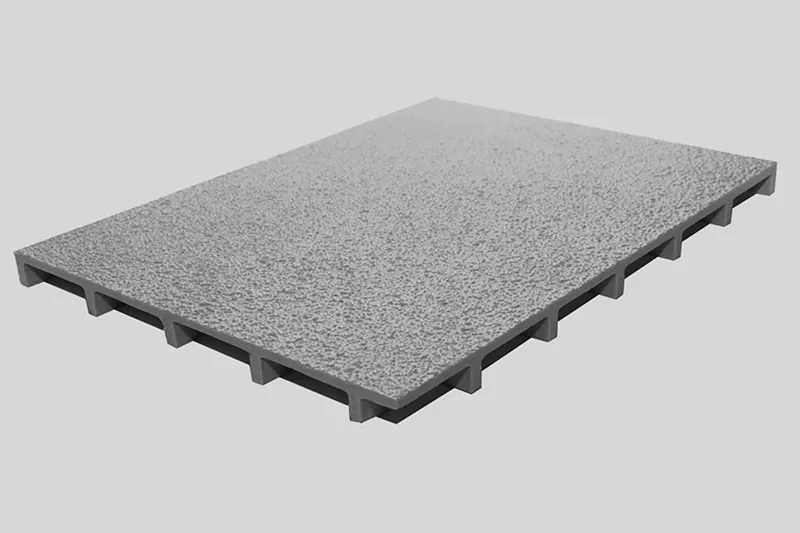
T-bar and I-bar are the two bearing-bar profiles used in pultruded FRP grating. T-bar is heavier and stiffer; I-bar is lighter and spans further per kilogram. The choice is a trade between first cost, self-weight and deflection.
- T-bar 38 mm: 11.5–13.0 kg/m², p38 load 35/18/9 kN/m² at 600/900/1200 mm span.
- I-bar 38 mm: 12.5–14.5 kg/m², p38-I load 40/21/11 kN/m² at the same spans.
- T-bar 50 mm: 15–17 kg/m²; I-bar 50 mm: 16.5–19 kg/m².
- Use T-bar where headroom and deflection matter; use I-bar where self-weight and span efficiency dominate.
- Both use the same crossbar spacing (40–60 mm) and clip system.
T-Bar vs I-Bar Pultruded FRP Grating
When you specify a pultruded FRP grating, the bar profile is the single biggest engineering decision after resin choice. T-bar and I-bar use the same raw materials and the same pultrusion line, but their shape distributes glass fiber differently — which changes both the mass and the allowable span. This guide compares them side by side.
Geometry: Why the Profile Matters
In a simply supported beam, the material at the top and bottom flanges carries the bending load; the web in the middle mostly holds the flanges apart. An I-bar puts glass in the flanges and keeps the web thin. A T-bar puts glass on the top and bottom but with a wider top flange for slip resistance.
| Feature | T-bar | I-bar |
|---|---|---|
| Top flange | Wide, good slip surface | Narrower, smooth |
| Web | Thick, vertical | Thin, vertical |
| Glass distribution | Top-heavy | Even, top and bottom |
| Typical depth | 25 / 38 / 50 mm | 25 / 38 / 50 mm |
| Crossbar spacing | 40 – 60 mm | 40 – 60 mm |
Mass per Area Comparison
The mass numbers below are the range we see on our own pultrusion line. They vary with resin system (ortho runs heavier than VE) and surface finish (grit adds about 0.5 kg/m²).
| Profile | 25 mm | 38 mm | 50 mm |
|---|---|---|---|
| T-bar | 7.5 – 9.5 kg/m² | 11.5 – 13.0 kg/m² | 15 – 17 kg/m² |
| I-bar | ~10.5 kg/m² | 12.5 – 14.5 kg/m² | 16.5 – 19 kg/m² |
| Molded reference | 12.5 kg/m² (25 mm) | 19.5 kg/m² (38 mm) | 27.0 kg/m² (50 mm) |
Note: 1 kg/m² = 0.2048 lb/ft². A 38 mm I-bar at 13.5 kg/m² is about 2.8 lb/ft² — roughly one third the mass of a comparable steel grating.
Load Capacity by Span
The load numbers are uniformly distributed load at the L/200 deflection limit. For point loads or rolling loads, ask for the point-load table.
| Panel | 600 mm span | 900 mm span | 1200 mm span |
|---|---|---|---|
| m38 molded (reference) | 25 kN/m² | 12 kN/m² | 6.5 kN/m² |
| p38 T-bar | 35 kN/m² | 18 kN/m² | 9 kN/m² |
| p38 I-bar | 40 kN/m² | 21 kN/m² | 11 kN/m² |
| p50 T-bar | 48 kN/m² | 26 kN/m² | 14 kN/m² |
| p50 I-bar | 55 kN/m² | 30 kN/m² | 16 kN/m² |
Span Selection Rules
Choose the shallowest panel that meets both the load and the deflection requirement. Over-specifying wastes money and adds self-weight.
| Scenario | Recommended profile | Why |
|---|---|---|
| Pedestrian walkway, 600 mm span | T-bar 25 or 38 | Good slip surface, cost-effective |
| Long-span bridge, 1200 mm | I-bar 38 or 50 | Better span-to-weight ratio |
| Offshore, rolling load | I-bar 50 | Stiffness matters |
| Plant floor, trolley traffic | T-bar 38 or 50 | Wide top flange handles wheel loads |
| Solar rooftop | T-bar 25 or 38 | Lightweight, non-conductive |
Cost and Installation Trade-offs
I-bar is typically 5–10% more expensive per m² than T-bar for the same depth, because the pultrusion die is more complex. But if I-bar lets you span 1200 mm where T-bar needs 900 mm, you save supports and installation labor.
| Factor | T-bar | I-bar |
|---|---|---|
| Cost per m² (38 mm) | Reference | + 5 – 10 % |
| Typical span | 600 – 900 mm | 900 – 1200 mm |
| Supports per 10 m | More | Fewer |
| Slip surface | Wide top, good | Narrower, needs grit |
| Clip system | Standard | Standard (same) |
Standard panel 1220×3660 mm. MOQ 10 m². Lead time 12–36 working days. Both profiles ship with the mill test report and Barcol record.
Crossbar and Clip Details
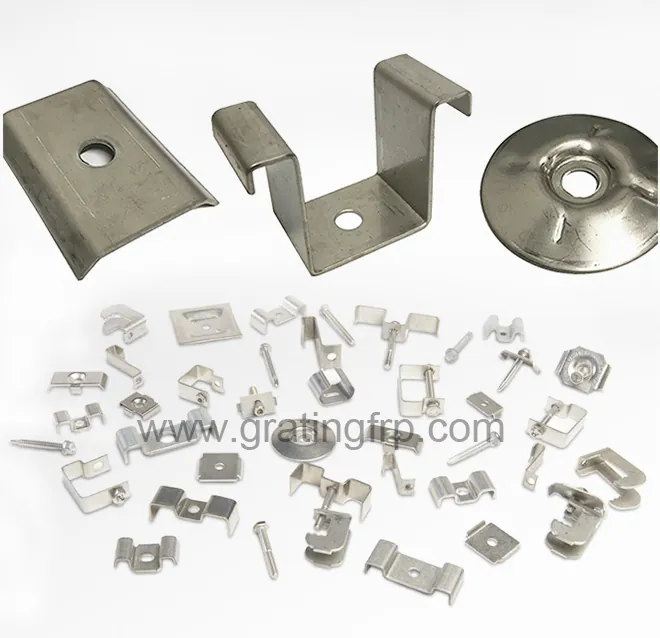
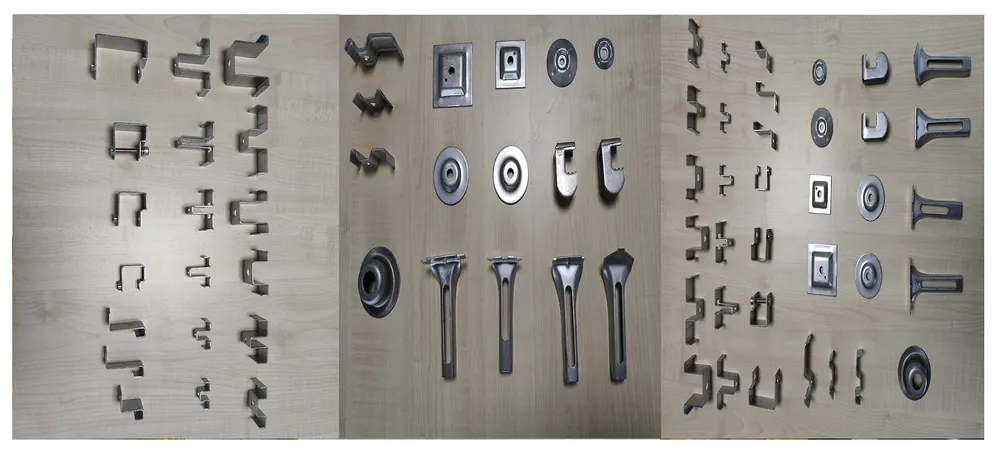
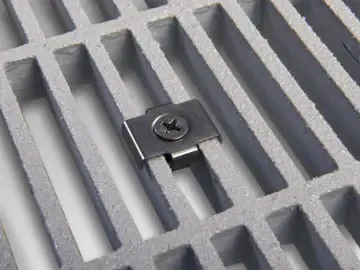
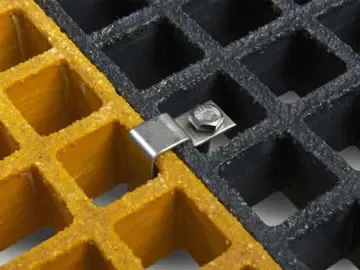
Both T-bar and I-bar use the same crossbar pultruded round tube (typically 12–16 mm diameter) and the same stainless steel or galvanized clip system. The clip choice depends on the support material (steel angle, FRP angle).
| Detail | T-bar | I-bar |
|---|---|---|
| Crossbar | Round tube, 12–16 mm | Round tube, 12–16 mm |
| Clip type | M-clip or C-clip | M-clip or C-clip |
| Clip material | SS304 / SS316 / galvanized | Same options |
| Typical spacing | Every 500 mm | Every 500 mm |
Deflection Behavior
At the same load and span, I-bar deflects slightly less than T-bar because the flanges are further from the neutral axis. But the difference is small (5–10%) — usually not enough to justify the premium if T-bar already meets the L/200 limit.
| Panel | Deflection at 900 mm, 5 kN/m² | Feel |
|---|---|---|
| T-bar 38 | 4.5 mm | Slightly springy |
| I-bar 38 | 4.0 mm | Rigid |
| T-bar 50 | 2.0 mm | Very rigid |
Next Steps
Send us your span, load and deflection limit. We will recommend T-bar or I-bar and return a load table calculated at your specified deflection.
| Parameter | Value | Unit |
|---|---|---|
| Standard panel size | 1220 × 3660 | mm |
| Bar depths available | 25 / 30 / 38 / 50 | mm |
| Density range | 1.5 – 2.0 | g/cm³ |
| Barcol hardness minimum | 40 | — |
| MOQ | 10 | m² |
| Lead time | 12 – 36 | working days |
| Conversion | Factor | Example |
|---|---|---|
| 1 kg/m² to lb/ft² | × 0.2048 | 19.5 kg/m² = 4.0 lb/ft² |
| 1 mm to inch | ÷ 25.4 | 38 mm ≈ 1.5 inch |
| 1 kN/m² to psf | × 20.885 | 25 kN/m² ≈ 522 psf |
| QC Check | Method | Acceptance |
|---|---|---|
| Barcol hardness | Barcol impressor | ≥ 40 across panel |
| Resin content | Burn-off / Ash | 25 – 35 % by weight |
| Density | Cut section | 1.5 – 2.0 g/cm³ |
| Dimensions | Tape measure | ± 3 mm on panel |
| Item | Standard | Note |
|---|---|---|
| Panel thicknesses | 25 / 30 / 38 / 50 mm | Molded and pultruded |
| Standard width | 1220 mm | Other widths by order |
| Standard length | 3660 mm | Cut pieces available |
| Surface finishes | Smooth / concave / grit | Grit adds ~0.5 kg/m² |
| Resin options | Ortho / Iso / VE / Phenolic | VE for strong acids |
Frequently Asked Questions
Is T-bar or I-bar stronger?
For the same depth, I-bar carries slightly more load at the same span because the flanges are further from the neutral axis. But T-bar has a wider top flange that handles wheel loads better.
Which is lighter, T-bar or I-bar?
At 38 mm, T-bar is 11.5–13.0 kg/m² and I-bar is 12.5–14.5 kg/m². T-bar is lighter at the same depth because the web is thinner.
Can I use T-bar for a 1200 mm span?
At 1200 mm, T-bar 38 carries about 9 kN/m² at L/200. If your load is below that, yes. For heavier loads, use I-bar 38 or T-bar 50.
Do T-bar and I-bar use the same clips?
Yes. Both use the same M-clip or C-clip system, in SS304, SS316 or galvanized steel.
What is the MOQ and lead time?
MOQ 10 m². Lead time 12–36 working days depending on profile, resin and surface finish.