Resin determines 80% of FRP grating corrosion resistance: vinyl ester handles harsher chemicals and higher temperatures, polyester is cheaper for mild service.
- Best for: choosing resin by chemical exposure
- Choose vinyl ester for: harsh/hot service; polyester for: mild/low-cost
- Key spec: vinyl-ester vs polyester chemistry, FR options
Choosing the Right Resin System
The resin system determines 80% of FRP grating's corrosion resistance. Selecting the correct resin is critical for long-term performance.
Orthophthalic Polyester (General Purpose)
- Best for: Dry indoor areas, mild exposure
- Cost: Lowest
- Temperature: -40°C to 60°C
- Chemical resistance: Limited
Isophthalic Polyester (Standard Industrial)
- Best for: Wastewater, general chemical exposure
- Cost: Medium
- Temperature: -40°C to 80°C
- Chemical resistance: Good for acids, alkalis
Vinyl Ester (Premium Corrosion)
- Best for: Strong acids, solvents, marine, offshore
- Cost: Highest (30-50% more than polyester)
- Temperature: -40°C to 120°C
- Chemical resistance: Excellent for harsh environments
Selection Guide by Industry
Wastewater Treatment: Isophthalic or Vinyl Ester depending on chemical concentration
Chemical Plants: Vinyl Ester for acid/alkali areas
Offshore/Marine: Vinyl Ester with UV stabilizers
Food Processing: Isophthalic with food-grade resin
Power Plants: Isophthalic or Vinyl Ester
Design Standards & Data Basis
All load, span and capacity values in this article are typical/indicative, derived from laboratory tests per NAAMM MBG-01 (FRP Grating Design Manual) methodology. Molded grating values apply a 5:1 factor of safety on ultimate capacity; pultruded grating values apply a 3:1 factor of safety, both measured at static ambient conditions. Impact loads are limited to 50% of stated values; long-term loads require creep adjustment per ASCE Structural Plastics Design Manual. Certified load tables, stamped engineering calculations and third-party test reports are available on request.
For structural sizing of your specific application, contact our engineering team with your load requirements, span and environmental conditions — we provide free structural calculations within 24 hours. Browse our molded grating and pultruded grating product pages for full specifications and resin options.
Model Naming: Thickness x Mesh Reference
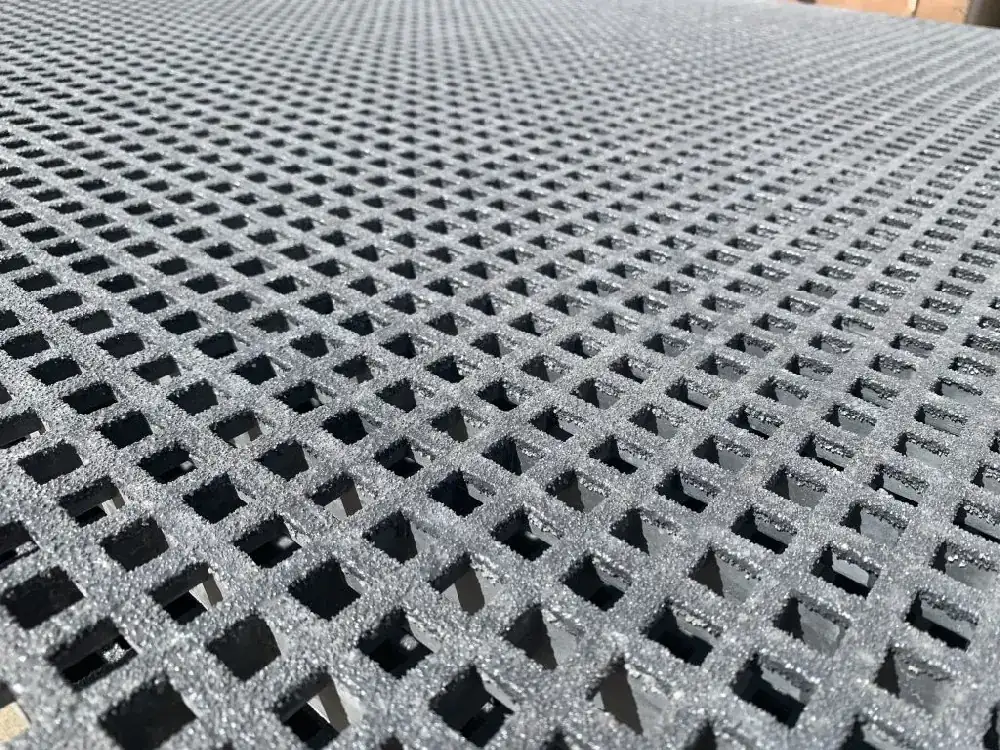
ZEALL molded FRP grating is designated by panel thickness x mesh opening. The standard catalog covers four depths (25 / 30 / 38 / 50 mm) and three mesh sizes (38x38, 19x19, 50x50 mm). A typical designation is "38 mm Molded Grating x 38x38 mm mesh" (model code FG-M3838). Common references:
| Model code | Thickness | Mesh | Duty class | Typical use |
|---|---|---|---|---|
| FG-M2538 | 25 mm | 38x38 mm | Light | Drainage covers, light walkways |
| FG-M3038 | 30 mm | 38x38 mm | Medium | General walkways, ramps |
| FG-M3838 | 38 mm | 38x38 mm | Standard | Industrial platforms, standard service |
| FG-M3819 | 38 mm | 19x19 mm | Standard mini-mesh | Tool handling, heel-safe walkways |
| FG-M5038 | 50 mm | 38x38 mm | Heavy | Forklift areas, long spans |
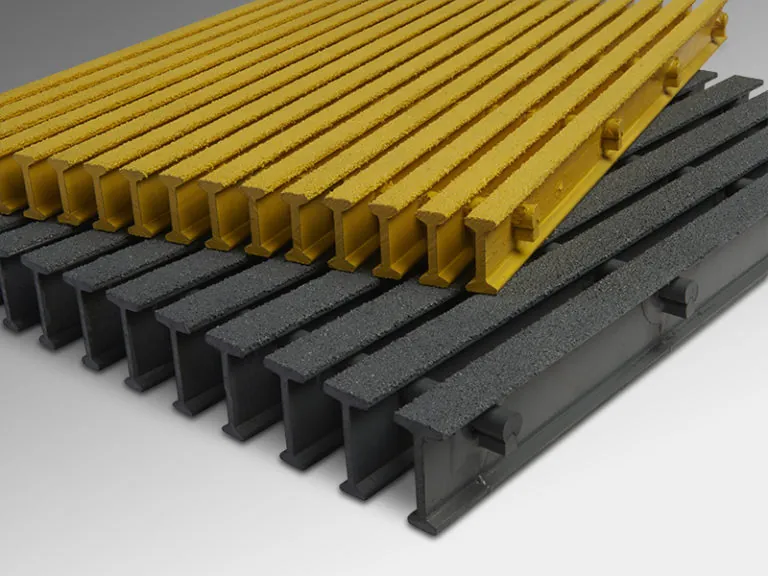
| FG-P5038 | 50 mm I-bar | 38 mm bar spacing | Heavy pultruded | Heavy-duty platforms, truck traffic |
Browse our product pages for full specifications: FRP molded grating.
Frequently Asked Questions
FRP (Fiberglass Reinforced Plastic) grating is a molded or pultruded fiberglass composite grid used for corrosion-resistant walkways, platforms and floorings. It combines glass fiber reinforcement with thermoset resin (polyester, vinyl ester, epoxy) for superior strength-to-weight ratio, zero rust and 20+ year service life.