Use a chemical-resistance chart to pick the resin: vinyl ester resists hot acids and solvents best, isophthalic covers most alkalis, and polyester suits mild exposure only.
- Best for: selecting the right resin before quoting corrosive service
- Choose vinyl ester for: strong acids/solvents; isophthalic for: general industrial
- Key spec: ASTM chemical immersion test data, max service temperature
FRP Grating Chemical Resistance Chart: Complete Resin Selection Guide
Choosing the correct resin system is the most critical decision for FRP grating in corrosive environments. This comprehensive chemical resistance chart compares the four main resin systems across 50+ common industrial chemicals. Use this guide to select the optimal resin for your specific application.
Resin Systems Overview
- Orthophthalic Polyester (General Purpose): Lowest cost, good for dry/non-corrosive areas. Not recommended for chemical exposure.
- Isophthalic Polyester: Good general chemical resistance, ideal for wastewater, marine, and mild chemical environments.
- Vinyl Ester: Superior chemical resistance for strong acids, alkalis, solvents, and severe corrosive environments. The industry standard for chemical plants and offshore.
- Phenolic: Excellent chemical resistance plus Class B fire rating (ASTM E-84), low smoke, zero halogen. For high-risk fire and chemical areas.
Chemical Resistance Chart
Ratings: E=Excellent (no effect), G=Good (minor effect), F=Fair (moderate effect), P=Poor (not recommended), N=Not recommended
| Chemical | Conc. | Temp | Ortho. | Iso. | Vinyl Ester | Phenolic |
|---|---|---|---|---|---|---|
| Sulfuric Acid | 10% | 25°C | F | G | E | E |
| Sulfuric Acid | 50% | 25°C | P | F | G | G |
| Hydrochloric Acid | 20% | 25°C | F | G | E | E |
| Hydrochloric Acid | 37% | 25°C | P | F | G | G |
| Nitric Acid | 10% | 25°C | P | F | G | G |
| Phosphoric Acid | 50% | 25°C | F | G | E | E |
| Acetic Acid | 50% | 25°C | F | G | E | E |
| Citric Acid | 50% | 25°C | G | E | E | E |
| Sodium Hydroxide | 10% | 25°C | F | G | E | E |
| Sodium Hydroxide | 50% | 25°C | P | F | G | G |
| Ammonium Hydroxide | 30% | 25°C | F | G | E | E |
| Sodium Hypochlorite | 12% | 25°C | P | F | G | G |
| Chlorine (wet) | Gas | 25°C | P | F | G | G |
| Hydrogen Peroxide | 30% | 25°C | P | F | G | G |
| Salt Water (NaCl) | 100% | 25°C | G | E | E | E |
| Crude Oil | 100% | 25°C | G | E | E | E |
| Gasoline | 100% | 25°C | F | G | G | G |
| Diesel Fuel | 100% | 25°C | G | E | E | E |
| Acetone | 100% | 25°C | P | P | F | F |
| Methanol | 100% | 25°C | P | F | G | G |
| Ethanol | 95% | 25°C | F | G | G | G |
| Benzene | 100% | 25°C | P | P | F | F |
| Toluene | 100% | 25°C | P | P | F | F |
| Formaldehyde | 37% | 25°C | F | G | E | E |
| Urea Solution | 50% | 25°C | G | E | E | E |
| Wastewater (sewage) | -- | 25°C | G | E | E | E |
| H2S (sour gas) | Gas | 25°C | F | G | E | E |
| Brine (saturated) | 100% | 25°C | G | E | E | E |
| Caustic Soda | 50% | 80°C | P | P | F | G |
| Sulfuric Acid | 50% | 80°C | P | P | F | G |
Temperature Effects
Chemical resistance decreases at elevated temperatures. General guidelines:
- Isophthalic polyester: suitable up to 60-80°C for most chemicals
- Vinyl ester: suitable up to 90-120°C depending on chemical
- Phenolic: suitable up to 150-200°C continuous
- Always reduce expected service life at higher temperatures
How to Select the Right Resin
- Identify all chemicals: List every chemical the grating will be exposed to, including concentrations
- Determine temperatures: Maximum operating temperature for each chemical
- Check the chart: Find the lowest-rated chemical and select resin accordingly
- Consider future changes: If processes may change, choose a more resistant resin
- Consult our engineers: For complex or unusual chemical exposures, request a custom material recommendation
Free Material Selection Service
ZEALL's engineering team provides free resin selection recommendations based on your specific chemical environment. Send us your chemical list, concentrations, and temperatures — we'll recommend the optimal resin system within 24 working hours. Request free material selection
Design Standards & Data Basis
All load, span and capacity values in this article are typical/indicative, derived from laboratory tests per NAAMM MBG-01 (FRP Grating Design Manual) methodology. Molded grating values apply a 5:1 factor of safety on ultimate capacity; pultruded grating values apply a 3:1 factor of safety, both measured at static ambient conditions. Impact loads are limited to 50% of stated values; long-term loads require creep adjustment per ASCE Structural Plastics Design Manual. Certified load tables, stamped engineering calculations and third-party test reports are available on request.
For structural sizing of your specific application, contact our engineering team with your load requirements, span and environmental conditions — we provide free structural calculations within 24 hours. Browse our molded grating and pultruded grating product pages for full specifications and resin options.
Model Naming: Thickness x Mesh Reference
ZEALL molded FRP grating is designated by panel thickness x mesh opening. The standard catalog covers four depths (25 / 30 / 38 / 50 mm) and three mesh sizes (38x38, 19x19, 50x50 mm). A typical designation is "38 mm Molded Grating x 38x38 mm mesh" (model code FG-M3838). Common references:
| Model code | Thickness | Mesh | Duty class | Typical use |
|---|---|---|---|---|
| FG-M2538 | 25 mm | 38x38 mm | Light | Drainage covers, light walkways |
| FG-M3038 | 30 mm | 38x38 mm | Medium | General walkways, ramps |
| FG-M3838 | 38 mm | 38x38 mm | Standard | Industrial platforms, standard service |
| FG-M3819 | 38 mm | 19x19 mm | Standard mini-mesh | Tool handling, heel-safe walkways |
| FG-M5038 | 50 mm | 38x38 mm | Heavy | Forklift areas, long spans |
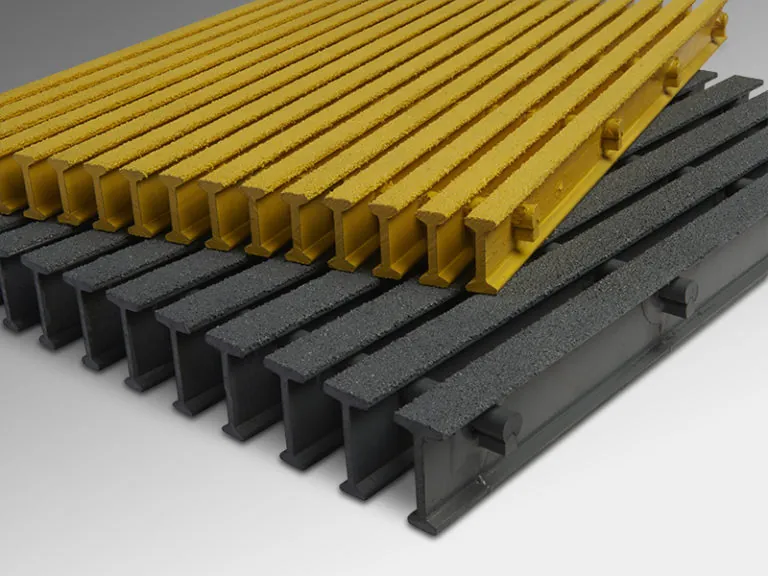
| FG-P5038 | 50 mm I-bar | 38 mm bar spacing | Heavy pultruded | Heavy-duty platforms, truck traffic |
Browse our product pages for full specifications: FRP molded grating · FRP pultruded grating.
How to Read the Resistance Ratings
Excellent — no effect after 2 years’ immersion; Good — slight effect, acceptable for service; Fair — moderate effect, limited service life; Poor — not recommended. For specific chemical exposures, request test coupons and a detailed compatibility analysis from ZEALL’s engineering team.
Frequently Asked Questions
FRP (Fiberglass Reinforced Plastic) grating is a molded or pultruded fiberglass composite grid used for corrosion-resistant walkways, platforms and floorings. It combines glass fiber reinforcement with thermoset resin (polyester, vinyl ester, epoxy) for superior strength-to-weight ratio, zero rust and 20+ year service life.