Resin choice sets FRP grating’s corrosion and fire performance: vinyl ester resists hot acids/solvents best, isophthalic covers most chemicals, polyester suits mild service.
- Best for: choosing the right resin for the chemical environment
- Choose vinyl ester for: harsh acids; isophthalic for: general; polyester for: mild
- Key spec: ASTM, EN 13501, match resin to chemical + temp
1. Unsaturated Polyester Resin (UPR)
Orthophthalic Polyester (GP): General-purpose resin, economical, good mechanical properties, moderate water resistance. Chemical resistance: fair to good in dilute acids (10% HCl, 10% H2SO4), poor in strong alkalis and solvents. Mechanical: tensile 50-70 MPa, flexural 80-110 MPa, heat distortion temp (HDT) 60-70°C. Applications: indoor walkways, commercial flooring, non-corrosive environments, cosmetic parts. Cost: USD 2.0-2.8/kg. Isophthalic Polyester: Premium polyester, improved corrosion and UV resistance vs orthophthalic. Chemical resistance: good in most acids (up to 30% H2SO4), alkalis (up to 20% NaOH), salts, and water. Mechanical: tensile 60-80 MPa, flexural 90-120 MPa, HDT 70-80°C. Applications: wastewater treatment, outdoor walkways, marine decking, moderate chemical environments. Cost: USD 2.8-3.8/kg. DCPD Polyester: low-profile, low-shrink resin, good surface finish, moderate corrosion, used in automotive and cosmetic parts. Cost: USD 2.2-3.0/kg.
2. Vinyl Ester Resin (VE)
Bisphenol-A Vinyl Ester: Standard vinyl ester, excellent corrosion resistance, good mechanical properties. Chemical resistance: excellent in strong acids (50% H2SO4, 37% HCl), most alkalis (up to 50% NaOH), bleaches (15% NaOCl), and many organic solvents. Mechanical: tensile 70-90 MPa, flexural 100-130 MPa, HDT 90-105°C. Applications: chemical plants, pulp & paper, offshore platforms, severe corrosion environments. Cost: USD 4.5-6.0/kg. Novolac Vinyl Ester: High-temperature vinyl ester, superior chemical and thermal resistance. Chemical resistance: excellent in strong acids, solvents, and high-temperature chemical environments, better than bisphenol-A VE in oxidizing acids. Mechanical: tensile 75-95 MPa, flexural 110-140 MPa, HDT 120-140°C. Applications: flue gas desulfurization (FGD), high-temperature chemical processing, scrubbers, tanks. Cost: USD 5.5-7.5/kg. Brominated Vinyl Ester: fire-retardant vinyl ester, self-extinguishing, good corrosion resistance, used in construction and transit where fire rating required. Cost: USD 5.0-6.5/kg.
3. Phenolic Resin
Fire-Retardant Phenolic: Exceptional fire performance, low smoke, low toxicity (LSTC < 3 MJ/m², smoke density < 100), self-extinguishing. Chemical resistance: good in acids and solvents, fair in alkalis, excellent heat resistance. Mechanical: tensile 40-60 MPa, flexural 60-90 MPa, HDT 150-180°C (highest among common resins). Applications: underground mining, tunnel linings, offshore living quarters, public buildings, mass transit (rail, marine), where fire safety is critical. Cost: USD 5.0-7.0/kg. Limitations: lower mechanical properties than polyester/VE, requires post-cure for full performance, more brittle, higher processing temperature, limited color options (typically dark brown/black). Fire performance comparison: Phenolic — best (Class A, low smoke, low toxicity), Vinyl Ester (brominated) — good (self-extinguishing, moderate smoke), Polyester (fire-retardant grade) — fair (self-extinguishing, higher smoke), Standard Polyester — poor (burns, drips, high smoke).
4. Epoxy Resin
Bisphenol-A Epoxy: Highest mechanical performance, excellent adhesion, good chemical resistance, low shrinkage. Chemical resistance: excellent in alkalis, salts, water, many solvents; fair in strong oxidizing acids. Mechanical: tensile 80-110 MPa, flexural 120-160 MPa, HDT 80-120°C (depending on curing agent). Applications: aerospace, high-performance composites, tooling, adhesives, electrical encapsulation, premium FRP products. Cost: USD 6.0-10.0/kg (highest among common resins). Novolac Epoxy: higher chemical and thermal resistance vs bisphenol-A, used in severe chemical environments and high-temperature applications. Cost: USD 8.0-12.0/kg. Limitations: higher cost, requires careful mixing ratio (resin:hardener), longer cure time, UV degradation (requires topcoat for outdoor use), limited to low-volume/high-value applications due to cost and processing complexity.
5. Selection Guide & Application Matrix
Selection criteria checklist: 1. Chemical environment — identify all chemicals, concentrations, temperatures (use chemical resistance chart). 2. Temperature range — continuous and intermittent operating temperature. 3. Fire safety requirements — building codes, industry standards (ASTM E84, EN 13501, IMO). 4. Mechanical load requirements — bending, compression, impact, fatigue. 5. UV exposure — outdoor vs indoor, UV stabilizer or topcoat needed. 6. Food contact / sanitary requirements — FDA, NSF compliance. 7. Budget and lifecycle cost — initial vs TCO. Application matrix: Wastewater Treatment — Isophthalic Polyester (standard) or Vinyl Ester (severe). Chemical Processing — Vinyl Ester (bisphenol-A or novolac based on chemicals). Offshore / Marine — Vinyl Ester (UV stabilized, fire-retardant grade). Mining / Tunnels — Phenolic (fire safety critical). Food & Beverage — Isophthalic Polyester or Vinyl Ester (FDA compliant grade). Electrical / Power — Vinyl Ester (non-conductive, arc resistant). Indoor / Commercial — Orthophthalic Polyester (cost-effective). High-Performance / Aerospace — Epoxy (maximum performance). General rule: start with polyester, upgrade to isophthalic for outdoor/moderate corrosion, upgrade to vinyl ester for severe corrosion/high temp, use phenolic for fire-critical, use epoxy for maximum performance. Always consult manufacturer chemical resistance chart and request sample testing for critical applications.
Design Standards & Data Basis
All load, span and capacity values in this article are typical/indicative, derived from laboratory tests per NAAMM MBG-01 (FRP Grating Design Manual) methodology. Molded grating values apply a 5:1 factor of safety on ultimate capacity; pultruded grating values apply a 3:1 factor of safety, both measured at static ambient conditions. Impact loads are limited to 50% of stated values; long-term loads require creep adjustment per ASCE Structural Plastics Design Manual. Certified load tables, stamped engineering calculations and third-party test reports are available on request.
For structural sizing of your specific application, contact our engineering team with your load requirements, span and environmental conditions — we provide free structural calculations within 24 hours. Browse our molded grating and pultruded grating product pages for full specifications and resin options.
Model Naming: Thickness x Mesh Reference
ZEALL molded FRP grating is designated by panel thickness x mesh opening. The standard catalog covers four depths (25 / 30 / 38 / 50 mm) and three mesh sizes (38x38, 19x19, 50x50 mm). A typical designation is "38 mm Molded Grating x 38x38 mm mesh" (model code FG-M3838). Common references:
| Model code | Thickness | Mesh | Duty class | Typical use |
|---|---|---|---|---|
| FG-M2538 | 25 mm | 38x38 mm | Light | Drainage covers, light walkways |
| FG-M3038 | 30 mm | 38x38 mm | Medium | General walkways, ramps |
| FG-M3838 | 38 mm | 38x38 mm | Standard | Industrial platforms, standard service |
| FG-M3819 | 38 mm | 19x19 mm | Standard mini-mesh | Tool handling, heel-safe walkways |
| FG-M5038 | 50 mm | 38x38 mm | Heavy | Forklift areas, long spans |
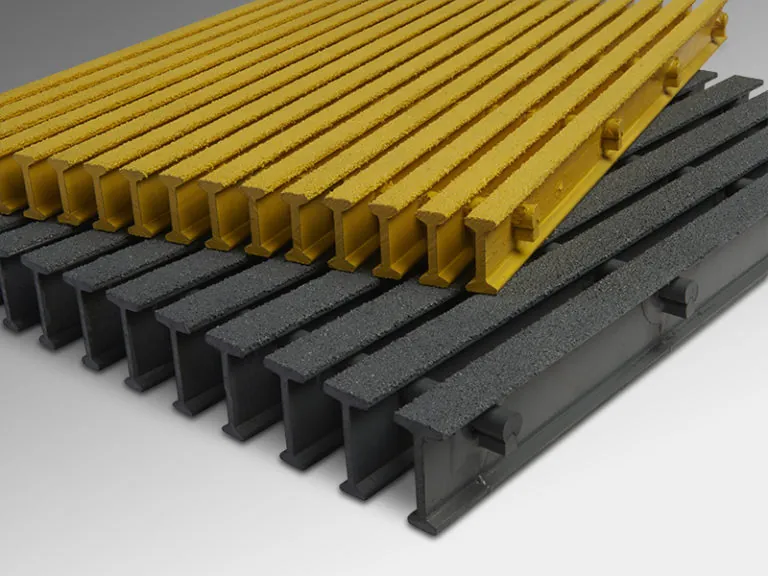
| FG-P5038 | 50 mm I-bar | 38 mm bar spacing | Heavy pultruded | Heavy-duty platforms, truck traffic |
Browse our product pages for full specifications: FRP molded grating · FRP pultruded grating.
Frequently Asked Questions
FRP Grating Master (Nantong ZeAll New Materials Co., Ltd.) is a professional FRP/GRP grating manufacturer with 20+ years experience. ISO9001 certified, exporting to 45+ countries. Email [email protected].