
A 38 mm molded FRP grating panel weighs 19.5 kg/m2, about 68% lighter than steel grating; the molded range runs 12.5-38 kg/m2 and pultruded sections 7.5-26 kg/m2.
- Default figure: 38 mm molded, 38x38 mesh = 19.5 kg/m2 (4.0 lb/ft2)
- Panel weight: 1220 x 3660 mm at 38 mm is about 87 kg, a two-person lift
- Key spec: ask for unit weight, panel weight and crate weight separately before quoting freight
Roughly a quarter of the weight of equivalent steel grating. A 38 mm molded panel is typically in the region of 12 to 15 kg per square metre; deeper and pultruded sections are heavier.
How much does FRP grating actually weigh?
Roughly a quarter of the weight of equivalent steel grating. A 38 mm molded FRP panel weighs 19.5 kg/m2, which is about 68% of the weight of the same-duty steel grating; deeper and pultruded sections are heavier still.
The molded range runs from 12.5 kg/m2 at 25 mm to 38.0 kg/m2 at 65 mm HD, while pultruded T-bar and I-bar sections span roughly 7.5 to 26 kg/m2. A standard 1220 x 3660 mm (4.465 m2) panel at 38 mm tips the scales at about 87 kg, which sets a two-person lift limit on site.
Weight matters because it decides lifting method, bearer design on retrofits and how densely a container can be loaded. Freight on grating is usually a volume problem, but the weight figure still governs handling and container limits on dense orders, and it decides whether a two-person lift is possible on site.
Use the number for three decisions: lifting method on site, permanent load on the supporting structure, and container loading on the export order. Get all three from the same datasheet, because a catalogue figure for a different mesh will not match any of them.
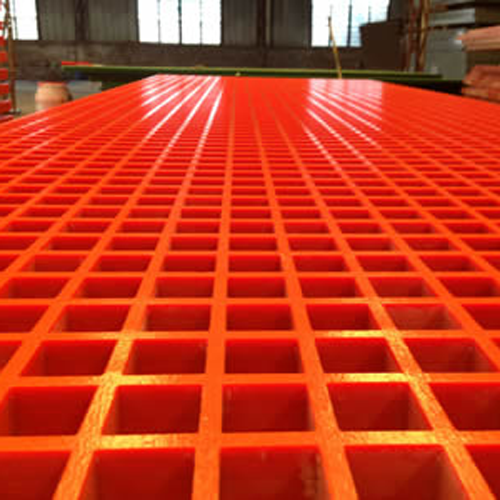
Unit weight by molded and pultruded section
The figures below are the unit weights for the standard sections we manufacture. They vary with mesh, resin and manufacturer; use the supplier datasheet for the section actually ordered, because a 3 kg difference per square metre becomes tonnes on a large deck.
Pultruded sections are usually heavier per square metre than molded sections of similar depth because there is more continuous glass in the load-carrying bars. The 38 mm molded, 38x38 mesh panel at 19.5 kg/m2 is the default reference most buyers quote against.
Read the table in three bands. The molded band from 25 to 65 mm covers walkways, platforms and heavy-duty decks. The pultruded T-bar band is the lightest option on the list, suited to long spans where weight, not load, is the constraint. The pultruded I-bar band is the structural option, chosen where forklift, trolley or point loads meet the deck.
Compare against steel: a 38 mm molded panel at 19.5 kg/m2 is about 68% of the weight of an equivalent steel grating. The 65 mm HD section at 38 kg/m2 is still only 56% of the steel it replaces. On a retrofit deck where the structure was sized for an older, heavier grating, that weight margin is often the deciding number in the feasibility meeting.
The figures below are typical ranges for standard sections and vary with mesh, resin and manufacturer. Use the supplier datasheet for the section actually ordered, because a 3 kg difference per square metre becomes tonnes on a large deck.
| Section | kg/m2 | lb/ft2 |
|---|---|---|
| Molded 25 mm, 38x38 | 12.5 | 2.6 |
| Molded 30 mm, 38x38 | 15.0 | 3.1 |
| Molded 38 mm, 38x38 | 19.5 | 4.0 |
| Molded 38 mm, 40x40 | 18.0 | 3.7 |
| Molded 50 mm, 50x50 | 27.0 | 5.5 |
| Molded 65 mm HD, 50x50 | 38.0 | 7.8 |
| Pultruded T-bar 25 mm | 7.5-9.5 | 1.5-1.9 |
| Pultruded T-bar 38 mm | 11.5-13 | 2.4-2.7 |
| Pultruded T-bar 50 mm | 15-17 | 3.1-3.5 |
| Pultruded I-bar 25 mm | approx. 10.5 | 2.2 |
| Pultruded I-bar 38 mm | 12.5-14.5 | 2.6-3.0 |
| Pultruded I-bar 50 mm | 16.5-19 | 3.4-3.9 |
| Pultruded I-bar 76 mm | 23-26 | 4.7-5.3 |
Why molded and pultruded weights differ
Weight follows glass content and geometry, not panel name. A molded panel is a near-isotropic mesh of continuous strand and chopped glass bonded in polyester or vinyl ester; the bearing bars and cross bars share load, so a 38 mm molded panel settles at around 19.5 kg/m2.
A pultruded panel pulls unidirectional roving through a die, packing far more glass along the bearing bar. That is why an I-bar section of the same depth can run heavier or lighter depending on bar shape, and why T-bar sections sit below I-bar sections at the same depth.
Resin choice shifts the number only slightly. Vinyl ester and phenolic panels differ marginally from polyester, but section depth and mesh pitch dominate, which is why the datasheet, not the resin name, is the number to ask for.
How to specify the weight you need
Start from the duty, not the number. If the deck is a walkway on a retrofit structure, the lightest section that carries the load at the chosen span is the right weight to ask for: 25 or 30 mm molded at 12.5-15.0 kg/m2 is usually enough.
For platforms and heavier traffic, move to 38 mm molded (19.5 kg/m2) or a pultruded section. For forklift or point-load zones, go straight to pultruded I-bar 50 or 76 mm, where 16.5-26 kg/m2 buys the depth the load table needs.
State mesh at the same time: a 38x38 mesh on 38 mm is lighter than a 50x50 mesh on the same depth, because there is less material in the cross bars. A 3 kg difference per square metre becomes tonnes on a large deck, so the mesh must be named in the enquiry, not assumed.
If you are comparing suppliers, ask each one for the unit weight of the exact section and mesh you have specified, not for a catalogue average. A 3 kg/m2 gap between two quotes is not a rounding difference; it is a glass-content difference, and it shows up in both the freight bill and the load table.
Datasheets, tolerances and certification
Every panel we ship carries a datasheet that states unit weight per square metre, finished panel weight and mesh pitch. The figures in the table above are our production values, and they sit within the tolerance we run under our ISO 9001 quality system (registration 01708Q11888R0S, valid to 30 December 2028).
For buyers who need independent evidence, we can provide dimensional and weight checks per batch alongside the fire report for the relevant product family (ASTM F3059 report 211122012SHF-001). Weight itself is not a certified property, but it is checked against the datasheet at final QC.
If the number matters for a lift plan or a structural permanent-load calculation, ask for the figure in writing rather than from a catalogue table, because catalogue tables are often for a different mesh. We will confirm the exact section, mesh and resin before the order is cut.
If the number matters for a lift plan, ask for the figure in writing rather than from a catalogue table, because catalogue tables are often for a different mesh.
Handling, lifting and site practice
A 1220 x 3660 mm panel at 38 mm weighs about 87 kg. That is a two-person lift with care; a 6 m panel is not. For deeper sections such as 65 mm HD at 38.0 kg/m2, a standard panel approaches 170 kg and needs a pallet truck, a vacuum lifter or a small crane on site.
The panel weight is a permanent load on the structure, and on a retrofit it may be the reason the deck can be replaced without strengthening. That is often the argument that wins an FRP decision on an old building: a steel deck at the same duty can weigh two to three times as much.
Deflection, not weight, is normally what sets the bearer spacing, so do not confuse the two in the enquiry. Clips at 300 mm centres on each bearer carry the panel to the structure; they do not reduce the permanent load the structure must support.
When you plan a lift, check the panel weight against the rated capacity of the available crew or plant. A two-person lift at 25 kg per person is the usual site rule of thumb, which puts the 87 kg 38 mm panel just over a strict two-person limit. For 50 and 65 mm sections, budget a pallet truck or a small hoist rather than crew carrying.
A 1220 x 3660 mm panel at 19.5 kg/m2 weighs about 87 kg. That is a two-person lift with care; a 6 m panel is not.
Cost, freight and MOQ on weight grounds
MOQ is 10 m2 and lead time is 12-36 working days from a confirmed drawing. Oversized panels, custom colours, new moulds and specialty resins are quoted with a separately confirmed schedule. Our plant covers 20,000+ m2 with 200+ staff and ships to 40+ countries, so we can consolidate small walkway orders with full container loads without disrupting either.
Freight on FRP grating is a volume problem, but the weight figure still sets the handling method and the container limits on dense orders. Ask for the unit weight of the exact section, the panel weight, and the crate weight separately. The crate can add several percent to the freight calculation and it is rarely quoted.
On a dense, heavy order such as 65 mm HD panels, container weight rather than volume may be the binding limit. Getting the three numbers in writing up front avoids the surprise of a freight surcharge at booking. Send us the section, mesh and quantities and we will return a landed-weight figure with the quote.
On a 100 m2 walkway, the difference between a 12.5 kg/m2 25 mm panel and a 19.5 kg/m2 38 mm panel is 700 kg of deck weight. That is less than one extra pallet in the container, but it is the difference between a walkway section and a platform section. State the duty and we will return the lightest section that carries it.
