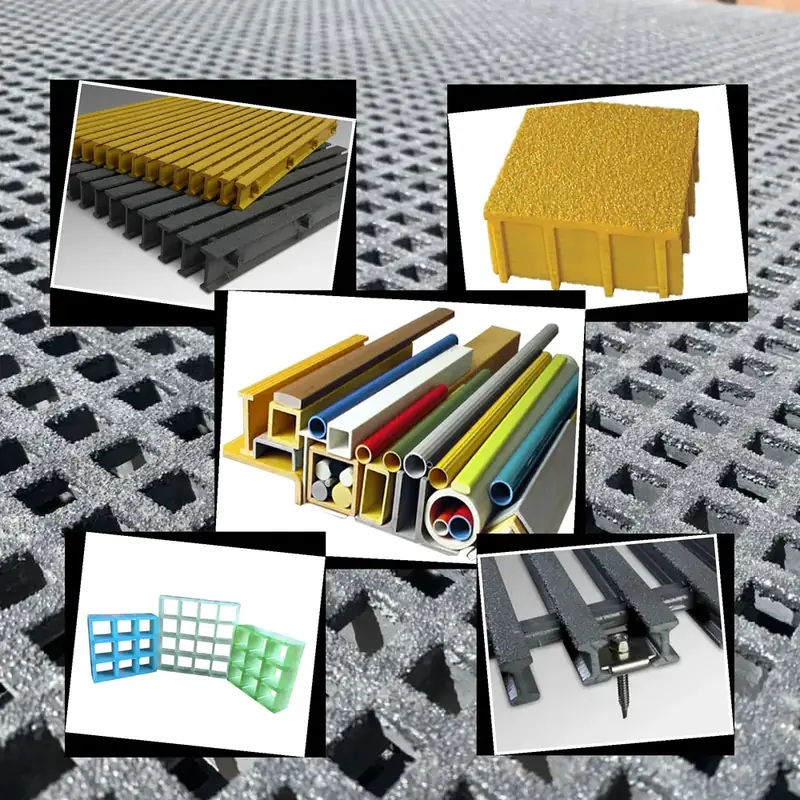
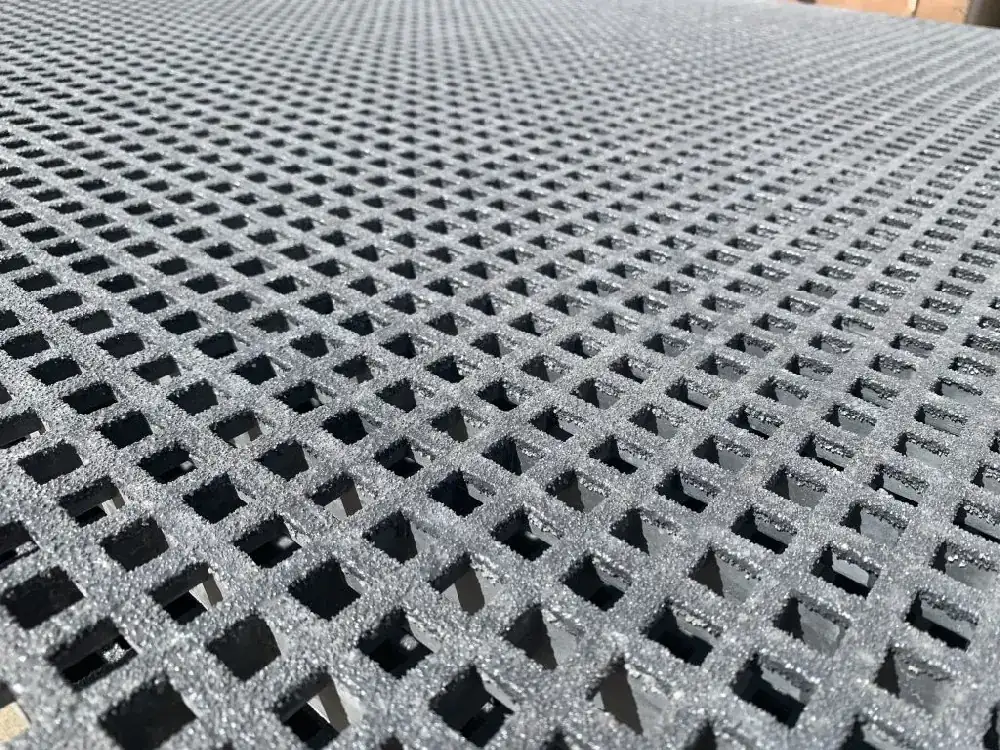
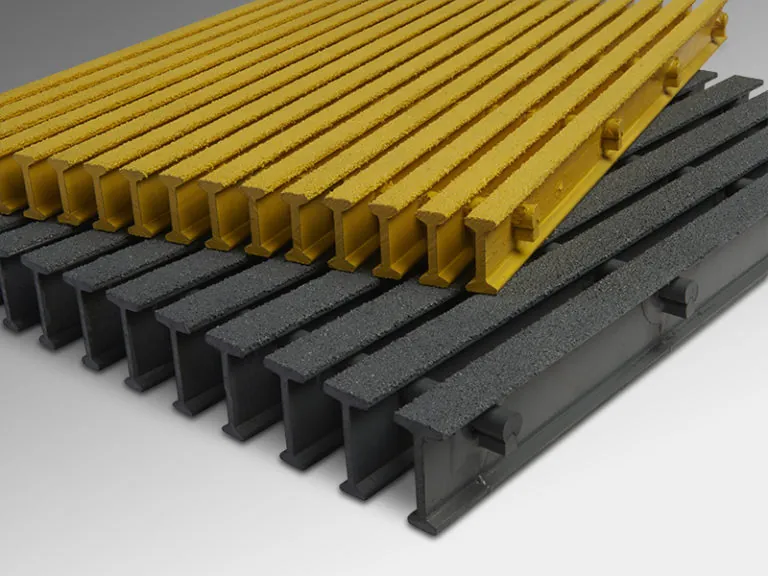
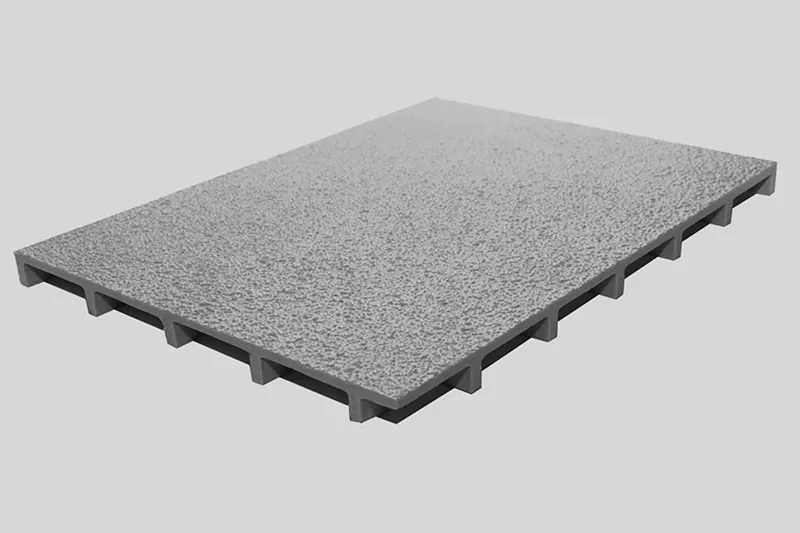
ASTM F3059 is the ASTM standard that covers fiberglass-reinforced plastic grating used for walking surfaces. It defines minimum performance for slip resistance, surface durability, fire response and structural adequacy — not a single product spec.
- Scope: pultruded and molded FRP/GRP grating intended for pedestrian traffic.
- Slip resistance: wet and dry coefficient of friction measured per ASTM F1679 or equivalent.
- Surface durability: Barcol hardness ≥40 after accelerated weathering cycles.
- Fire response: reference to ASTM E84 surface burning characteristics, not a standalone fire rating.
- Structural: load tables must be calculated at the project deflection limit (L/200 or L/360).
ASTM F3059 for FRP Grating Pedestrian Surfaces
When a spec engineer writes 'FRP grating shall comply with ASTM F3059', what are they actually asking for? This guide decodes the standard section by section, with the test numbers Zeall records on its own production panels. Our internal production test report reference for grating is 211122012SHF-001 — used for grating surface and mechanical tests only.
What ASTM F3059 Covers (and What It Does Not)
F3059 is a performance-based standard. It does not tell the factory which resin to use or which mesh to mold. It tells the buyer what the delivered panel must be able to do.
| Topic | F3059 requirement | How it is tested |
|---|---|---|
| Pedestrian use only | Rating applies to walking surfaces | Load tables exclude vehicular traffic |
| Slip resistance | CoF wet and dry | ASTM F1679 or equivalent ramp test |
| Surface hardness | Barcol ≥40 after weathering | Barcol impressor on cut panel |
| Fire response | Reference to ASTM E84 | E84 test report from resin supplier |
| Structural adequacy | Load at specified deflection | Third-party or mill test calculation |
Note: F3059 is not a product certification. A factory cannot be 'F3059 certified' — it can supply panels that meet the F3059 performance thresholds.
Slip Resistance Testing
Slip resistance is the most-tested property on a walkway grating. The standard expects both dry and wet coefficient of friction (CoF) to be measured, because most slip incidents happen on wet surfaces.
| Surface type | Dry CoF | Wet CoF | Best for |
|---|---|---|---|
| Smooth grit top | 0.6 – 0.8 | 0.4 – 0.6 | Dry industrial floors |
| Concave (serrated) | 0.5 – 0.7 | 0.35 – 0.55 | Wet walkways, food plants |
| Grit-coated (silica) | 0.7 – 0.9 | 0.5 – 0.7 | Chemical plants, offshore |
| Micro mesh | 0.6 – 0.8 | 0.45 – 0.65 | Barefoot areas, pools |
See the anti-slip surface guide for how surface finish changes CoF across a 12-month weathering cycle.
Surface Durability and Barcol
F3059 expects the surface to survive UV and moisture cycling without chalking or crazing beyond a defined limit. The Barcol hardness test is the field check — a quick, non-destructive way to confirm the resin has cured properly.
| Barcol reading | Interpretation | Action |
|---|---|---|
| ≥ 45 | Well-cured, dense | Accept |
| 40 – 44 | Acceptable | Accept with record |
| 35 – 39 | Marginal, possibly under-cured | Reject or retest |
| < 35 | Under-cured resin | Reject batch |
See the dedicated guide on Barcol hardness testing for the full procedure and what a passing Barcol actually tells you about the laminate.
Fire Response References
F3059 does not itself set a fire rating. It references ASTM E84 (surface burning characteristics) and expects the buyer to specify the required class (A, B or C) separately.
| E84 class | Flame spread index | Smoke developed index | Typical use |
|---|---|---|---|
| Class A | ≤ 25 | ≤ 450 | Public buildings, enclosed spaces |
| Class B | ≤ 75 | ≤ 450 | Industrial plants, corridors |
| Class C | ≤ 200 | ≤ 450 | Outdoor, open structures |
Note: FRP/GRP grating is typically Class B out of the box with standard isophthalic resin. Class A requires vinylester or phenolic resin and must be confirmed with the resin supplier's E84 report.
How to Specify F3059 on an RFQ
Writing 'comply with F3059' on an RFQ is not enough. You must specify the sub-items you care about.
| RFQ clause | What to write | Why |
|---|---|---|
| Standard | 'Grating shall meet ASTM F3059 pedestrian grating requirements' | Sets the baseline |
| Slip | 'Wet CoF ≥ 0.5, tested per ASTM F1679' | Clarifies the threshold |
| Barcol | 'Barcol ≥ 40, mill test report required' | Receiving inspection |
| Fire | 'ASTM E84 Class B minimum' | Clarifies the fire class |
| Load | 'Load at L/200 deflection, span ___ mm' | Structural adequacy |
Standard panel size 1220×3660 mm. MOQ 10 m². Lead time 12–36 working days depending on resin and surface.
Common Misconceptions
- 'F3059 certified' is meaningless. The standard does not certify factories or products — it sets performance thresholds.
- F3059 is not a fire rating. You still need E84 or the local building code requirement.
- Wet CoF matters more than dry CoF. Most slip incidents happen when the surface is wet.
- Barcol is not a strength test. It confirms cure, not load capacity.
- Third-party reports matter. Ask for the resin supplier's E84, not the fabricator's self-declaration.
Our Internal Test Record
For grating surface and mechanical tests, Zeall uses internal production test report reference 211122012SHF-001. This record covers Barcol hardness, flexural strength and slip resistance on molded and pultruded panels. It is a factory production record, not a third-party certification.
| Test | Method | Typical result on m38 panel |
|---|---|---|
| Barcol hardness | Barcol impressor | 42 – 48 |
| Wet CoF | Ramp, grit top | 0.55 – 0.65 |
| Flexural strength | 3-point bend | 180 – 240 MPa |
| Density | Cut section | 1.6 – 1.8 g/cm³ |
Next Steps
Send us your project conditions (wet/dry, indoor/outdoor, chemical list, required E84 class). We will return a surface recommendation and the relevant test record excerpt.
| Parameter | Value | Unit |
|---|---|---|
| Standard panel size | 1220 × 3660 | mm |
| Bar depths available | 25 / 30 / 38 / 50 | mm |
| Density range | 1.5 – 2.0 | g/cm³ |
| Barcol hardness minimum | 40 | — |
| MOQ | 10 | m² |
| Lead time | 12 – 36 | working days |
| Conversion | Factor | Example |
|---|---|---|
| 1 kg/m² to lb/ft² | × 0.2048 | 19.5 kg/m² = 4.0 lb/ft² |
| 1 mm to inch | ÷ 25.4 | 38 mm ≈ 1.5 inch |
| 1 kN/m² to psf | × 20.885 | 25 kN/m² ≈ 522 psf |
| QC Check | Method | Acceptance |
|---|---|---|
| Barcol hardness | Barcol impressor | ≥ 40 across panel |
| Resin content | Burn-off / Ash | 25 – 35 % by weight |
| Density | Cut section | 1.5 – 2.0 g/cm³ |
| Dimensions | Tape measure | ± 3 mm on panel |
| Item | Standard | Note |
|---|---|---|
| Panel thicknesses | 25 / 30 / 38 / 50 mm | Molded and pultruded |
| Standard width | 1220 mm | Other widths by order |
| Standard length | 3660 mm | Cut pieces available |
| Surface finishes | Smooth / concave / grit | Grit adds ~0.5 kg/m² |
| Resin options | Ortho / Iso / VE / Phenolic | VE for strong acids |
Frequently Asked Questions
Is ASTM F3059 a mandatory certification?
No. It is a performance standard. Specifiers write it into project documents as a minimum performance requirement; it is not a product certification issued by a body.
What Barcol hardness does F3059 expect?
Barcol ≥40 on the surface after weathering. Below 38 the resin is likely under-cured and the surface will chalk within a few years.
Does F3059 set a fire rating?
No. It references ASTM E84. The buyer must specify the required class (A/B/C) separately based on the local building code.
Can I get an F3059 certificate for my project?
You receive a mill test report showing the panel's Barcol, CoF and load results against the F3059 thresholds. There is no 'F3059 certificate' from a third party.
What is the lead time for F3059-compliant panels?
Standard 12–36 working days depending on resin (ortho/iso/VE/phenolic) and surface finish. MOQ is 10 m².