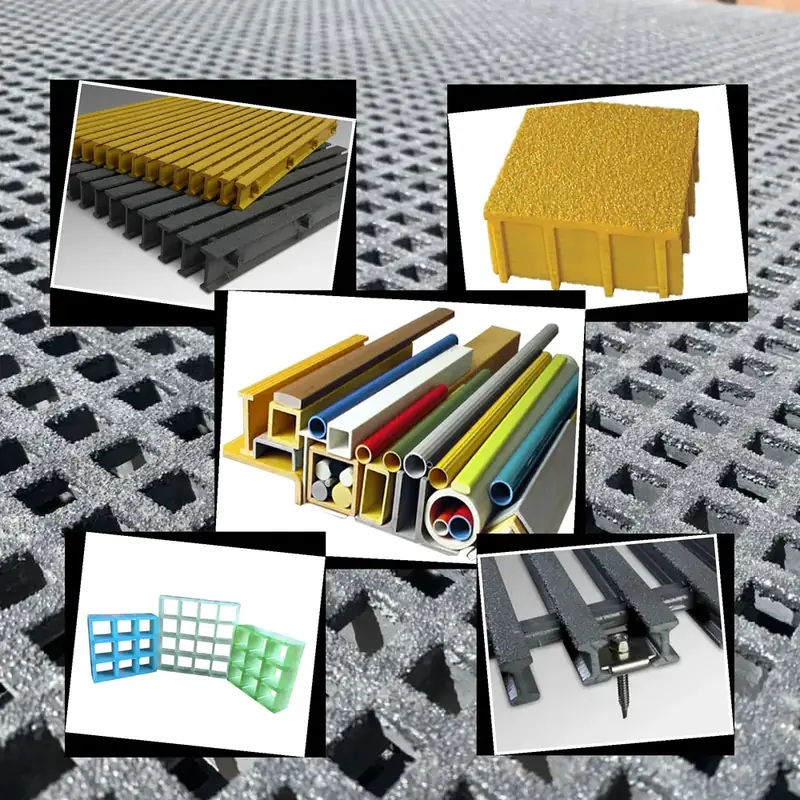
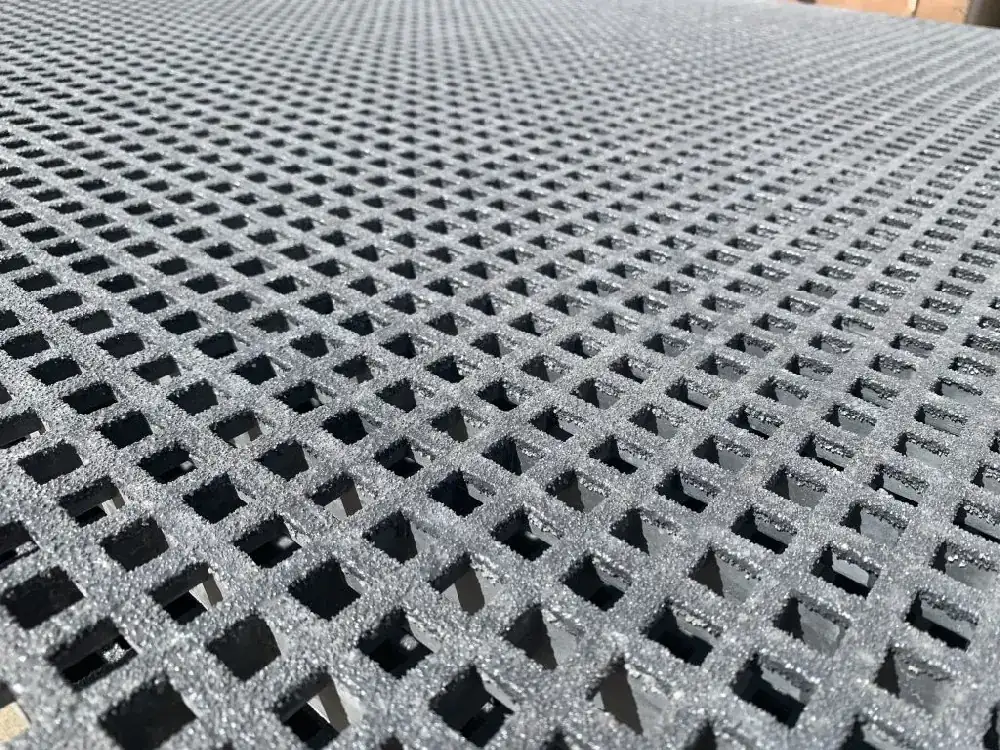
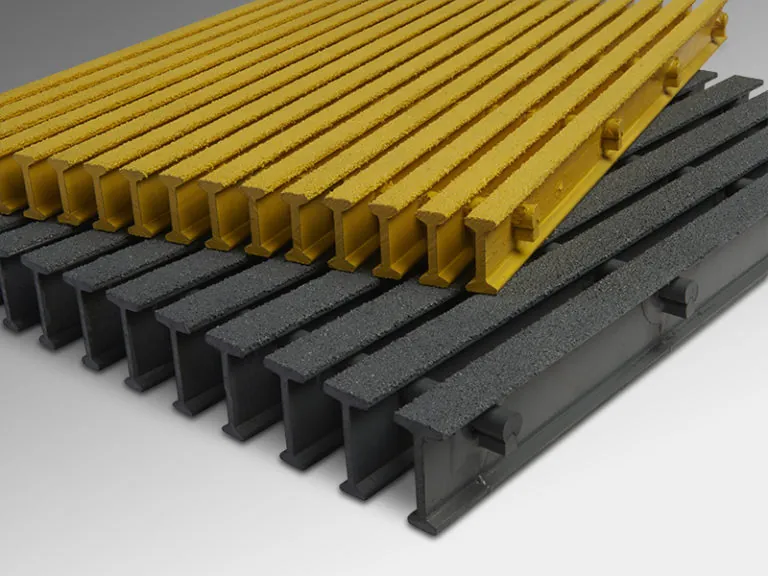
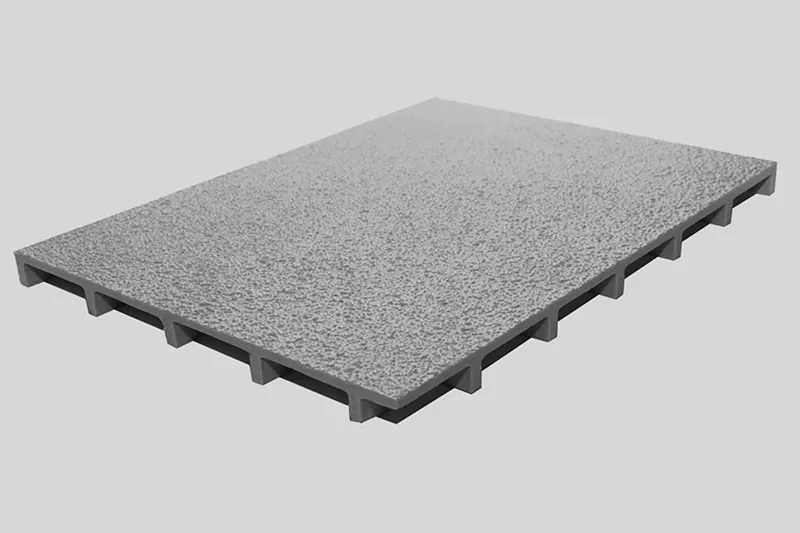
FRP/GRP grating is a standard decking choice for docks, pontoons and marina walkways because it does not corrode in salt spray and stays light underfoot. The design calls for the right resin (vinyl ester for prolonged splash), a grit or concave anti-slip surface for wet feet, a panel joint that drains freely, and stainless fixings rated for the marine atmosphere. Floating docks need extra clearance for water movement; gangways and boarding ladders need a slip-rated surface under wet conditions.
- Resin: vinyl ester for prolonged splash and immersion; isophthalic polyester for covered or low-splash walkways
- Surface: grit top or concave profile for wet-foot slip resistance; confirm the slip rating per project
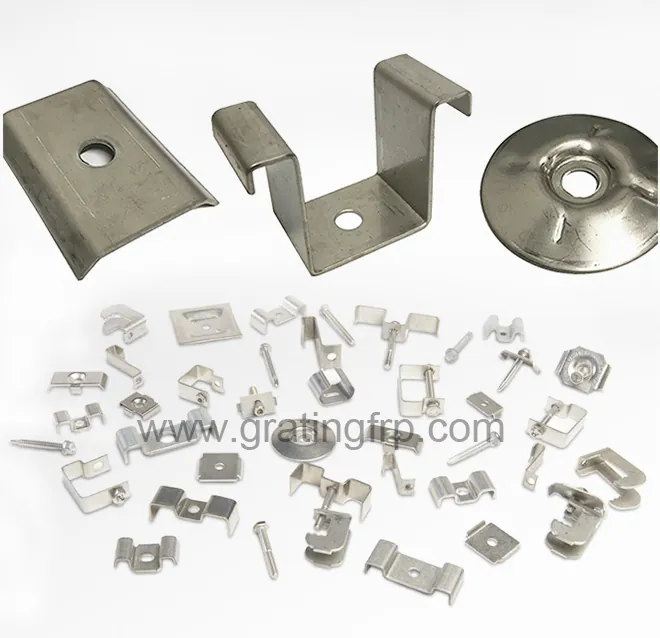
- Joints: leave drainage gaps between panels; clip with marine-grade stainless (SS316 preferred)
- Floating dock: account for tide heave, water movement and flex; do not fix panels rigidly to a moving pontoon
Why FRP grating fits docks and marinas
Wooden dock planks rot in the marine atmosphere; steel decks corrode; aluminum is slippery and conducts. FRP/GRP grating addresses all three: it does not rot, does not rust, is non-conductive, and a grit or concave walking surface stays underfoot when wet. It is also light enough to lift by hand for occasional deck removal, which matters on pontoons and emergency access routes.
| Deck material | Marine atmosphere | Wet slip | Deck removal | Typical maintenance |
|---|---|---|---|---|
| Softwood plank | Rot, splinters, fastener pull-out | Slippery when wet | Heavy, warped | Yearly sealing, replacement |
| Steel bar grating | Corrosion at cut edges | Slippery when wet | Heavy | Galvanize or paint, recoat |
| Aluminum deck | Galvanic risk in tidal water | Very slippery wet | Light | Drainage and anodic check |
| FRP/GRP grating | No corrosion, no rot | Grit top available | Hand-liftable panels | Rinse, inspect clips annually |
Note: This guide covers dock and marina decking. It is not an offshore platform specification; offshore wind and oil-and-gas platforms use a separate, heavier engineering envelope.
Tide range and the splash zone
A dock deck sits in three vertical zones: the permanently submerged structure, the splash and tidal wetting band, and the dry walkway above high water. FRP grating deck panels belong in the upper two zones; the submerged structure is a separate engineering scope. The critical design question is how high the splash band reaches, because that decides where the more resistant resin is specified.
| Vertical zone | Condition | Resin guidance | Fixing guidance |
|---|---|---|---|
| Above high water, dry walkway | Sea spray only | Isophthalic polyester often adequate | Marine-grade stainless clips |
| Splash / tidal wetting band | Wet most of the tide cycle | Vinyl ester preferred | SS316 clips, inspect yearly |
| Boarding ladder lower rungs | Wet and abraded by boat fenders | Vinyl ester, grit surface | SS316, check for impact damage |
| Permanently submerged structure | Immersed | Separate scope, not deck grating | Per marine engineer |
The exact tide range and splash height are site-specific. Confirm them against the local tide table and a site visit rather than against a generic value. A dock on a protected marina differs from one on an exposed open-coast pontoon.
Resin choice under salt spray and immersion
Resin choice on a dock is not cosmetic. Orthophthalic polyester is fine for a covered, low-splash walkway. Isophthalic polyester handles general marine spray. Vinyl ester is the default for the splash band, boarding ladders and any panel that sees repeated wetting. Phenolic is reserved for fire-route decks where low smoke is a project requirement.
| Resin system | Marine use | Expected strength | When to choose it |
|---|---|---|---|
| Orthophthalic polyester | Covered, low-spray walkway | General | Indoor or fully sheltered pier |
| Isophthalic polyester | Open marina deck above high water | Good spray resistance | Standard pontoon walkway |
| Vinyl ester | Splash band, boarding ladder | Strong wetting and chemical resistance | Tidal wetting, exposed coast |
| Phenolic | Fire-route deck | Fire performance, low smoke | Emergency egress route requirement |
Cut edges on a dock panel are exposed to salt and should be sealed per the resin supplier's instruction. Unsealed cut edges are the most common failure point on an otherwise well-specified marine deck.
Slip resistance for wet feet and boarding
Marina decking is walked on by people in deck shoes, boat boots and bare feet, often wet. A smooth resin surface is the wrong default. The two standard anti-slip options are a gritted top and a concave (dimpled) surface. The gritted top carries the highest friction under wet conditions; the concave profile drains well and is easier to hose clean.
| Surface | Wet performance | Cleaning | Where it fits |
|---|---|---|---|
| Smooth resin top | Low when wet | Easy | Not recommended for open deck |
| Concave / dimpled | Good, drains well | Hose clean | General marina walkway |
| Grit top | Highest wet friction | Brush, avoid pressure blast | Gangway, boarding ladder, egress |
| Covered / solid top | Good when new | Hose clean | Wheelchair or stroller route |
The numeric slip rating is set by the project spec and any local marina safety code; confirm it per project conditions rather than assuming a universal value. For boarding ladders and gangways, specify the highest available slip surface.
Panel joints, gaps and clip fixings
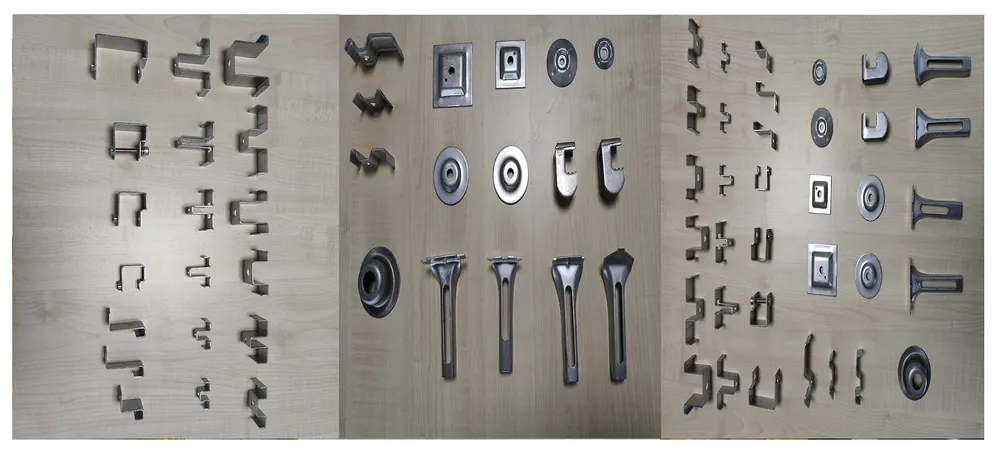
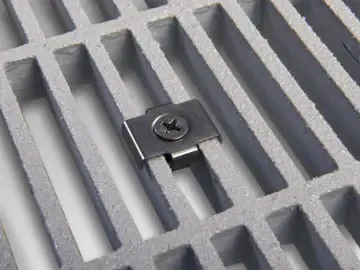
Dock panels must drain. A tight joint that traps seawater and debris shortens the life of both the panel and the bearer. Standard molded panels ship at 1220 by 3660 mm; cut to length on site with the correct safety gear. Fix panels with marine-grade stainless clips, not carbon-steel bolts, because the bolt itself is the part that will corrode first.
| Detail | Guidance | Why it matters |
|---|---|---|
| Joint gap | Leave drainage gap per detail drawing | Stops trapped water and debris |
| Clip type | M / C / L / Z clip per bearer layout | Holds panel without over-fastening |
| Clip material | SS316 preferred on exposed coast | Resists salt-spray corrosion |
| Cut edge | Seal per resin supplier instruction | Stops wicking at exposed roving |
| Bearer support | Confirm bearer spacing against load table | Prevents over-deflection under traffic |
Does FRP grating rust? The panel does not, but the clips and bolts do. On a dock, inspect the fixing set yearly rather than waiting for a deck failure. Stainless that looks fine in spring can show pitting by the next autumn on an exposed pontoon.
Floating dock and pontoon adaptation
A floating pontoon moves with the tide, swells and boat wake. A rigidly fixed grating panel will work loose or crack its clip holes under repeated flex. The deck on a floating dock needs to allow small movements, drain freely, and stay light enough not to add unnecessary buoyancy load.
| Floating dock detail | Guidance | Reason |
|---|---|---|
| Panel fixing | Do not over-fasten; allow minor flex | Prevents clip-hole cracking |
| Panel weight | Keep decking light; confirm panel weight | Buoyancy must carry the deck |
| Joint gap | Generous drainage gap | Water and spray must run off |
| Bearers | Mount to pontoon structure flexibly | Deck follows pontoon movement |
| Gangway hinge | Bridge fixed and floating sections with a hinge | Absorbs relative tide movement |
The exact bearing and fixing schedule for a floating pontoon is confirmed per the pontoon manufacturer and local marina code. Do not adapt a fixed-bridge detail directly onto a floating structure without that check.
Gangways and boarding access
The gangway and the boarding ladder are the highest-risk parts of any marina: wet, sloped, and used by people carrying bags or children. They deserve the best slip surface on the whole dock, clip fixings checked at every inspection, and a clear load assumption (pedestrian only, or plus trolley / wheelchair).
| Access element | Surface | Fixing | Inspection focus |
|---|---|---|---|
| Gangway deck | Grit top | SS316 clips | Clip tightness, grit wear |
| Boarding ladder rungs | Grit or concave | SS316 | Impact damage from fenders |
| Pontoon end apron | Grit top | SS316 | Wear at disembarkation point |
| Wheelchair ramp | Covered top where required | SS316 | Surface smoothness, edge trip |
Load assumptions for a gangway are pedestrian by default. If a service trolley or wheelchair is expected, confirm the span and panel bar size against the load table before ordering, rather than after the deck is laid.
Load, span and panel sizing for dock traffic
A marina walkway is pedestrian traffic. A service pier may see a cart, a battery trolley or a small service vehicle. The span and bar size are chosen from the load table for the expected load, not from a generic 'dock panel' assumption. Standard molded panels ship at 1220 by 3660 mm and are cut to the required walkway width.
| Traffic type | Typical use | Panel guidance | Span check |
|---|---|---|---|
| Pedestrian only | Fingers, pontoon, boarding | Standard molded, grit top | Per load table for foot traffic |
| Pedestrian + service cart | Maintenance pier | Heavier bar or pultruded | Confirm span against cart load |
| Emergency egress | Escape route | Grit top, resin per fire spec | Egress load per code |
| Wheelchair / stroller | Accessible route | Covered top option | Small mesh or solid cover |
Production lead time for dock panels is 12 to 36 working days depending on resin, mesh and destination. A production order typically starts at 10 m²; a small marina replacement order is confirmed per project conditions.
Maintenance and inspection on a working dock
FRP dock decking is low-maintenance, not no-maintenance. The yearly cycle is a rinse with fresh water, a clip-tightness walk, and a look at cut edges and grit wear. Winter in a freezing marina adds ice and de-icing salt to the inspection list.
| Task | Frequency | What to check |
|---|---|---|
| Freshwater rinse | Seasonally | Salt and debris off panel tops |
| Clip walk | Yearly | Loose, pitted or broken clips |
| Cut-edge check | Yearly | Wicking or fraying at cut edges |
| Grit wear | Yearly | Polished grit on gangway and boarding |
| Winter ice check | After freeze events | Impact cracks, de-icing salt residue |
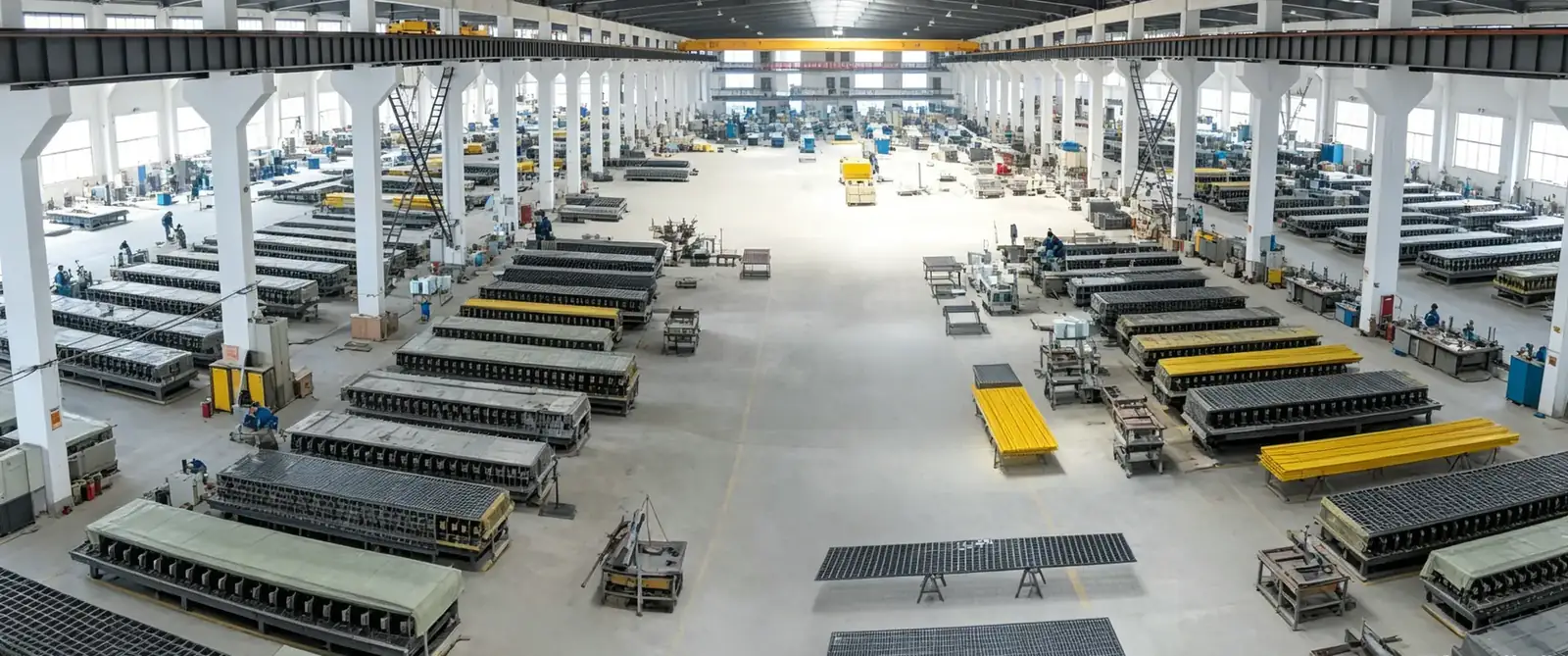
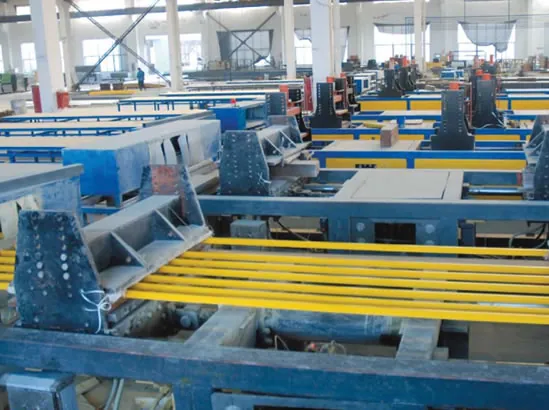
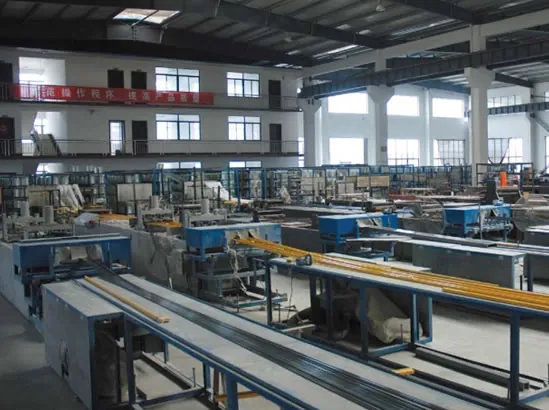
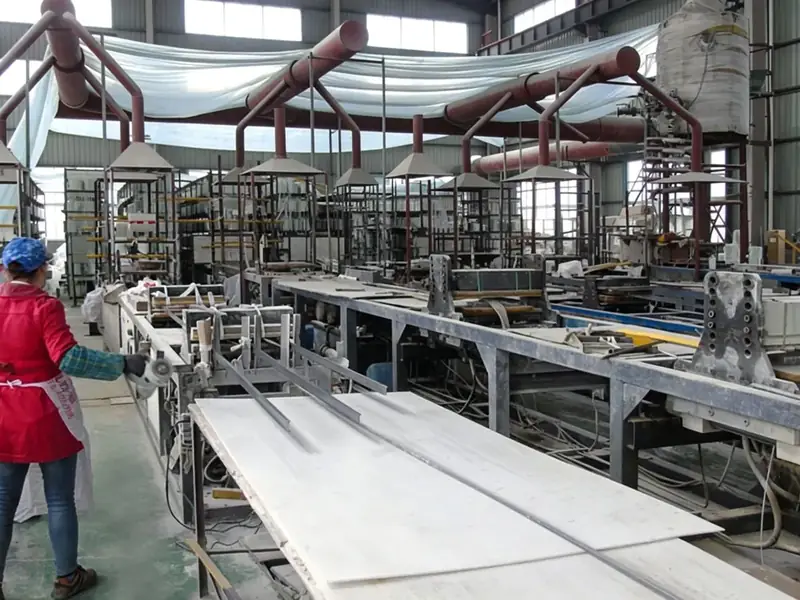
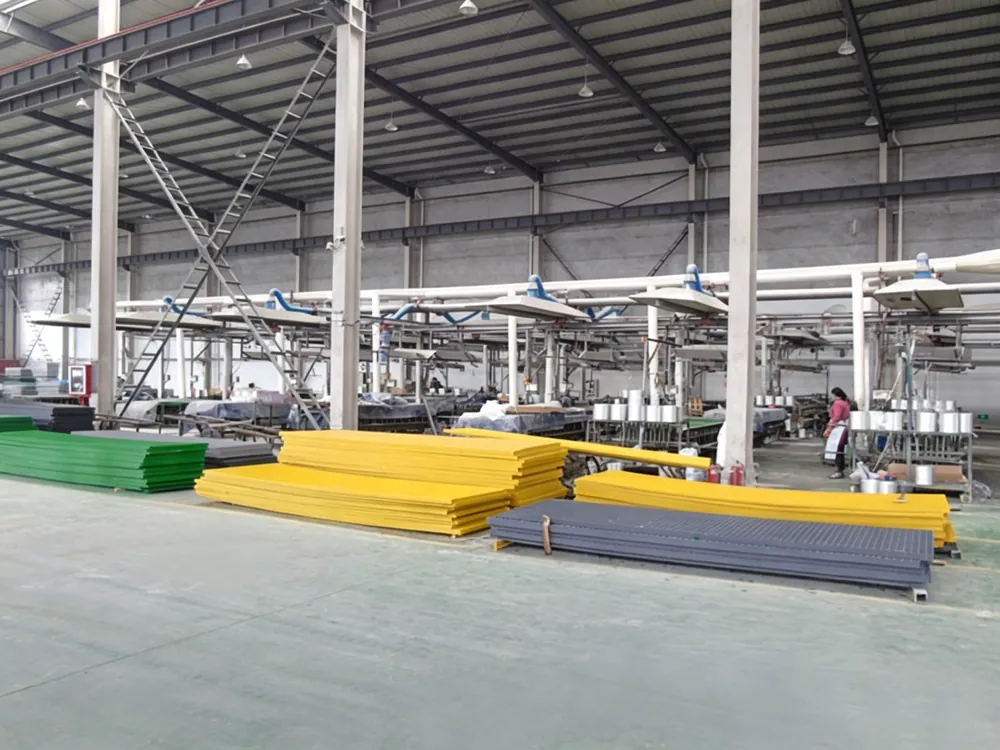
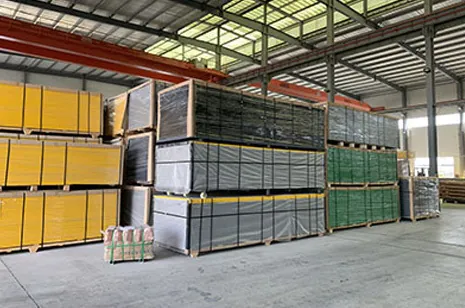
Our factory has run FRP and GRP grating since 2004, covers 20,000 plus square meters and employs more than 200 people. We supply dock and marina panels in molded and pultruded form, with vinyl ester resin available for the splash zone. Send the tide range, expected traffic and walkway width for a sizing recommendation.
Common dock-specification mistakes
Marina decking goes wrong in predictable ways: specifying smooth resin where feet will be wet, using carbon-steel clips on a salt pontoon, fixing floating-dock panels as if they were on a fixed bridge, and ignoring the boarding ladder which sees more wear than the main walkway.
- Do not specify smooth top for an open or gangway deck.
- Do not use carbon-steel clips on a marine pontoon.
- Do not transfer a fixed-bridge detail onto a floating dock.
- Do not forget to seal cut edges against wicking.
- Do not skip the slip rating check for the boarding ladder.
| Mistake | Consequence | Correct detail |
|---|---|---|
| Smooth top on open deck | Wet-foot slip hazard | Grit or concave surface |
| Carbon-steel clips | Corrosion, failed fixing | SS316 marine clips |
| Rigid fix on floating pontoon | Clip-hole cracking | Allow flex, hinged gangway |
| Unsealed cut edge | Salt wicking into roving | Seal per resin supplier |
| No slip check on ladder | Boarding falls | Grit top on rungs |
A dock deck that follows these points gives the marina owner a light, non-corroding, slip-resistant walking surface that lasts long after wooden planks and steel gratings have been replaced.
Frequently Asked Questions
What resin is best for FRP dock grating?
Vinyl ester is the default for the splash band, boarding ladders and exposed pontoons that see repeated wetting. Isophthalic polyester is adequate for a covered or low-splash walkway above high water. Confirm against the local tide range and exposure.
Is FRP grating slip-resistant when wet?
A smooth resin top is not. Specify a gritted top for gangways, boarding ladders and egress routes, or a concave dimpled surface for general walkways. The numeric slip rating is confirmed per project and local marina safety code.
Can FRP grating be used on floating docks?
Yes, but do not fix panels rigidly to a moving pontoon. Allow minor flex, leave generous drainage joints, keep decking light for buoyancy, and bridge fixed and floating sections with a hinged gangway.
Do the fixings corrode on a marine dock?
The FRP panel itself does not rust, but clips and bolts do. Use marine-grade stainless, preferably SS316 on an exposed coast, and walk the clip set at least once a year for pitting or looseness.
How long does dock grating take to produce?
Production lead time is 12 to 36 working days depending on resin, mesh and destination. A production order typically starts at 10 m²; a small marina replacement is confirmed per project conditions. Standard panels ship at 1220 by 3660 mm.