Anti-slip FRP grating uses embedded silica grit or concave-convex profiles to raise slip resistance; specify grit top when oil/water are present, because wet COF is the real safety number.
- Best for: walkways, platforms and mezzanines where workers carry loads in wet or oily areas
- Choose grit top for: high-slip zones; concave/convex for: dry process areas
- Key spec: grit top = 2–8 mm embedded silica, target wet COF > 0.5
Slip resistance, surface options and standards
1. Why Slip Resistance Matters on FRP Grating
Anti-slip FRP grating is specified wherever people walk on fiberglass platforms in wet, oily, icy or chemical-laden environments. Steel grating becomes dangerously slippery when wet or coated with oil, whereas anti-slip fiberglass grating is molded with a textured surface that maintains grip under almost every condition. Slip-and-fall accidents are among the most common causes of injury on industrial platforms, offshore decks, walkways and mezzanines, which is why specifying the correct anti-slip surface is a safety-critical decision, not just an aesthetic one.
2. Anti-Slip Surface Options: Grit Top vs Concave vs Smooth
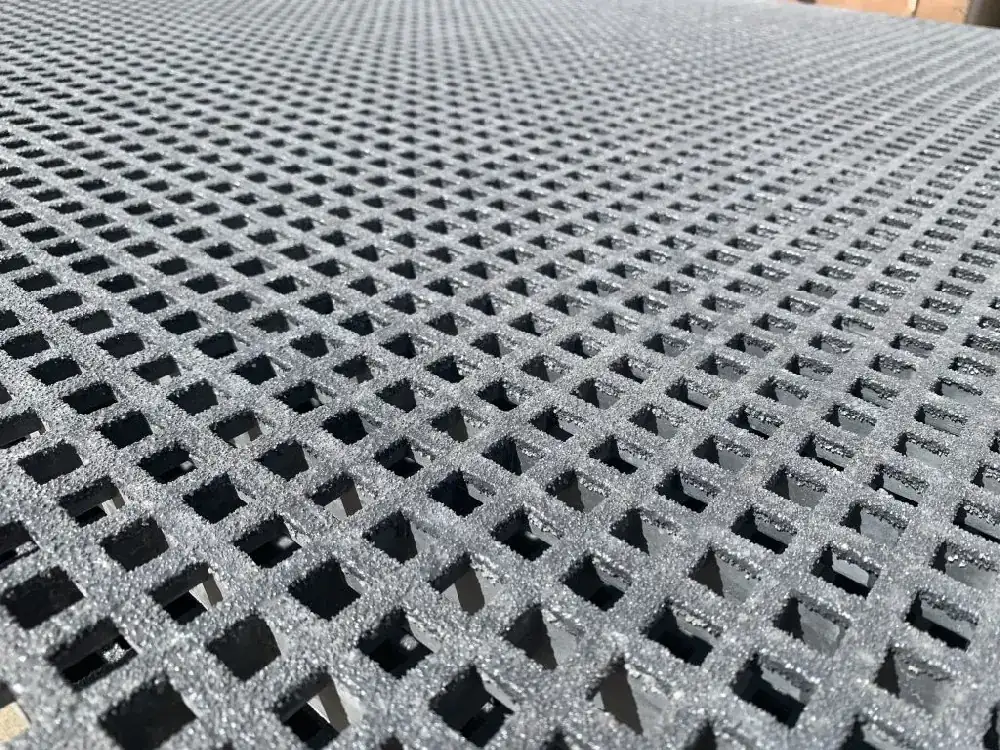
FRP grating is available in three main surface profiles. Grit top surface has angular quartz particles embedded into the resin during molding, giving the highest slip resistance and recommended for walkways, stair treads and areas regularly exposed to water or oil. Concave surface (also called dished or bucket-top) provides a shallow channel that drains liquids and offers moderate slip resistance, ideal for trench covers and drainage grating. Smooth surface is easiest to clean and best suited to pallet racking, platforms and areas where water does not pool. For the highest safety, grit top is the standard specification.
3. Slip Resistance Standards and Classifications
Slip resistance is classified internationally by ramp test standards such as DIN 51130 and AS/NZS 4586. Grit top molded FRP grating typically achieves R12 to R13 classification, meaning it is suitable for public stairways and pedestrian areas that remain safe when wet or greasy. In the UK and Australia, the pendulum test value (PTV) is used; high-performance anti-slip fiberglass grating commonly reaches PTV 36 and above, classed as very good. When specifying, request the slip-resistance class from the manufacturer and match it to the exposure conditions of your site.
Wet, oily and outdoor conditions
4. Wet and Oily Conditions: Choosing the Right Surface
In food processing, car washes, offshore platforms and chemical plants, floors are constantly wet or coated with oil and lubricants. Under these conditions a smooth FRP surface can become as slippery as steel. Grit top anti-slip grating, with its embedded quartz particles, breaks the film of water and oil and maintains friction. For extreme oil exposure, specify grit top with an isophthalic or vinyl ester resin that resists the specific chemicals present, and consider a tighter mesh (micro mesh) to further improve traction and prevent small tool drops.
5. Safety Benefits of Anti-Slip Fiberglass Grating
- Reduces slip-and-fall injuries on walkways, platforms and stair treads
- Non-conductive material prevents electrical shock near live equipment
- Corrosion-resistant surface survives wet, chemical and salt environments
- Textured surface keeps grip wet or dry, unlike smooth steel or plastic
- Low weight and one-piece construction speed up installation
Applications, specification and ordering
6. Applications Requiring Anti-Slip FRP Grating
- Industrial walkways and mezzanine platforms
- Offshore platforms and marine decks
- Car wash and vehicle service ramps
- Food and beverage processing floors
- Water and wastewater treatment plants
- Swimming pool surrounds and overflow gutters
- Stair treads, landings and access ramps
7. How to Specify and Buy Anti-Slip FRP Grating
ZEALL (ZeAllgrate) manufactures anti-slip fiberglass grating with grit top, concave and smooth surfaces, in polyester, isophthalic or vinyl ester resin. We supply standard panels and custom cut-to-size pieces with documented slip-resistance classes. Contact our engineering team with your application and exposure conditions to select the correct anti-slip surface and load rating.

