
Yes. Grit and concave surfaces are the slip-resistant options: grit-top panels reach the R12-R13 ramp classes used for wet, oily and marine decks, while smooth panels are for dry indoor areas only.
- Best for: wet walkways, stair treads, food plants, jetties
- Not for: smooth surface on any wet or oily deck
- Key spec: grit top, R12-R13, and correct nosing on stairs
It depends on the surface specified, not on the material. Concave is the standard walking surface, grit is the specification for wet, oily or icy decks, and smooth is for applications where nothing walks on it.
Is FRP grating slip-resistant?
It depends on the surface specified, not on the material. Grit and concave surfaces are the slip-resistant options: grit-top panels reach the R12-R13 ramp classes used for wet, oily and marine decks, while smooth panels are for dry indoor areas only. Concave is the standard walking surface, grit is the specification for wet, oily or icy decks, and smooth is for applications where nothing walks on it.
Concave surface has a shallow dish in each bar top that holds a little water away from the foot. It is the normal walkway finish and performs well in rain, sitting at R11-R12. Grit surface bonds abrasive particles into the resin and is the specification for ramps, washdown areas, jetties and any deck with oil, ice or frequent spillage, reaching R12-R13.
Smooth surface is used where the panel is a cover rather than a walking surface, or where cleaning is the priority and the traffic is light. It sits at R9-R10 and performs poorly when wet, so it should never be specified on an outdoor or washdown deck.
The material is not the slip variable; the surface is. Concave, grit and smooth are three different products in three different ramp classes, and specifying one on the wrong duty is a safety problem, not a preference. Name the surface on the order, and the safety file matches the panel on the deck.
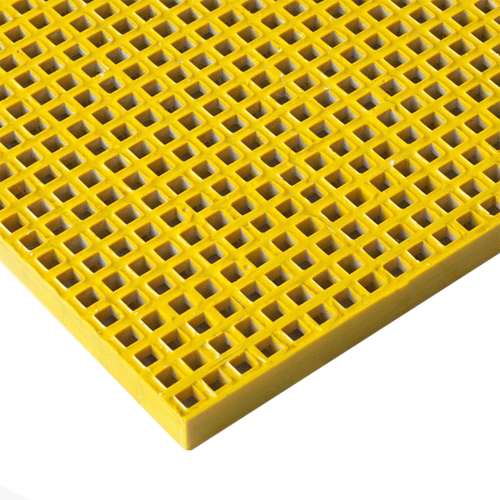
Surface types and ramp test classes
The table below matches each surface to its ramp test class, its wet-and-oily grip and the duty it is best for. Pick the surface by the film that will sit on the deck: water, oil, ice or nothing at all.
Covered or solid-top panels sit between open mesh and plate: R10-R11 with a grit top, good for trench covers and small openings where something must not fall through. They are not a substitute for open mesh on a walkway, because they do not drain the same way.
Read the table by the film that will sit on the deck. Smooth at R9-R10 is for dry indoor areas only, where nothing walks on it or where cleaning is the priority. Concave at R11-R12 is the general walkway finish, handling rain and normal foot traffic across industrial and municipal decks.
Grit top at R12-R13 is the wet, oily, food and marine option, where the abrasive aggregate interrupts the film between sole and bar. Covered or solid top at R10-R11 with grit is for trench covers and small openings where something must not fall through; it is not a substitute for open mesh on a walkway, because it does not drain the same way.
| Surface | Ramp test class | Wet and oily grip | Best for |
|---|---|---|---|
| Smooth | R9-R10 | Poor when wet | Dry indoor areas only |
| Concave | R11-R12 | Good | General walkways, stairs |
| Grit top | R12-R13 | Best | Wet, oily, food and marine decks |
| Covered / solid top | R10-R11 with grit | Good | Trench covers, small openings |
What actually causes slips on grating
Not the material, but the film between foot and bar: water on a smooth surface, oil on any surface, ice, and fine grit or product spillage. Grit surface interrupts that film; concave only manages water. The abrasive aggregate bonded into the bar top gives the sole something to bite into through the film.
The second cause is geometry. A bar pitch that is too open for the shoe size, or a deck with an unexpected slope, sends the foot sideways. A 38 mm pitch is the usual walkway standard for that reason: it keeps the contact area large enough for a work boot and small enough that a high heel does not drop through.
On a slope the problem changes. Foot shear is higher and the consequences are worse, which is why ramps and stairs need more than grit: they need a nosing at the edge so the slope reads as a step change.
How to specify the slip-resistant surface
Start with the film. Dry indoor corridor or plant room: smooth is fine. General walkway, rain, normal traffic: concave. Wet, oily, food-grade, marine, jetty, cooling tower, washdown: grit top. Ramp or stair: grit top plus a visible nosing strip.
If the ramp is outdoors and subject to frost, state that in the enquiry. Some projects then move to a deeper grit or an additional aggregate specification, because ice on grit is still a slip hazard and the surface is the only line of defence between the foot and the bar.
Stair treads use a grit top with a contrasting nosing, usually yellow or black. The nosing is both a safety edge and a wear pad: it takes the toe scuffing that would otherwise polish the grit in the first metre of every flight.
On ramps and stairs, grit alone is not enough. Add a contrasting nosing at the edge, usually yellow or black, so the slope reads as a step change. The nosing is also a wear pad: it takes the toe scuffing that would otherwise polish the grit in the first metre of every flight. State the ramp angle in the enquiry, because some projects move to a deeper grit where the angle exceeds the usual walkway slope.
On a ramp, grit surface plus a nosing at the edge, and on stairs a stair tread with a grit top and a visible nosing strip. Slip resistance on a slope is not the same problem as on a level deck, because the foot shear is higher and the consequences are worse.
Ramp tests, standards and documentation
Slip resistance is measured by ramp test, reported as R9 to R13, where R13 is the highest grip class. Our concave panels sit at R11-R12 and grit-top panels at R12-R13 under the relevant ramp test method. The class is set by the surface, not by the resin, so the same numbers apply across isophthalic, vinyl ester and phenolic.
For offshore and marine projects we also supply the ASTM F3059 report (211122012SHF-001) covering the product family, and production runs under ISO 9001 registration 01708Q11888R0S (valid to 30 December 2028). The surface type and ramp class are recorded on the datasheet so the safety file matches the panel on the deck.
Where the deck is a safety-critical route, record the surface type and the installation date on the drawing so a replacement matches. A grit panel replaced years later with a concave panel on the same walkway is a slip-history waiting to happen.
Maintenance keeps the grip
Grit wears with heavy traffic and can polish under constant abrasion; a deck that was grippy when new becomes less so after years of foot traffic in an abrasive environment. Washdown areas accumulate product film that fills the surface texture, which is the most common reason a grit deck starts to slip.
Cleaning and periodic inspection are part of the slip performance, not an afterthought. Pressure-wash walkdown decks at the interval the product film builds up; brush food-plant surfaces with a mild detergent; inspect grit coverage on stair nosings every 12 months.
The grit is bonded into the resin rather than applied on top, so it wears gradually rather than peeling. Heavy abrasive traffic can polish it over years, at which point the panel is replaced rather than re-coated; surface is set during molding or pultrusion, so a retrofit is normally a panel replacement.
Washdown areas accumulate product film that fills the surface texture, which is the most common reason a grit deck starts to slip. Pressure-walk the deck at the interval the film builds up; brush food-plant surfaces with a mild detergent; inspect grit coverage on stair nosings every 12 months. Cleaning is part of the slip performance, not an afterthought.
Cost: surface is a small premium, a large saving
Grit top is a small premium over concave, and concave a small premium over smooth. Against the cost of a slip incident, a downtime shutdown or a compensation claim, the premium is trivial. MOQ is 10 m2 and lead time is 12-36 working days from a confirmed drawing, so even a small stair or ramp package runs through the same line as a full jetty deck. Oversized panels, custom colours, new moulds and specialty resins are quoted with a separately confirmed schedule.
Our plant is 20,000+ m2 with 200+ staff and 40+ export countries. Grit-top panels for food plants, marine jetties and chemical washdown areas ship on repeat programs, with the grit coverage checked at final QC and recorded on the packing list.
When you compare quotes, compare surface, ramp class and nosing together. A smooth quote at half the price is not the same product on a wet deck. Send us the exposure, the slope and the traffic and we will return the surface, the class and the nosing detail that match the safety case.
Grit top is a small premium over concave, and concave a small premium over smooth. Against the cost of a slip incident, a downtime shutdown or a compensation claim, the premium is trivial. On a food plant or a marine jetty, the safety case writes the surface specification; the price difference is rounding in the budget.
