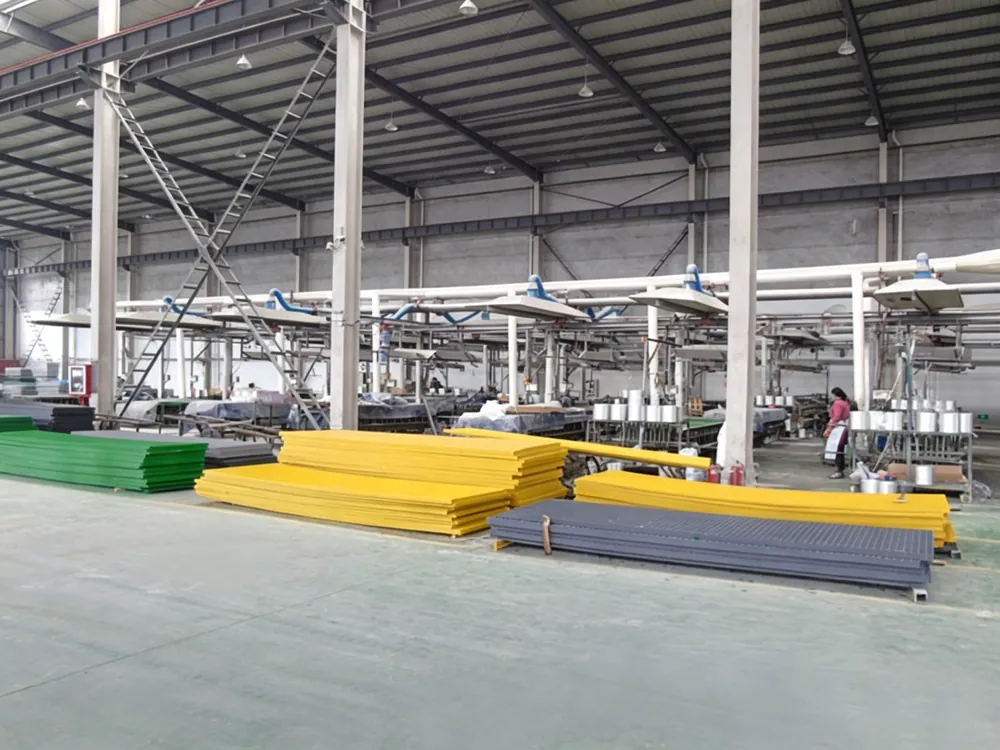
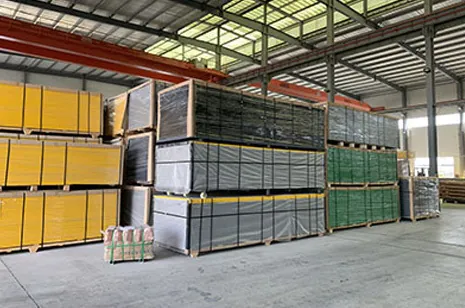
Pultruded grating quality is set on the line, not in the catalog. Resin bath viscosity, preforming convergence, die-zone temperatures and pull speed together decide cure conversion, void content and final Barcol hardness. When any one drifts, the profile looks right but fails load or chemical testing. This page is about the control loop and the defect-to-cause logic, not the product spec.
- Resin bath: viscosity and temperature are held inside a narrow band for wet-out.
- Preforming: rovings converge before the die to avoid dry spots and wash.
- Die zones: entry, center and exit temperatures drive gel and cure separately.
- Pull speed: too high under-cures; too low burns resin and swells the profile.
- Online QC: Barcol, dimensions and wet-out are checked each shift.
Why Line Control Is a Process Problem
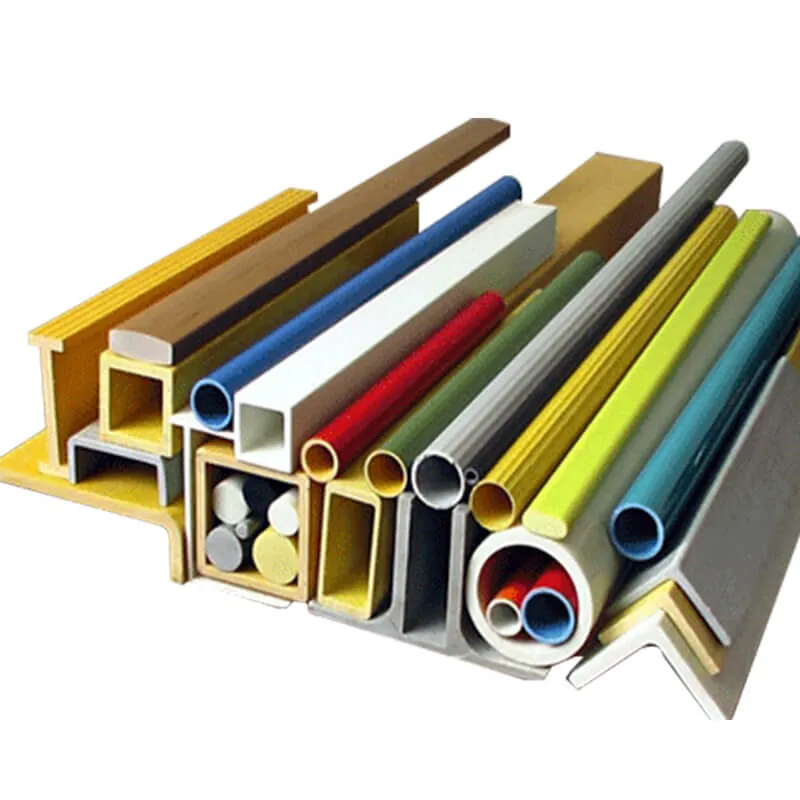
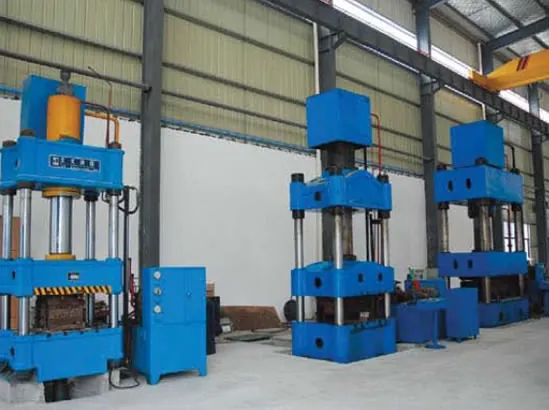
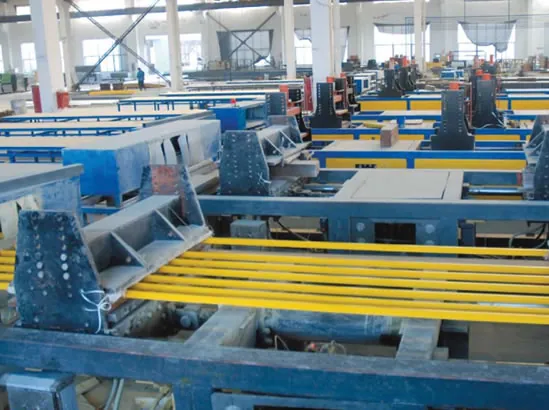
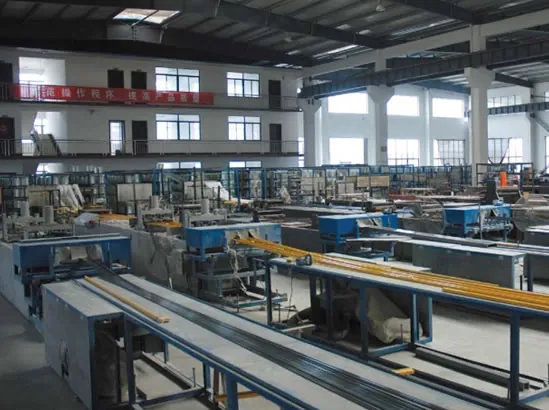
Pultrusion pulls continuous glass reinforcement through a resin bath, a preformer and a heated die, then a puller and saw. The profile leaves the die looking identical from shift to shift; the inside is not. Cure conversion, void fraction and glass content are set by a handful of linked parameters, and a small drift in one of them shows up weeks later as a low Barcol reading or a failed load test.
| Stage | What it controls | If it drifts |
|---|---|---|
| Resin bath | Wet-out, filler, voids | Dry streaks, poor surface |
| Preformer | Fiber architecture, glass content | Wash, springback, distortion |
| Die zones | Gel, cure, dimensional stability | Under-cure, over-cure, voids |
| Puller | Speed, tension | Rippling, ovality, cure mismatch |
| Saw / cut | Length, squareness | Fit-up problems on site |
Resin Bath: Viscosity and Gel Time
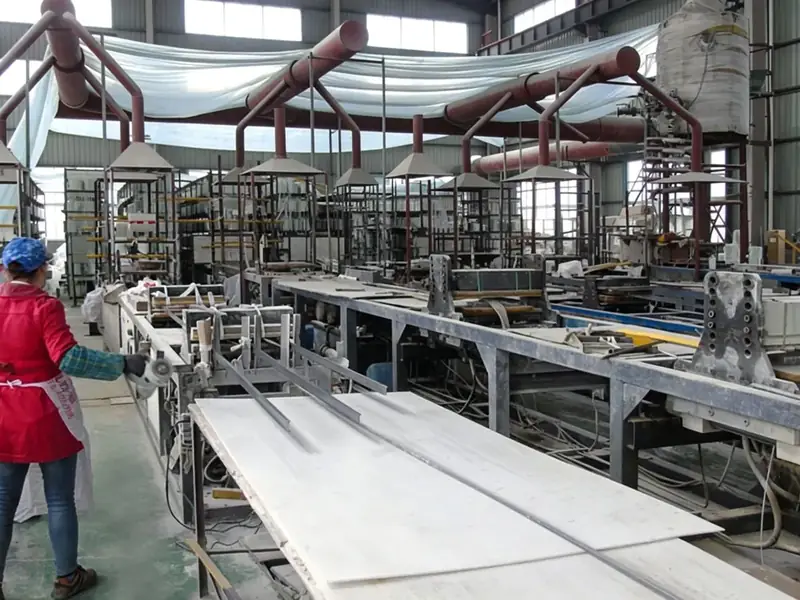
The bath is where every fiber strand is wet. Too cold and too viscous, and resin cannot penetrate the roving bundle; too hot and the bath starts gelling before the die. Filler and pigment must stay dispersed, which is why bath circulation and filtration are part of the control loop, not an afterthought.
| Parameter | Control target | Consequence of drift |
|---|---|---|
| Resin temperature | Narrow band per resin system | Viscosity swings, poor wet-out |
| Viscosity | Per resin datasheet | Undersized glass bundle = void |
| Gel time | Per system, bath-cooled | Pre-gel in bath, lumps |
| Filler dispersion | Circulated, filtered | Settling, surface streaks |
| Bath level | Held constant | Starving at fast pull |
Note: Exact bath temperature and viscosity windows are resin-specific and must be confirmed against the resin manufacturer's datasheet; they are not a single universal number.
Preforming: Converging the Reinforcement
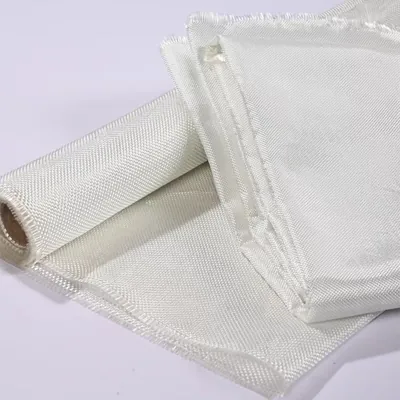
Before the die, rovings, mat and braid are gathered through a series of guides that shape them into the cross-section. This is where glass content and resin-rich surface are set. Bad preforming either leaves too much resin (low glass, soft profile) or crushes the bundle (dry spots, weak edges).
| Preform stage | Function | Common fault |
|---|---|---|
| Creel | Tension-controlled roving feed | Broken ends, uneven tension |
| Guide plate | First convergence | Fraying, strand crossing |
| Preform die | Near-net shape | Resin wash, fiber bunching |
| Felt / mat feed | Surface veil | Misplaced veil, dry spots |
Die Temperature Zones
A production die is not a single heater. It is split into zones: an entry zone that brings the wet laminate up to gel, a center zone that drives cure, and an exit zone that stabilizes dimensions. Set them all the same and the resin gels too early (voids from trapped volatiles) or too late (under-cure, sticky surface).
| Die zone | Purpose | If wrong |
|---|---|---|
| Entry | Heat to gel start | Late gel = under-cure; early = voids |
| Center | Drive cure conversion | Low Barcol, poor chemical resistance |
| Exit | Stabilize, size hold | Ovality, dimensional drift |
| Die temperature control | Closed-loop per zone | Hot spots, surface burn |
Note: Zone temperatures depend on resin system, line speed and profile cross-section; the exact setpoints are confirmed per product line, not copied across resins.
Pull Speed and Cure Conversion
Pull speed sets the residence time in the die. Faster pull means less heat exposure; the profile may be fully gelled on the surface but under-cored inside. Slower pull risks resin degradation, blistering and a rough, over-heated surface. The speed is chosen to match the cure that the die zones deliver, not to maximize throughput.
| Pull behavior | Cure result | Visible sign |
|---|---|---|
| Too fast | Under-cored, low Barcol | Soft edges, post-cure creep |
| Correct | Full conversion, stable | Consistent dimensions |
| Too slow | Resin degradation | Sticky or burnt surface, voids |
| Speed change without die reset | Mixed cure across run | Variable Barcol along length |
Void Content: Sources and Detection
Voids are the enemy of pultruded grating: they lower transverse strength, let chemicals migrate and raise the sound level of the profile. They come from poor wet-out, trapped air in the roving, volatiles released during cure, and resin-rich pockets that shrink. Detection is by cut-section microscopy on sampled lengths and by ultrasonic inspection where the customer requires it.
| Void source | Typical root cause | Check |
|---|---|---|
| Dry streaks | Bath viscosity too high | Wet-out inspection |
| Trapped air | Preformer too tight | Section cut-up |
| Volatile blow | Entry zone too hot | Die zone review |
| Shrink pockets | Resin-rich corner | Preform geometry |
Online QC Checkpoints
Quality is checked on the line, not only at the end. Each shift logs Barcol hardness on the cured profile, dimension checks against the die drawing, visual inspection for wet-out and surface, and weight-per-length as a proxy for glass content. Samples are cut for laboratory cross-section and mechanical testing at defined intervals.
| Checkpoint | Method | Acceptance |
|---|---|---|
| Barcol hardness | Impressor on cured surface | >=40 per spec |
| Dimensions | Caliper / gauge vs drawing | Within tolerance |
| Surface / wet-out | Visual, 100% | No dry streaks, no voids |
| Weight per length | Scale on cut samples | Within target band |
| Cross-section | Microscopy on samples | Void content per spec |
Defect to Root Cause
Most line defects are traceable to one or two parameters. A short table lets the operator correct at the machine instead of arguing about the resin batch.
| Defect | Likely root cause | First action |
|---|---|---|
| Soft / low Barcol | Under-cure, fast pull | Slow pull, raise center zone |
| Surface burn / blister | Over-temperature | Lower exit zone, check sensors |
| Dry streaks | Bath viscosity, preformer | Warm bath, ease preform |
| Dimensional drift | Exit zone unstable | Restabilize exit zone |
| Voids in section | Trapped volatiles | Review entry zone profile |
| Color uneven | Pigment settlement | Recirculate bath |
Changeover When Resin or Profile Changes
Switching from polyester to vinyl ester, or from one profile cross-section to another, is not a die swap. Bath, preformer, die zones and pull speed all reset, and the first meters are scrapped until Barcol and dimensions come back inside band. Running a new resin on old setpoints is the most common cause of a bad production batch.
| Changeover item | Why it resets | Scrap allowance |
|---|---|---|
| Resin system | Viscosity, cure chemistry | Bath clean + warm-up |
| Profile cross-section | Preformer geometry | Die + preformer swap |
| Pull speed | New cure balance | First meters sampled |
| Color / filler | Dispersion, shade | Run-in length |
Shift Log and Acceptance Limits
A controlled line logs bath temperature, each die-zone setpoint and actual, pull speed, Barcol reading, dimension and operator on duty. If a customer later disputes a batch, the log is the evidence. Acceptance limits include Barcol >=40 on the cured surface and density in the 1.5-2.0 g/cm3 band.
| Logged field | Unit | Limit |
|---|---|---|
| Resin bath temperature | C | Per resin datasheet |
| Die zones (3) | C | Per product recipe |
| Pull speed | m/min | Per recipe |
| Barcol hardness | - | >=40 |
| Density | g/cm3 | 1.5-2.0 |
| Panel / profile length | mm | 1220x3660 standard panel |
What a Buyer Should Ask
Asking for the catalog is easy; asking for the control loop is what separates a reproducible supplier from a lucky one. Request the shift-log fields, the Barcol acceptance, and the changeover practice for your resin.
- Ask whether Barcol >=40 is checked each shift on the cured surface.
- Ask how voids are detected: cut-section samples, ultrasonic, or both.
- Ask what changes when your resin system differs from the standard.
- Ask for the density band (1.5-2.0 g/cm3) and the glass-content control.
- Spare and custom runs: MOQ 10 m2, lead time 12-36 working days.
Note: Factory scale: 20,000+ m2 site, 200+ staff, established 2004. Certification GB/T19001-2000 idt ISO9001:2000, register 01708Q11888R0S, valid to 2028-12-30. ASTM F3059 report 211122012SHF-001 covers grating only.
Frequently Asked Questions
What causes voids in pultruded profiles?
Voids come from poor wet-out (bath too viscous), trapped air from an over-tight preformer, volatiles released if the entry die zone is too hot, or resin-rich corners that shrink. They are found by cutting sections and microscopy, sometimes by ultrasonic scan.
How is Barcol hardness controlled on the line?
The cured surface is checked with a Barcol impressor each shift against the die-zone and pull-speed recipe. Acceptance is Barcol >=40. A low reading means under-cure; the operator slows the pull or raises the center die zone before continuing.
What happens if pull speed is too high?
The profile gels on the surface but stays under-cored inside. It may look right yet show low Barcol, post-cure creep and poor chemical resistance. Speed must match the heat the die delivers, not maximize throughput.
How do die temperature zones affect cure?
The entry zone brings the wet laminate to gel, the center zone drives cure conversion, and the exit zone stabilizes dimensions. Setting all zones equal either traps volatiles (voids) or leaves the profile under-cured with a sticky surface.
Can pultrusion defects be repaired later?
Surface defects can sometimes be addressed, but internal voids or under-cure cannot be repaired reliably; the affected length is scrapped. That is why online Barcol, dimension and wet-out checks exist on the line.