Buying FRP grating from China is safe when the PO carries a seven-stage QC checklist from drawing approval to loading photos; the two stages buyers skip, resin batch and weight per square metre, are the ones that catch substitution.
- Best for: first orders and repeat orders with a new mould
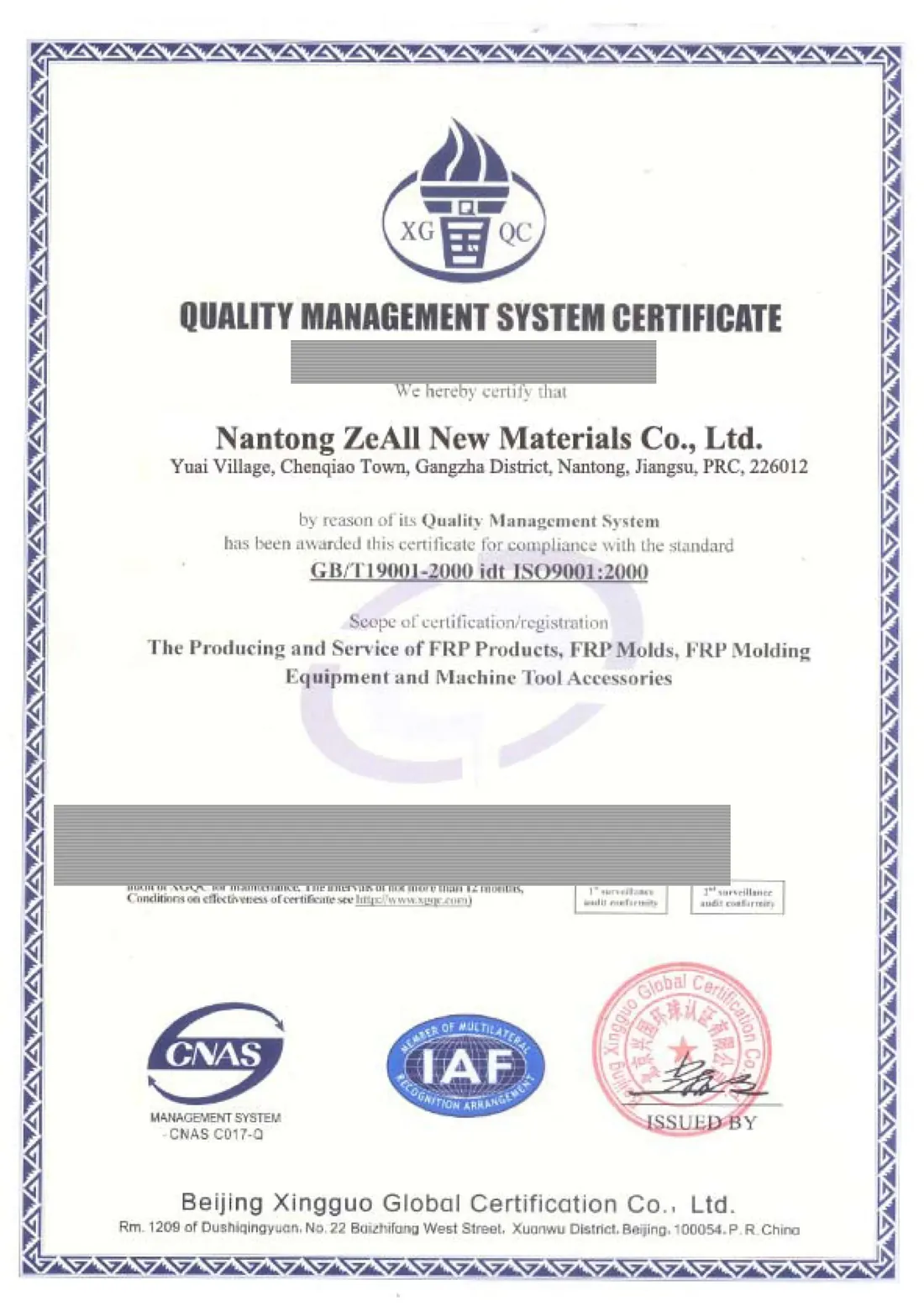
- Non-negotiable: ISO 9001 registered supplier (certificate 01708Q11888R0S)
- Key spec: pre-shipment photos, weight check per panel, ASTM F3059 report 211122012SHF-001
What to check, when to check it, and what a photograph actually proves. A practical inspection sequence for a grating order placed overseas.
Is It Safe to Buy FRP Grating from China?
Buying FRP grating from China is safe when the PO carries a seven-stage QC checklist from drawing approval to loading photos; the two stages buyers skip, resin batch and weight per square metre, are the ones that catch substitution. What to check, when to check it, and what a photograph actually proves. A practical inspection sequence for a grating order placed overseas.
In this guide: pre-production approval, raw material evidence, in-process checks, dimensional inspection, surface and resin cure, load and deflection verification, packing and marking, documents, and the inspection report. Most import problems are discovered at site, when the container is open and the deck does not fit. By then the cheapest correction is a local cut, and the most expensive is a re-order. Inspection works only if it happens earlier: at pre-production, at first-off, and before packing. That is three checkpoints rather than one. A single pre-shipment visit sees the finished product but cannot change the resin batch or the bar depth. A supplier who refuses inspection at pre-production is telling you, in advance, which stage is not under control.
The Seven-Stage QC Checklist at a Glance
Approval before production and an in-process check are what actually protect the order. The table below is the seven-stage sequence written as a checklist a buyer can attach to the purchase order. Each stage has a check and an acceptance line, and the acceptance line is what turns a friendly visit into a record that can be used if a dispute arises later.
Walk the sequence in order: a problem caught at stage one costs a drawing revision, a problem caught at stage seven costs a re-order. The two stages most buyers skip are resin batch and weight per square metre, and those are exactly the two where a supplier can quietly substitute a cheaper grade and still deliver a panel that looks right on arrival. Insist on both. Weight per square metre is the cheap test: a 38 mm molded panel should read 19.5 kg/m2, and a panel that weighs 17 kg/m2 on the crate scale has less glass and resin than the datasheet promised.
| Stage | Check | Acceptance |
|---|---|---|
| Pre-production | Drawings, resin batch, glass content | Approved drawing signed |
| In-process | Mould fill, cure, mesh alignment | No voids, uniform colour |
| Dimensional | Length, width, thickness, mesh pitch | Within stated tolerance |
| Weight | Unit weight per m2 | Matches datasheet |
| Surface | Grit coverage, concave profile | Uniform, no bare patches |
| Testing | Load, fire, resin content | Report per batch or family |
| Packing | Crate, edge protection, marks | Photo before loading |
Sample Approval and Raw Material Evidence
Ask for one panel in the specified resin, section, surface and colour, and keep it. Mark it with the order number and photograph the markings. That panel becomes the reference for surface texture, colour and bar geometry for the whole order. Approval is not a courtesy. It is the document that decides whether a later difference is a defect or a misunderstanding, and it is the reason to write the approval into the purchase order rather than to accept it by chat message.
Ask for the resin batch certificate and the glass reinforcement specification covering the production window, not a generic datasheet. The certificate is the only evidence that the vinyl ester quoted is the vinyl ester used. Where the deck is in chemical or marine service, this is the single most valuable document in the file. A deck in the wrong resin looks identical on arrival and fails years later, on the far side of the warranty. We ship with resin batch certificates covering the production window of the order, and with the ISO 9001 certificate 01708Q11888R0S valid to 2028-12-30 as the umbrella quality record.
In-Process and Dimensional Inspection
During production, three things are worth a visit: the bar geometry, the resin cure and the surface application. Bar pitch and depth can be measured with a caliper in seconds, and a drifted pitch is invisible once the panels are stacked. Cure is judged by hardness and by the absence of tackiness, and it is the cause of most complaints about panels that smell or chalk. Grit surface should be checked for uniform coverage and for grit that comes off when rubbed; a poorly bonded grit layer is a slip hazard dressed as a safety feature.
A photograph with a tape measure proves intention, not dimension. Ask for a written dimensional report per bundle: overall length and width, panel squareness, bar pitch, bar depth, open area, and the cutout positions against the drawing. Set the acceptance criteria in the purchase order. A 3,660 mm panel with a 10 mm length variation will not fit a fixed frame, and a squareness error shows up as a visible gap at every joint. Measure panel length and width with a steel tape on three panels per bundle, squareness by diagonal, bar pitch over 10 bars, and bar depth at three points per bar.
Surface, Cure, Load and Fire Evidence
Walk the deck before it is packed. A cured panel feels hard and does not smell of styrene; a poorly cured one is soft under a thumbnail and still smells. Grit should not rub off into a hand. Cut edges and drilled holes must be sealed with matching resin. An unsealed cut is where water enters the glass, and it is the defect that most often turns a ten-year deck into a five-year deck.
A factory can verify geometry, resin, mass and surface. It cannot easily verify a deflection figure for a simply supported span without a test rig, and most suppliers do not have one for every section. So the honest position is this: ask for the certified load table for the section supplied, and if a physical test is required for the project, write it into the order as a witnessed test with an agreed rig, load steps and acceptance deflection. Do not accept a screenshot of a table as a test result. We hold the Intertek ASTM F3059 report 211122012SHF-001 covering the grating product family, and we send it with the certificate pack on request.
Packing Inspection and On-Site Handling
Open one bundle and one crate. Check corner protection, strapping tension, whether panels are separated, and whether the bundle marking matches the panel schedule. Count the clips and bolts against the packing list, because accessories are the line most often short. Photograph the load before the doors close. A container photograph with the seal number visible is the single most useful record if damage is found on arrival, and it costs nothing at the time.
On site, a 1220 x 3660 mm panel at 38 mm weighs about 87 kg and is a two-person lift. Cut edges are sealed with matching resin putty or edge trim before handover, and stainless clips are fixed at every edge: SS304 inland, SS316 on coastal or chloride service. Keep the approved sample panel on site so the installer can compare colour, grit and bar geometry. If any panel arrives with a soft patch, a tacky smell or grit that rubs off, reject it at the quay rather than on the deck; the cost of a return shipment is far lower than the cost of stripping a sealed walkway.
Documents, Acceptance and the Supplier Angle
Packing list with bundle markings, commercial invoice, certificate of origin, resin batch certificates, the load table for the supplied section, installation instructions, and the inspection report with photographs. Where the destination requires it, add the relevant declaration for the resin or the country of origin. Keep them together with the approved sample photographs. If a dispute ever arises, that file is the case, and assembling it after the fact is always more expensive than collecting it during production.
We manufacture at a 20,000 m2+ plant with 200+ staff, export to 40+ countries, hold MOQ 10 m2 and a 12-36 working day lead time from a confirmed drawing. Oversized panels, custom colours, new moulds and specialty resins are quoted with a separately confirmed schedule. We welcome third-party inspection at pre-production and at packing, and we will send pre-shipment photos of the loaded container with the seal number visible. On a first order or a large order, a third-party inspection company at pre-production and packing is the cheapest insurance in the order; on repeat orders with a clean record, an in-process visit plus packing photographs is usually enough. The cost of a one-week inspection is trivial next to the cost of a container that arrives with the wrong resin, the wrong bar depth or a short clip count, and a supplier who has nothing to hide will welcome it.