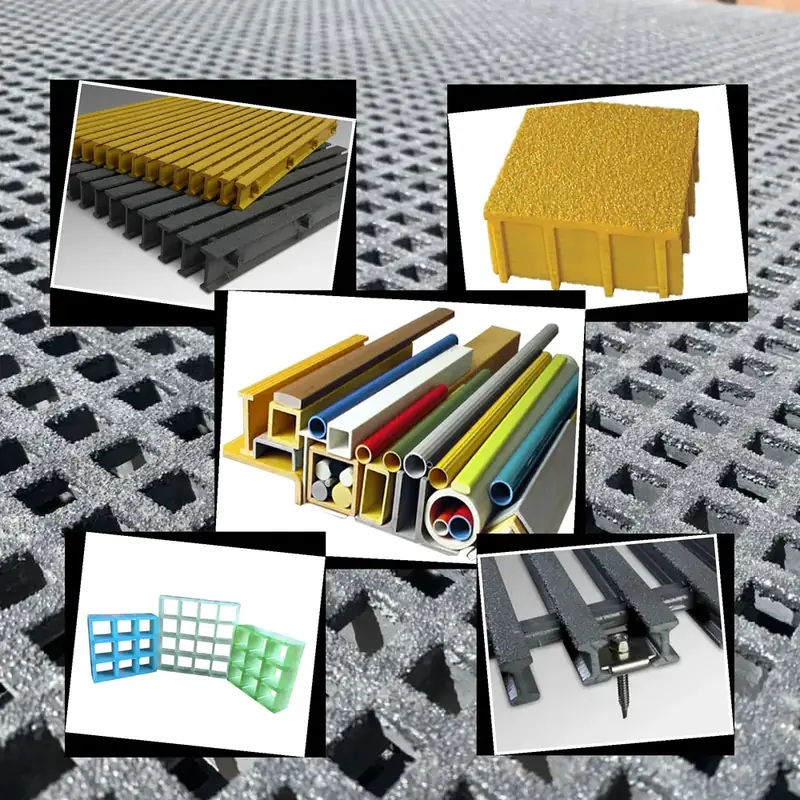
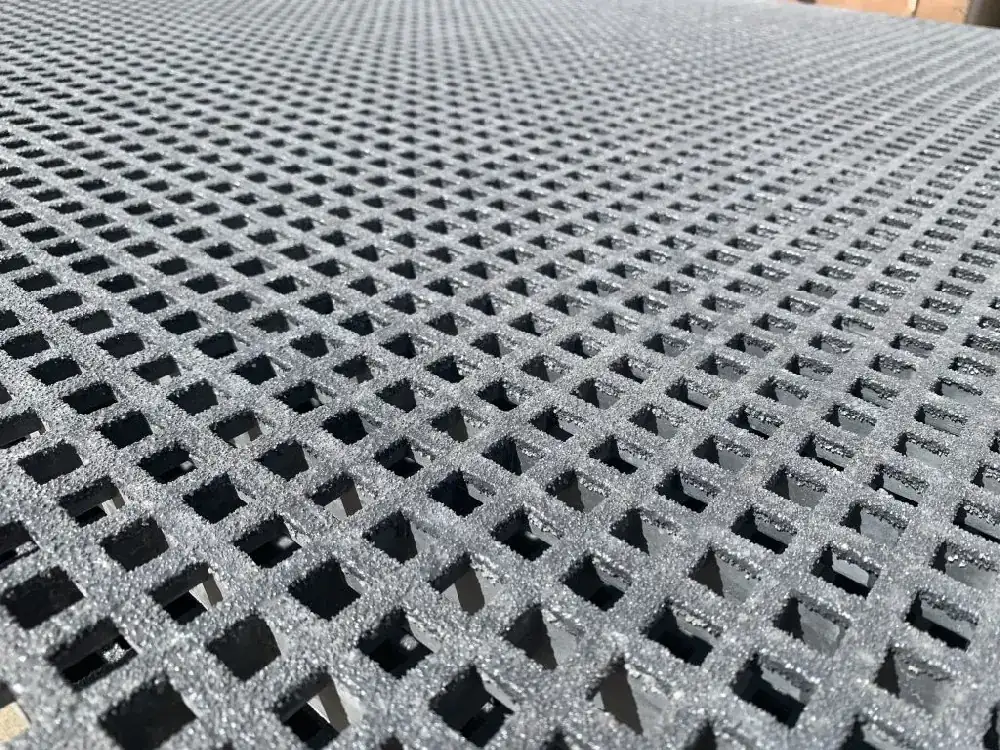
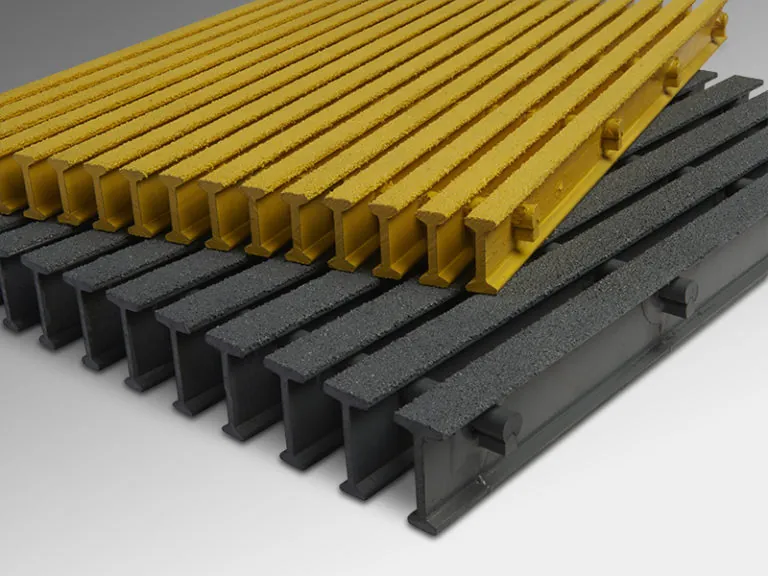
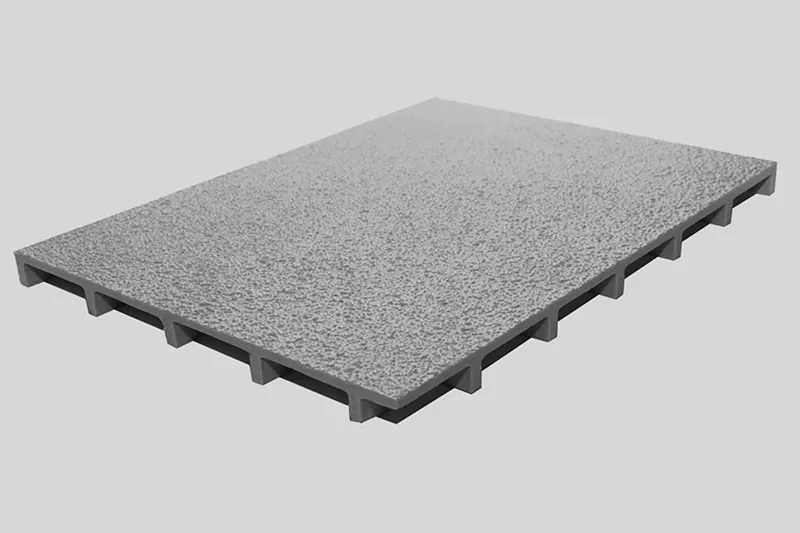
FRP grating is not universal. It loses strength above its resin's continuous-service temperature, fails in strong oxidizing acids unless the resin is upgraded, deflects more than steel at L/360, chalks and fades under UV without losing structural strength, and burns rather than melts in fire. Knowing where it stops is as important as knowing where it excels.
- Temperature: each resin has a continuous-service ceiling; above it, strength drops.
- Chemicals: standard polyester fails in strong oxidizers; vinyl ester or phenolic may be needed.
- Deflection: L/360 designs need deeper profiles or shorter spans than steel.
- UV: surface chalk and color fade are cosmetic, not structural.
- Fire: FRP chars and burns; it is not a fire-rated assembly on its own.
Why State the Limits
Most FRP marketing lists advantages. This page does the opposite: it maps the conditions under which FRP grating should not be the default choice. A specifier who knows the boundaries avoids a field failure, and a buyer who knows them can ask the right upgrade questions early.
| Boundary | What happens | Typical wrong assumption |
|---|---|---|
| Above resin temperature limit | Strength drops, softens | 'It is plastic, it is heat proof' |
| Strong oxidizer | Surface attack, blistering | 'FRP resists all acids' |
| L/360 on long spans | Excessive deflection | 'Same section as steel' |
| UV years outdoors | Chalk and fade | 'It is rotting' (it is not) |
Continuous High Temperature
The glass fiber is heat tolerant; the resin matrix is not. Every resin has a continuous-service ceiling above which it softens, creeps and loses load capacity. A short surge is tolerated; continuous exposure near or above the limit is not. Specify the resin against the actual peak service temperature, not the average.
| Resin family | Continuous service (typical) | Behavior above limit |
|---|---|---|
| General polyester | By project condition confirm | Softens, creep, loss of strength |
| Isophthalic | By project condition confirm | Surface blister, strength drop |
| Vinyl ester | By project condition confirm | Better heat, still has ceiling |
| Phenolic | By project condition confirm | Low smoke, chars rather than drip |
Note: Exact continuous-service temperatures are resin-specific and must be confirmed against the resin manufacturer's datasheet; do not quote a single number for all FRP.
Strong Oxidizing Acids and Solvents
FRP resists most dilute acids and alkalis, but strong oxidizers (concentrated nitric, chromic, hypochlorite bleach) attack the resin matrix even when the glass itself is fine. Standard polyester is the weakest here; vinyl ester is the usual upgrade; phenolic suits some low-smoke duties. Concentration and temperature both matter.
| Exposure | Polyester FRP | Vinyl ester FRP | Action |
|---|---|---|---|
| Dilute acid | Good | Good | Standard |
| Concentrated oxidizer | Poor | Conditional | Confirm concentration/temp |
| Hypochlorite / bleach | Poor | Conditional | Resin table required |
| Strong solvent | Poor | Good | Upgrade resin |
| Strong alkali | Poor | Conditional | Check table |
Deflection-Sensitive Structures
FRP has a lower modulus than steel, so at the same section it deflects more. For pedestrian walkways checked at L/200 this is usually fine. For floors carrying sensitive equipment, long pipe runs or glazed facades checked at L/360, FRP needs a deeper profile or shorter support spacing. That is a sizing change, not a disqualification.
| Design case | Typical limit | FRP response |
|---|---|---|
| Pedestrian walkway | L/200 | Usually fine |
| Equipment floor | L/360 | Deeper profile / shorter span |
| Pipe rack | Per code | Check deflection not just strength |
| Glazed / sensitive | L/360 or tighter | May favor steel |
UV Weathering: Color vs Strength
Outdoor FRP chalks and fades over years. This is the resin-rich surface oxidizing, not the structural glass. The underlying section keeps its strength; only the surface appearance changes. UV-stabilized resin slows this, and a recoat can restore color, but some fade over a 20-30 year life is expected.
| Symptom | Meaning | Action |
|---|---|---|
| Surface chalk | Surface resin oxidizing | Cosmetic; clean, optionally recoat |
| Color fade | UV pigment breakdown | Expected; UV resin slows it |
| Fiber bloom / white fuzz | Surface wear | Inspect; may need recoat |
| Cracks through section | Structural | Remove and replace |
Fire Rating Boundaries
FRP does not melt and drip like aluminum; it chars and burns. Standard polyester meets typical flame-spread classes under ASTM E84, and phenolic FRP is the low-smoke option for enclosed escape routes. But a flame-spread class is not a fire-resistance rating: FRP grating is not a floor that survives a fire, and hydrocarbon-fire integrity is limited. Never use it where a fire-resistance-rated floor is required.
| Claim | What it covers | What it does not |
|---|---|---|
| ASTM E84 flame spread | Surface flame propagation | Structural fire resistance |
| Phenolic low smoke | Reduced smoke in enclosure | No load during fire |
| Hydrocarbon fire | Limited performance | Not a rated floor |
| OSHA / code walkway | Pedestrian surface | Fire-rated assembly |
Note: Our ASTM F3059 report 211122012SHF-001 covers pedestrian grating surfaces only; it is not a fire-resistance certification.
Impact and Concentrated Loads
FRP is stiff but relatively brittle under point impact. A dropped tool is fine; a repeated heavy concentrated load or a forklift on the wrong panel can crack or shear the bars. Pultruded sections resist point loads better than molded panels, and HD grades exist. Match the panel to the actual traffic, not just the live load.
| Load type | Molded panel | Pultruded / HD | Action |
|---|---|---|---|
| Pedestrian foot | Fine | Fine | Standard |
| Dropped tool | Fine | Fine | Standard |
| Forklift / vehicle | Not rated | By project confirm | Use HD / solid cover |
| Point load over opening | Marginal | Better | Support directly |
Repair vs Replacement Economics
FRP cannot be welded like steel or patched like concrete. A damaged bar usually means cutting out the panel and clipping in a new one. Where the damage is widespread or the whole surface has chalked for decades, a recoat may cost nearly as much as partial replacement; sometimes replacement is the lower-risk choice.
| Damage | Repair option | Economics |
|---|---|---|
| One cracked bar | Cut out panel, replace | Cheap, clip-in |
| Chalked surface | Recoat | Compare to replacement |
| Widespread degradation | Partial replacement | Often lower risk |
| Chemical attack | Resin-compatible patch | Confirm compatibility first |
Machining and Field Modification
FRP can be cut and drilled on site, but it produces dust and needs carbide tools; cut edges should be sealed to avoid wicking. Extensive field rework of a poorly sized panel is rarely economical. Order cut-to-size to avoid it.
| Operation | Tool | Note |
|---|---|---|
| Cutting | Carbide-toothed saw | Dust extraction, PPE |
| Drilling | Cobalt / carbide bit | Slow feed, no overheating |
| Edge sealing | Resin-compatible sealer | Prevent wicking |
| Field rework | Possible | Often cheaper to reorder |
Code Exceptions and Approvals
Some codes exclude FRP from certain fire-rated or high-temperature applications, or require special approval. Always check the local code for the exact occupancy; where in doubt, a code-approved alternative may be cheaper than fighting the approval.
| Scenario | FRP position | Check |
|---|---|---|
| Fire-rated floor | Not permitted | Use rated assembly |
| High-temp process | Conditional | Resin limit |
| Pedestrian walkway | Permitted | ASTM F3059 |
| Explosive area | Conductive variant required | ESD classification |
Decision Checklist
Run these before defaulting to FRP. If more than one answer points away, reconsider the material.
- Is continuous service temperature within the resin's confirmed ceiling?
- Is the worst chemical exposure on the resin compatibility table?
- Is the deflection limit L/200, or do you need L/360 with deeper sections?
- Is this a fire-rated floor, or only a pedestrian walkway?
- Is there vehicle or forklift traffic that needs HD / solid cover?
- Spare and cut-to-size: MOQ 10 m2, lead time 12-36 working days.
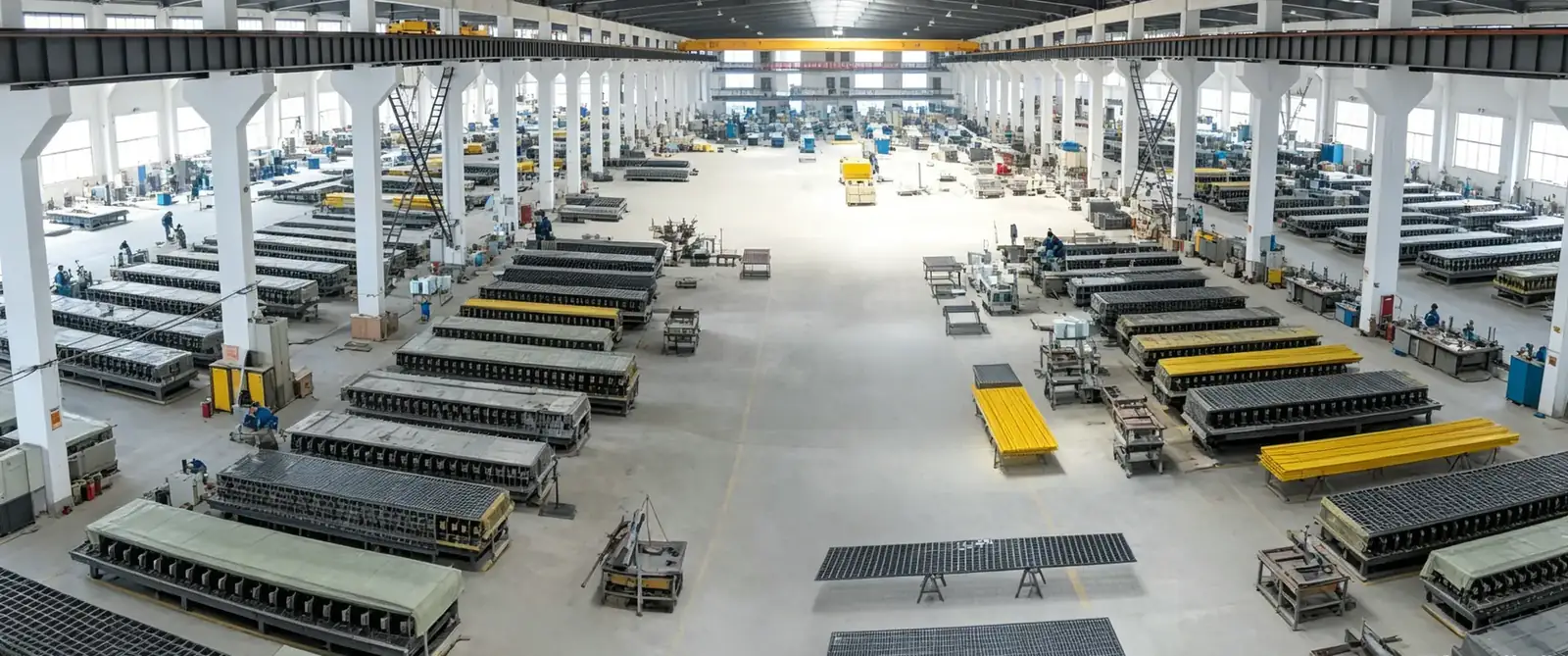
Note: Factory: 20,000+ m2, 200+ staff, since 2004. Certification GB/T19001-2000 idt ISO9001:2000, register 01708Q11888R0S, valid to 2028-12-30.
Frequently Asked Questions
At what temperature does FRP grating fail?
The glass fiber tolerates heat well; the resin matrix has a continuous-service ceiling that is resin-specific and must come from the datasheet. Above it, the profile softens, creeps and loses strength. Treat any sustained temperature near that limit as a resin-upgrade decision.
Can FRP handle concentrated oxidizing acids?
Standard polyester cannot. Strong oxidizers like concentrated nitric, chromic or hypochlorite attack the resin matrix even though the glass is inert. Move to vinyl ester or phenolic and confirm concentration and temperature against the resin chemical-resistance table.
Does FRP turn yellow or chalk in UV?
Yes, over years outdoors the resin-rich surface chalks and fades. This is cosmetic surface oxidation, not structural decay; the underlying glass keeps its strength. UV-stabilized resin slows it and a recoat can restore color.
Is FRP grating fireproof?
No. FRP chars and burns rather than melting. It can meet a flame-spread class under ASTM E84, and phenolic FRP offers low smoke, but it is not a fire-resistance-rated floor. Never specify it where a fire-rated assembly is required.
When should I NOT use FRP grating?
For floors that must survive a fire, for sustained service near the resin's temperature ceiling, for strong oxidizers on standard polyester, for L/360 designs without deeper sections, and for forklift traffic without an HD or solid-top panel. Confirm each against the resin table and local code.