
FRP grating fire performance is judged by four documents: ASTM E-84 for flame spread and smoke, ASTM F3059 for the grating itself, EN 13501-1 in Europe, and IMO FTP Code for marine work.
- Best for: specifying a fire class without over-specifying phenolic everywhere
- Read together: E-84 gives the index, F3059 gives the product-level evidence
- Key spec: ask for the report, not the claim: report number and test date
Four different fire classifications turn up on grating datasheets, and buyers compare them as if they were the same scale. They are not: each answers a different question, and one of them is not a fire test at all.
Which Fire Rating Actually Applies to FRP Grating?
FRP grating fire performance is judged by four documents: ASTM E-84 for flame spread and smoke, ASTM F3059 for the grating itself, EN 13501-1 in Europe, and IMO FTP Code for marine work. Four different fire classifications turn up on grating datasheets, and buyers compare them as if they were the same scale. They are not: each answers a different question, and one of them is not a fire test at all.
The rating belongs to the resin system, not to grating as a category. Standard polyester reaches a reduced flame spread class, fire-retardant polyester and vinyl ester reach Class 1 on ASTM E-84, and phenolic is the low-smoke choice where escape routes matter. The practical rule is simple: ask for the report, not the claim, and quote the standard name exactly because a class without a report number and a test date cannot be verified. A buyer who only reads the class number is buying a promise; a buyer who reads the standard, the resin and the report number is buying evidence.
The Four Standards Side by Side
The tunnel test. A specimen is laid horizontally in a tunnel, a flame is applied at one end, and two numbers come out: flame spread index and smoke developed index. Class A is the best band, Class B next. It is the most quoted rating on FRP grating datasheets, including ours. What it tells you: how far flame travels along the surface under a controlled exposure. What it does not tell you: whether the material survives a real fire, how much heat it releases, how it behaves when the fire is underneath it, or whether a structure built from it stays up.
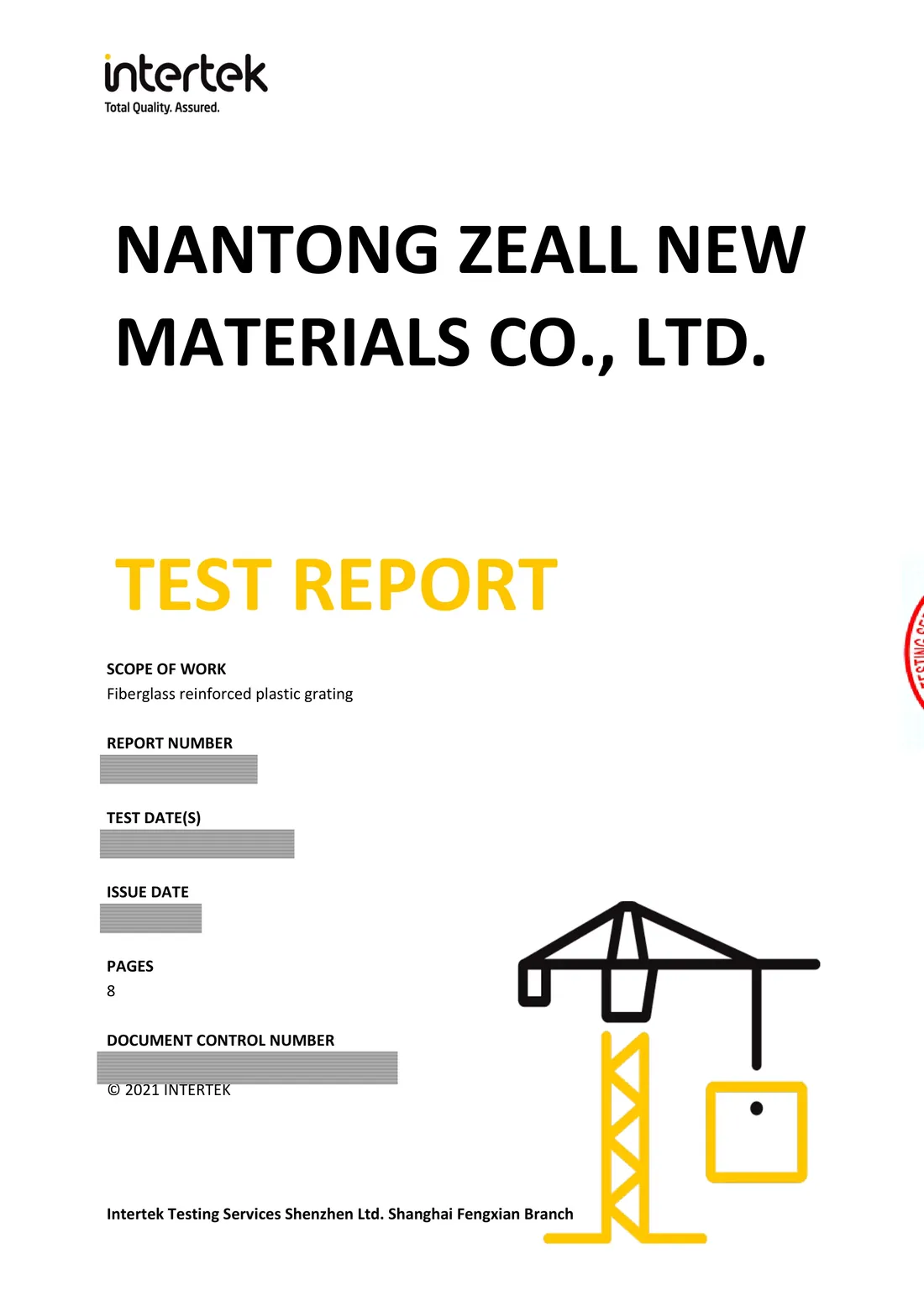
F3059 is a material and performance specification for FRP gratings used in marine service. It is not a fire classification, though it addresses fire performance as one of several properties, alongside mechanical and durability requirements. It is the report we hold from Intertek for the grating, and it is the document to ask for when a marine buyer wants evidence that the product, not just the resin, has been assessed.
| Standard | What it tests | Typical requirement |
|---|---|---|
| ASTM E-84 | Surface burning: flame spread and smoke index | Class 1: FSI 25 or less |
| ASTM F3059 | Grating-specific fire and structural performance | Report per product family |
| EN 13501-1 | European reaction-to-fire classification | B-s1-d0 to E-d2 range |
| IMO FTP Code | Marine surface spread of flame | Required for ships and offshore |
Why the Resin, Not the Glass, Decides the Fire Class
The glass fibre reinforcement is the inert part of the panel; it does not burn, but it also does not protect itself. The resin is the phase that responds to heat, and the resin chemistry is what separates a Class 1 panel from a Class 1 panel that fills a room with smoke. Standard polyester pyrolyses quickly and releases dense, visible smoke. Fire-retardant polyester and vinyl ester trade flame spread for a slower burn, but they still smoke.
Phenolic is the grade that matters in fire, and it matters for two reasons. It chars rather than burns, forming a carbon layer that insulates the material behind it, and it produces very little smoke and very little toxic gas compared with polyester or vinyl ester. Smoke is the reason phenolic is specified more often than flame spread: in an enclosed space, a deck that keeps its structural integrity while filling the room with dense smoke is still a deck nobody escapes across. Phenolic keeps the escape route visible for longer, which is why it appears in offshore modules, tunnels, rail and enclosed plant rooms rather than in open yards.
How to Specify the Right Standard for Your Project
The European system classifies construction products A1 to F, with additional smoke and flaming-droplet sub-classes. It is a reaction-to-fire classification, closer in spirit to E-84 than to a resistance test, but it is built from a set of tests rather than one tunnel, and the class is written with suffixes, for example a class with an smoke suffix. Where a European project specifies a class to EN 13501-1, an ASTM E-84 Class B certificate is not a substitute, and the reverse is also true. The two systems do not convert.
Ships and offshore units are specified under the IMO Fire Test Procedures Code, which defines surface flammability, and separately the A, B, H class divisions for bulkheads and decks. A marine deck is usually assessed as a division, not as a product: what matters is whether the assembled boundary holds the fire for the stated time. A grating walkway inside an offshore module is commonly specified with a division requirement and a smoke and toxicity requirement together, which is why phenolic appears in that service. When you write the specification, name the standard, the class, the resin and the report number in one line, and ask suppliers to state deviations rather than re-interpret.
How to Read a Datasheet in Ten Seconds
Most disputes about fire rating come from a datasheet read too quickly. The five checks below take ten seconds and catch almost every mis-selling:
- Find the standard, not the class. "Class B" without a standard is a number without a unit.
- Check whether the claim is a product test or a system test; a division rating belongs to an assembled boundary, not to a panel.
- Check the resin named beside the claim, because the class belongs to that resin and does not transfer to another grade.
- Check whether smoke is stated separately, since smoke is often the deciding requirement in enclosed spaces.
- Check the date and the report number, because a claim without a report cannot be verified.
We hold an Intertek ASTM F3059 report, number 211122012SHF-001, covering the grating product family, and our manufacturing runs under ISO 9001 registration 01708Q11888R0S (valid to 2028-12-30). Both documents are sent with the certificate pack on request, together with the resin batch certificates for the production window. Treat any claim that arrives without these three documents as unpriced, not as cheaper: a fire class that cannot be traced to a resin batch and a test report is a liability on the specification, not a saving on the order.
Installation and System Checks That Protect the Rating
A fire class on the panel does not transfer to the deck. The load path through clips, bearers and handrail bases decides whether the system stays put, and a deck specified as phenolic panels on polyester bearers, fixed with ordinary clips, has one fire-rated component and three that are not. Where the design case is fire, the bearers, the clips and the handrail bases should be specified in the same resin system, or protected in the same passive-fire package, as the walking surface.
Cut edges and drilled holes must be sealed with matching resin before handover. An unsealed edge does not change the flame spread index, but it is where water and chemicals enter the glass, and a degraded panel performs unpredictably in any later test. On site, use stainless clips matched to the environment: SS304 for inland, SS316 for coastal and splash-zone work. Keep the approved sample panel on site so the installer can compare colour, grit and bar geometry before the first bundle is fixed.
Cost, Lead Time and Sourcing for Fire-Rated Grating
Phenolic and fire-retardant grades cost more than standard polyester, and the premium is justified only where the specification actually calls for a class. Over-specifying phenolic on an open, ventilated walkway buys a low-smoke property nobody needs; under-specifying is the more common and more expensive mistake. Compare the landed cost and the 20-year maintenance line, not the unit price, and ask every supplier for a landed-cost table rather than an FOB number. A fire-rated panel is bulky, so freight is volume-driven and a part container can look disproportionately expensive per square metre.
We manufacture at a 20,000 m2+ plant with 200+ staff and export to 40+ countries. MOQ on molded grating is 10 m2 and lead time is 12-36 working days from a confirmed drawing, which is short enough to stage a fire-rated order alongside the structural steel rather than after it. Oversized panels, custom colours, new moulds and specialty resins are quoted with a separately confirmed schedule. For offshore and marine projects we will name the resin of every component in the load path, and we will not describe a general purpose or isophthalic panel as fire rated because it passed a surface flame spread test. Where the evidence does not exist for a component, the specification says so in writing.
