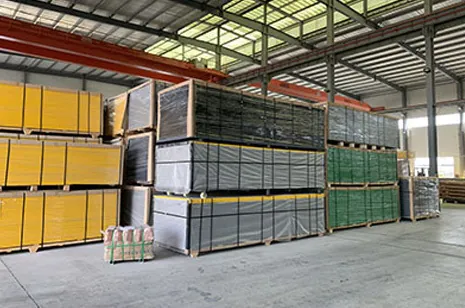
FRP grating works in cold climates, but cold-weather design differs from ordinary load design. Choose a tough low-temperature resin, leave room for contraction, size the span for the factored snow load, and ban sharp metal blades from the surface. Exact impact values are confirmed per resin system and cure level.
- Core risk: resin stiffens and becomes notch-sensitive as temperature falls; fixings usually control failures
- Snow design: use the factored site snow load in kN/m², not a pedestrian load; 1 kN/m² ≈ 20.9 lb/ft²
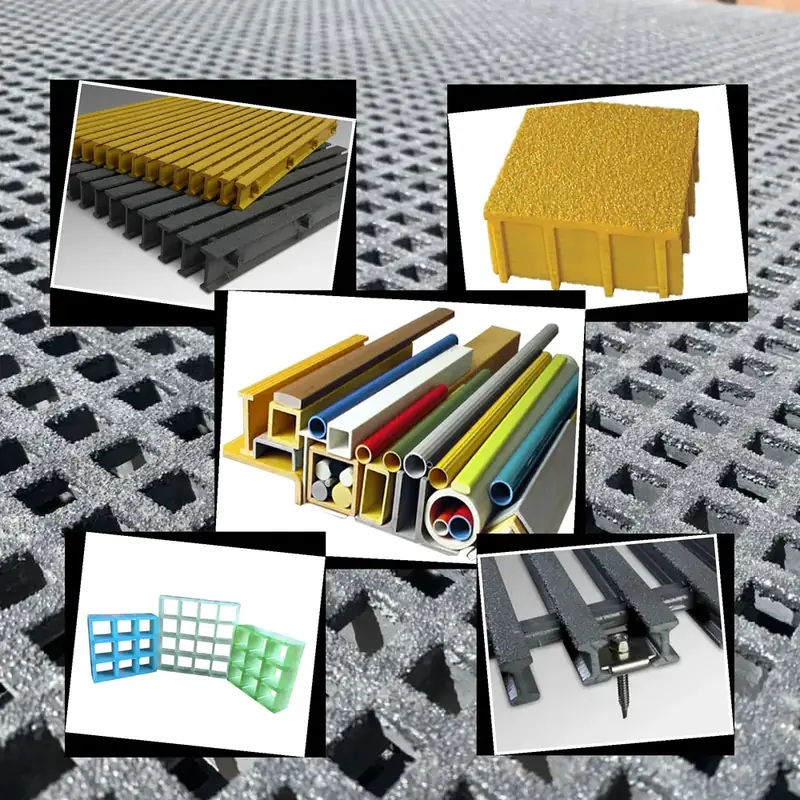
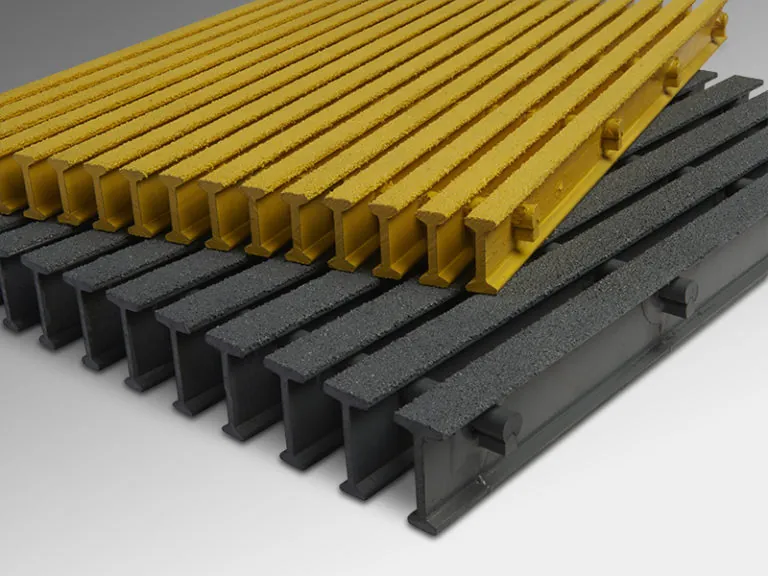
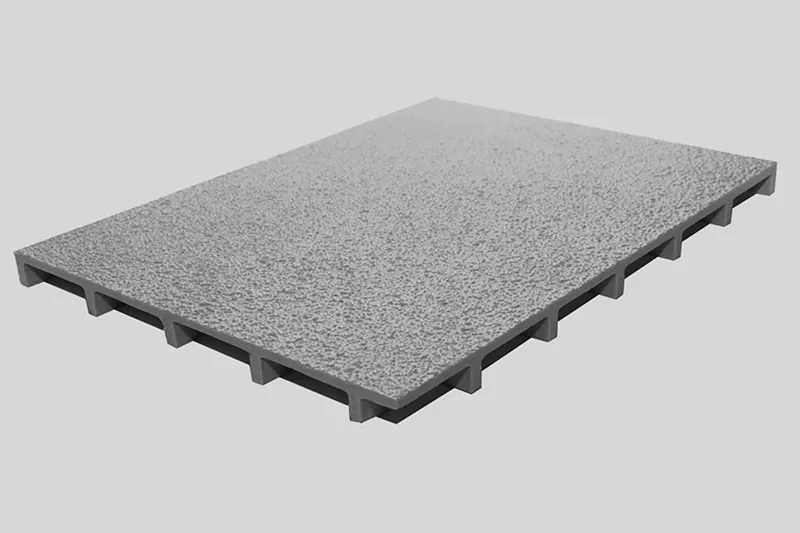
- Panel choice: pultruded I-bar or T-bar carries ice bridging and point loads better than thin molded panels
- Snow removal: plastic pushers and nylon brooms only; steel shovels cut the grit surface
- Lead time: 12–36 working days; production MOQ 10 m²; standard panel 1220×3660 mm
Why cold-climate design differs from ordinary load design
Most grating sizing starts from a pedestrian live load. A walkway in a snow zone adds a heavier case: accumulated snow, frozen slush and drifting ice sitting on the panel for weeks, while the resin is least forgiving. The clips must also absorb contraction that can pull a fixing loose.
Note: No universal -40 °C impact number applies to every panel. Low-temperature performance is confirmed per resin system, glass content and cure level; request project-specific data rather than a generic brochure figure.
How FRP behaves at low temperature
A cured thermoset does not freeze like water, but its resin matrix stiffens as it cools: a surface nick that bends at room temperature can propagate as a crack at -30 °C. The glass fiber is unaffected; the limiting material is always the resin. Thermal movement is the second effect: a long run fixed solidly at both ends builds stress when it contracts overnight. The fix is detailing, not a stronger resin.
| Low-temperature effect | Cause | Design response |
|---|---|---|
| Chip spreads under traffic | Notch in cold resin | Tougher resin; avoid grit abrasion |
| Panel lifts at interior clip | Restrained contraction | Sliding clips at inner supports |
| Joint gaps widen in winter | Linear contraction | Size joints for full seasonal swing |
| Barcol reads higher | Stiffer matrix, not better cure | QC at reference temperature |
| White crack on impact | Matrix crack ahead of fiber | Confirm resin; inspect before winter |
Density stays 1.5–2.0 g/cm³ and delivered Barcol ≥40 under standard conditions. Cold adds no weight; it makes the resin less tolerant of a sharp local load.
Snow, ice and how the load actually arrives
Snow on an open grate is not snow on a solid roof. Dry snow partly passes through the openings, but wet snow, refrozen slush and an ice crust bridge across the mesh and act like a distributed load; drift against a parapet adds a localized pile beyond the uniform code figure. Take the factored snow load from the local code, including drift and exposure factors, and treat the worst drift patch as a patch load.
| Load scenario | Action on grating | Design note |
|---|---|---|
| Dry fresh snow | Partly through openings | Check minimum bar spacing |
| Wet snow plus freeze | Bridges as a slab | Uniform distributed load |
| Drift at parapet | Localized edge pile | Design strip as patch load |
| Ice sheet on grit | Weight plus lost grip | Combine load and slip case |
| Meltwater refreeze | Ice dams at drains | Keep drains open |
Conversion: 1 kN/m² ≈ 20.9 lb/ft². A 3.0 kN/m² factored load is about 63 lb/ft². Confirm the governing value and safety factor with the structural engineer.
Resin and panel selection for cold service
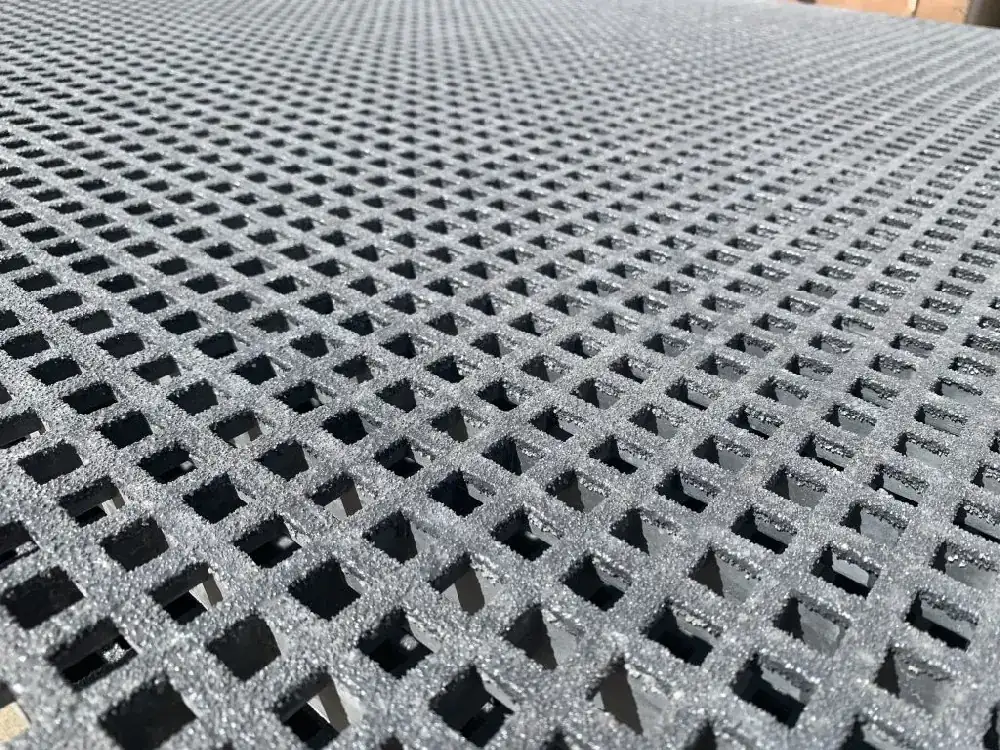
Resin choice is the key decision: general-purpose polyester is most notch-sensitive at low temperature, isophthalic polyester improves weathering, and vinyl ester raises toughness and corrosion margin. Geometry matters as much as resin — pultruded I-bar and T-bar span longer and carry a patch load better than thin molded mesh, because the load path runs along continuous rovings. Use a gritted or concave top; a smooth surface is unsafe once slush refreezes.
| Option | Cold-climate role | Typical use |
|---|---|---|
| Molded m38 isophthalic | Milder winters, light snow | General access platforms |
| Molded m50 / m65HD vinyl ester | Heavier patches, notch margin | Roof aprons, drift zones |
| Pultruded I-bar 38/50/76 | Long spans, point loads | Elevated walkways |
| Pultruded T-bar | Drainage, clean walking line | Treads, canopy edges |
| Gritted top | Ice-slip resistance | All freeze-zone surfaces |
Note: Standard panel is 1220×3660 mm and production MOQ is 10 m². State the minimum design temperature, snow-load code and resin family in the RFQ; cold performance is confirmed per resin system and cure.
Fixings, clips and thermal movement
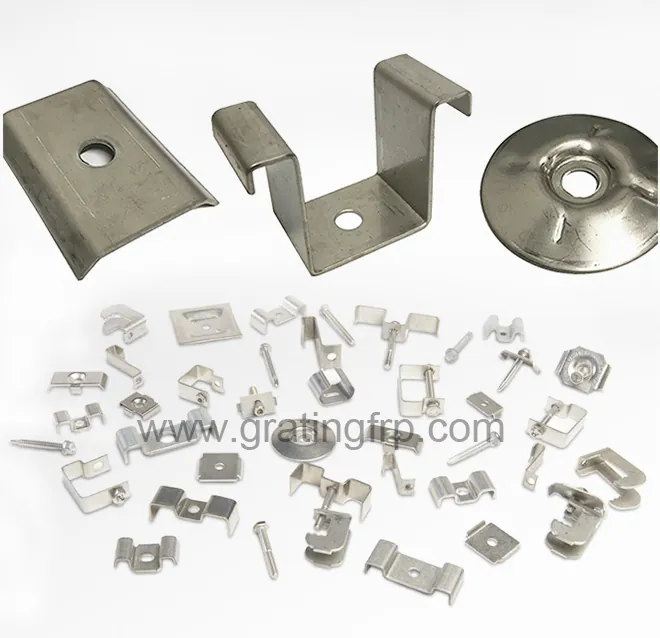
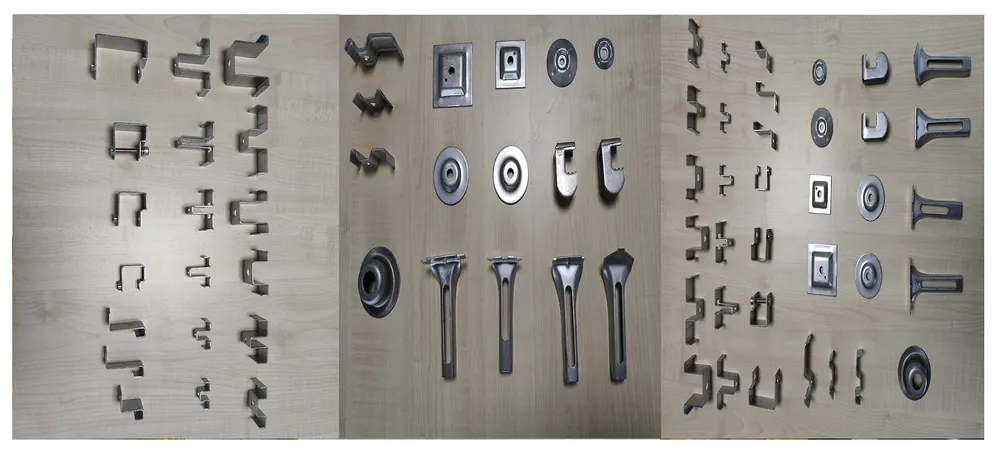
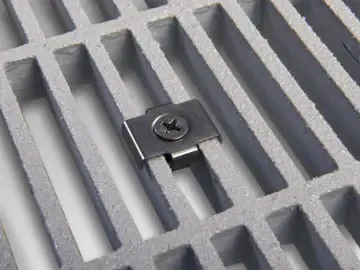
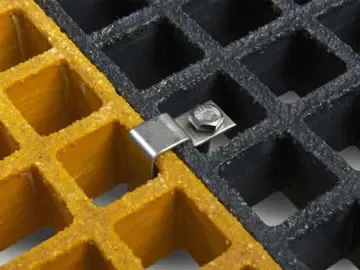
In warm climates clips only hold the panel down. In a cold climate they must also let it move: a long run fixed solidly at both ends will buckle, pull a fastener or crush a bar edge, so detail one fixed end and one slotted sliding end with intermediate clips finger-tight. Clip material follows the corrosion route — SS316 where de-icing salts or coastal spray reach the structure, SS304 inland; avoid painted carbon steel in salt zones, where the clip, not the grating, fails first.
| Clip detail | Cold-climate function | When to use |
|---|---|---|
| Fixed clip, one end | Anchors the run | One end of each line |
| Slotted clip, other end | Allows movement | Opposite end of long runs |
| L/M clip, finger-tight | Stops rattle, no lock | Inner supports |
| SS316 clip | Salt and spray resistant | Bridges, coastal, salted yards |
| SS304 clip | Inland use | Sheltered inland rooftops |
Gap detailing at curbs and drains is where cold projects fail. Leave room for full seasonal contraction plus tolerance; a joint that closes in summer pries a clip loose in winter.
Snow-removal tools and surface damage
The gritted anti-slip layer is only a few millimeters thick: a steel shovel, ice pick or metal scraper cuts it away, leaving a scratch line that becomes an ice-slide hazard the next freeze. Push dry snow with a plastic-bladed pusher, sweep slush with a nylon broom, and let a thin ice film melt if drainage allows; never drive a tracked or wheeled machine over pedestrian grating.
| Tool | Effect on grit | Allowed? |
|---|---|---|
| Plastic pusher | Harmless | Preferred |
| Nylon broom | Harmless | Yes |
| Rubber squeegee | Harmless | Thin ice film |
| Steel shovel | Cuts grit | No |
| Ice pick | Chips bar edges | No |
| Tracked vehicle | Point crush, overload | No |
De-icing salts justify SS316 fixings, not a resin change: FRP resists common de-icers, but the clips and support steel do not. Rinse supports in spring if salt accumulates.
Span and load reference data (L/200, simply supported)
The table reproduces the factory published working loads for a single simply supported span at the L/200 limit, as uniformly distributed load in kN/m² at 600, 900 and 1200 mm spacing. Use it for initial sizing; the final design is checked against the project factored snow and drift case.
| Panel type | 600 mm | 900 mm | 1200 mm |
|---|---|---|---|
| Molded m25 | 12.5 kN/m² | 6.0 kN/m² | 3.2 kN/m² |
| Molded m38 | 25 kN/m² | 12 kN/m² | 6.5 kN/m² |
| Molded m38–50 | 22 kN/m² | 10 kN/m² | 5.5 kN/m² |
| Pultruded p38 | 35 kN/m² | 18 kN/m² | 9 kN/m² |
| Pultruded p50 | 48 kN/m² | 26 kN/m² | 14 kN/m² |
| Pultruded p65 | 62 kN/m² | 35 kN/m² | 20 kN/m² |
At 900 mm spacing, molded m38 tolerates 12 kN/m² while pultruded p50 tolerates 26 kN/m². For heavier accumulation, start from the pultruded range. Convert with 1 kN/m² ≈ 20.9 lb/ft².
| Molded panel | Face weight | Resin content |
|---|---|---|
| 25 mm | 12.5 kg/m² | 68% |
| 30 mm | 15.0 kg/m² | 66% |
| 38 mm | 19.5 kg/m² | 68% |
| 38×40 mm | 18.0 kg/m² | 70% |
| 50 mm | 27.0 kg/m² | 60% |
| 65 mm HD | 38.0 kg/m² | 56% |
Detailing for drainage, ice bridges and movement joints
Cold-climate failures are rarely a bar snapped by snow; they are drains that iced over, gaps that bridged and clips that locked. Keep water moving and let the panel move. Drain on to open grate, not a solid trough.
| Detail | Cold-climate rule | Risk if ignored |
|---|---|---|
| Drain position | Open, grated | Ice bridge overload |
| Curb edge gap | Allow full contraction | Panel pries clip loose |
| Expansion joint | Slotted at one end | Thermal stress cracks edge |
| Support contact | Flat bearing | Cold stress chip |
| Grit at threshold | Continuous finish | Slip at door on refreeze |
Keep the anti-slip finish continuous across door thresholds; the transition step is the most common winter slip point.
QC, inspection and acceptance in cold service
Acceptance follows standard Barcol and visual QC, scheduled at a reference temperature rather than on frozen stock. A panel at -10 °C reads stiffer than at 23 °C; record both the value and the temperature. Barcol acceptance is ≥40 under standard conditions.
| Check | Basis | Note |
|---|---|---|
| Barcol | ≥40 at reference T | Record surface temperature |
| Grit integrity | Uniform, no bare spots | Bare spots slip on refreeze |
| End clips | One fixed, one slotted | Verify on site |
| Drain openness | Clear at handover | Check first winter |
| Edges | No chips or long scratches | Scratches spread in cold |
The factory holds ISO 9001:2000 (registration 01708Q11888R0S, valid 2025-03-31 to 2028-12-30), and pedestrian performance follows ASTM F3059, report 211122012SHF-001, covering grating only, not profiles or handrails. For extreme cold, request project-specific data.
Specification checklist for cold-climate grating
A short specification stops a general-purpose resin being substituted mid-project. Include the items below in every cold-climate RFQ. Standard lead time is 12–36 working days, MOQ 10 m², panel 1220×3660 mm.
| Item | State | Why |
|---|---|---|
| Min design temperature | Site cold envelope | Sets resin confirmation |
| Factored snow load | Code value plus drift | Sizes the span |
| Resin family | Polyester or vinyl ester | Controls cold notch toughness |
| Surface finish | Gritted or concave | Ice-slip resistance |
| Clip material | SS316 where salt exists | Protects the fixing |
| Movement detail | Fixed one end, slotted other | Prevents thermal failure |
State also whether de-icing salts are used and whether the route is coastal, so clip and support material is specified once, correctly.
Common cold-climate mistakes and fixes
Most winter failures trace to a few recurring errors. The table pairs each mistake with its fix, for a pre-release design review.
| Mistake | Effect | Fix |
|---|---|---|
| Pedestrian load only | Under-designed for drift | Size on snow plus drift |
| All clips tight | Thermal stress, lifted bars | Slotted clips one end |
| Smooth top in freeze zone | Slip on refrozen slush | Gritted or concave |
| Steel shovel on grit | Wears anti-slip layer | Plastic pusher, broom |
| Carbon clips in salt | Rusted fixings | SS316 clips |
| Blocked drains | Ice bridge overload | Open grates over drains |
Treat the first winter as verification: walk the route after the first freeze, photograph drains and grit, and note any clip that moved. Cold detailing is cheap on the drawing board and expensive after snow arrives.
Frequently Asked Questions
Can FRP grating be used at -40 °C?
Yes, with the right resin system and detailing. The glass fiber is unaffected by cold, but the resin matrix stiffens and becomes notch-sensitive, so low-temperature performance must be confirmed per resin system and cure level.
Does snow load act like on a solid roof?
No. Dry snow partly passes through the openings, but wet snow and refrozen slush bridge the mesh like a distributed load, and drift against a parapet adds a localized patch. Size the span for the factored snow load plus drift case.
Can I shovel FRP grating with a steel shovel?
No. A steel shovel or ice pick cuts the thin gritted surface and leaves a scratch line that becomes an ice-slide hazard. Use a plastic-bladed pusher and nylon broom, or a plastic squeegee on thin ice.
Do I need special fixings for cold climates?
Yes, detailing matters more than resin. Use one fixed end and one slotted sliding end on long runs, finger-tight intermediate clips, and SS316 stainless clips where de-icing salt or coastal spray reaches the structure.
Which panel is best for a long snow-laden span?
Pultruded I-bar or T-bar usually out-performs a molded panel of the same weight on long, loaded spans, because the load path runs along continuous rovings. Start from the factory L/200 load table and confirm the size with the structural engineer.