Heavy-duty FRP grating uses thicker bearing bars to carry high point and wheel loads; specify the load class and bearing span from the table to size the bar depth.
- Best for: forklift/vehicle and high-point-load platforms
- Choose heavy-duty when: standard molded load class is exceeded
- Key spec: bar height/span load table, FR option
What heavy duty grating is and how load capacity works
1. What Is Heavy Duty FRP Grating?
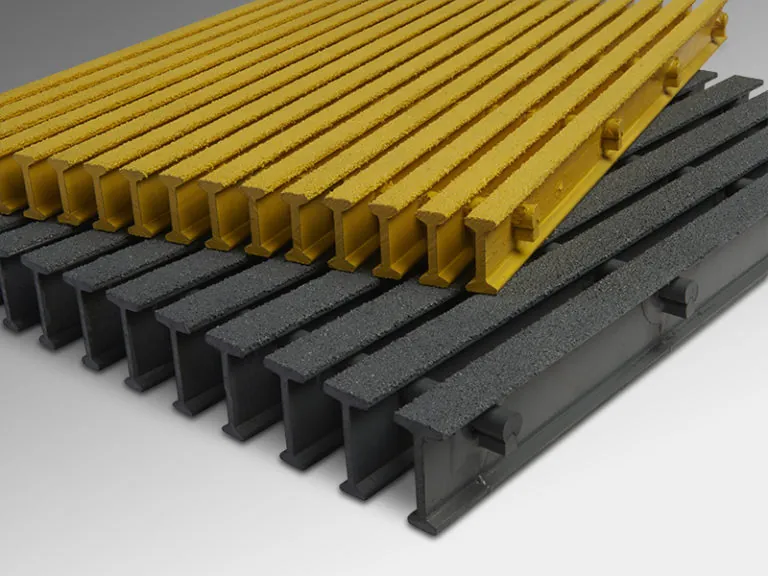
Heavy duty FRP grating is fiberglass reinforced plastic grating engineered to support high uniform and concentrated loads with long spans, typically used for industrial platforms, pipe racks, offshore decks and equipment access where steel grating would previously have been specified. It is available in two forms: thick molded panels (38mm and 50mm) and pultruded I-bar grating (38mm, 50mm and heavier profiles). Heavy duty fiberglass grating delivers load capacities close to steel while remaining corrosion-resistant, non-conductive and around 60-70% lighter.
2. Load Capacity Basics: Uniform vs Concentrated Load
Load capacity is described by two values. Uniform distributed load (UDL) is the load spread evenly across the panel, expressed in kN/m², and is the common basis for platform design. Concentrated or point load is a load applied to a small area, such as a pallet leg, machine foot or a person standing, expressed in kN. Both must be checked against the deflection limit, usually span/100 or a fixed value, because stiffness (not strength) is often the governing criterion for GRP/FRP grating.
3. Load Tables and Deflection Limits
A 38mm heavy duty pultruded FRP grating panel with 600mm clear span typically supports a safe uniform load of around 15 kN/m² with deflection below span/100. A 50mm I-bar panel at 750mm span can exceed 20 kN/m². Molded 38mm panels with 500mm span commonly support 10-15 kN/m². Because actual values depend on bar depth, mesh, resin and support spacing, always use the manufacturer's certified load table for your exact panel and span rather than generic figures.
4. Panel Thickness and Span
The relationship between thickness, span and load is direct: increasing bar depth or panel thickness raises stiffness and therefore load capacity, while increasing span reduces it. For heavy loads, use thicker panels and shorter spans. Pultruded I-bar grating offers the highest strength-to-weight ratio because the aligned glass fibres run the full length of the bar, making it the preferred choice for long spans and concentrated loads on pipe racks and equipment platforms.
Applications, steel comparison and specification
5. Heavy Duty Applications
- Industrial plant platforms and access walkways
- Pipe racks, cable trays and valve access platforms
- Offshore platform decks, gangways and helideck surrounds
- Heavy equipment and maintenance platforms
- Warehouse mezzanines and pallet racking floors
- Chemical plant walkways exposed to aggressive chemicals
- Vehicular access and drive-over covers
6. Comparing FRP with Steel Load Capacity
For equivalent load capacity, heavy duty FRP grating matches steel performance while weighing far less and never corroding. The trade-off is higher material cost than plain steel, offset over the service life by zero maintenance, no repainting and no replacement from corrosion. In coastal, chemical and offshore environments, whole-life cost of heavy duty FRP grating is typically lower than galvanized steel. For fire-rated areas, specify fire-retardant or phenolic resin systems.
7. Specifying Heavy Duty Grating from ZEALL
ZEALL (ZeAllgrate) manufactures heavy duty molded and pultruded FRP grating with certified load tables, in fire-retardant, isophthalic and vinyl ester resin systems. We supply standard and custom panels for spans from 300mm to over 1000mm. Provide your load and span data and our engineers will recommend the correct panel, bar depth and fixing system.
Design standards, load tables and structural data
Design Standards & Data Basis
All load, span and capacity values in this article are typical/indicative, derived from laboratory tests per NAAMM MBG-01 (FRP Grating Design Manual) methodology. Molded grating values apply a 5:1 factor of safety on ultimate capacity; pultruded grating values apply a 3:1 factor of safety, both measured at static ambient conditions. Impact loads are limited to 50% of stated values; long-term loads require creep adjustment per ASCE Structural Plastics Design Manual. Certified load tables, stamped engineering calculations and third-party test reports are available on request.
For structural sizing of your specific application, contact our engineering team with your load requirements, span and environmental conditions — we provide free structural calculations within 24 hours. Browse our molded grating and pultruded grating product pages for full specifications and resin options.
Typical Allowable Uniform Load (kN/m²) - Pultruded I-bar Grating
| Model | Span 1000 mm | Span 1500 mm | Span 2000 mm | Span 2500 mm |
|---|---|---|---|---|
| FG-P5038 (50 mm I-bar x 38 mm spacing) | 22-28 | 10-14 | 5.5-7.5 | 3.5-5.0 |
| FG-P6538 (65 mm I-bar x 38 mm spacing) | 40-50 | 20-26 | 11-15 | 7-10 |
Unidirectional strength measured along bearing bars; spans must be taken between supports along the bar direction. Typical/indicative per NAAMM MBG-01; certified table on request.
Tonnage reference: convert kN/m² to tonne-force per m² by dividing by 9.81. As an indicative rule of thumb, a 50 mm heavy duty pultruded I-bar panel (FG-P5038) typically supports around 6 tonnes UDL per metre of panel width at a 600 mm clear span, and the 65 mm panel (FG-P6538) roughly doubles that figure. Values are typical/indicative, not certified test results.
Model Naming: Thickness x Mesh Reference
ZEALL molded FRP grating is designated by panel thickness x mesh opening. The standard catalog covers four depths (25 / 30 / 38 / 50 mm) and three mesh sizes (38x38, 19x19, 50x50 mm). A typical designation is "38 mm Molded Grating x 38x38 mm mesh" (model code FG-M3838). Common references:
| Model code | Thickness | Mesh | Duty class | Typical use |
|---|---|---|---|---|
| FG-M2538 | 25 mm | 38x38 mm | Light | Drainage covers, light walkways |
| FG-M3038 | 30 mm | 38x38 mm | Medium | General walkways, ramps |
| FG-M3838 | 38 mm | 38x38 mm | Standard | Industrial platforms, standard service |
| FG-M3819 | 38 mm | 19x19 mm | Standard mini-mesh | Tool handling, heel-safe walkways |
| FG-M5038 | 50 mm | 38x38 mm | Heavy | Forklift areas, long spans |
| FG-P5038 | 50 mm I-bar | 38 mm bar spacing | Heavy pultruded | Heavy-duty platforms, truck traffic |
Typical Structural Parameters (I / S / E)
The table below gives typical flexural stiffness ranges for FRP grating profiles. Values are typical per NAAMM MBG-01 and are not a substitute for a certified mill test report. E depends on resin system (isophthalic polyester approx. 10-12 GPa; vinyl ester approx. 12-15 GPa); I and S scale with bar depth and profile shape.
| Profile | E flexural (GPa) | I (cm⁴ / m width) | S (cm³ / m width) |
|---|---|---|---|
| 25 mm molded grid | 10-12 | 2.5-4.0 | 2.0-3.2 |
| 30 mm molded grid | 10-12 | 4.5-7.0 | 3.2-4.8 |
| 38 mm molded grid | 11-13 | 8-13 | 5.0-7.5 |
| 50 mm molded grid | 11-14 | 16-26 | 8.5-13 |
| 50 mm I-bar pultruded | 12-15 | 55-85 | 22-32 |
Typical values per NAAMM MBG-01; certified values per project-specific mill test report on request.
Heavy Duty vs Standard Grating: When to Specify Heavy Duty
FRP grating is supplied in standard and heavy duty grades. Choose heavy duty whenever the application combines high loads, long spans or vehicle traffic; standard grating is the more economical choice for general pedestrian walkways and drainage covers. The table below summarises the typical differences.
| Criterion | Standard FRP grating | Heavy duty FRP grating |
|---|---|---|
| Panel depth | 25-38 mm molded | 50 mm molded, or 38-65 mm pultruded I-bar |
| Typical clear span | up to ~600 mm | 600-1200 mm and beyond |
| Typical UDL capacity | ~5-15 kN/m² | ~15-50 kN/m² (indicative) |
| Traffic | Pedestrian only | Pallet jacks, forklifts, light vehicle access |
| Material cost index | Lower | Higher, but offset by zero maintenance in corrosive sites |
| Best applications | Walkways, drains, ramps, fences | Industrial platforms, pipe racks, equipment decks, drive-over covers |
Rule of thumb: if a pallet jack, forklift, maintenance cart or any wheeled load will cross the panel, specify heavy duty.
EN 1433 Load Classes (D400-F900)
EN 1433 defines load classes A15 to F900 originally for drainage channels and their covers; these class labels are widely reused in industry for gratings, trench covers and drive-over panels. The table below maps each class to its test load and typical use, with an indicative note on where heavy duty FRP grating is a realistic solution.
| Class | Test load (kN) | Typical application | FRP grating note |
|---|---|---|---|
| A15 | 15 | Pedestrian areas, landscaped zones | Standard molded grating |
| B125 | 125 | Pedestrian areas, car parks, kerbsides | Standard to heavy duty |
| C250 | 250 | Kerbside channels, light vehicle traffic | Heavy duty molded |
| D400 | 400 | Roadways, industrial yards, lorry access | Heavy duty pultruded / reinforced covers |
| E600 | 600 | Heavy industrial traffic, container yards | Heavy duty pultruded, engineering review required |
| F900 | 900 | Ports, airports, heavy-duty pavements | Steel-reinforced or hybrid construction; confirm with ZEALL engineering |
Values above are indicative class definitions per EN 1433; actual FRP panel suitability depends on span, bearing width and fixings. Request a certified load statement for the exact cover or panel.
Installation, FAQ and project data
Installation Guide: Heavy Duty FRP Grating
Correct installation is essential to realise the certified load capacity. Follow these key points:
- Space supports exactly to the certified load table span; never exceed the maximum span stated for the panel depth.
- Provide a minimum bearing length of 50-75 mm on steel or concrete supports along every bearing bar.
- Fix each panel at every support with FRP grating clips or clamps — minimum four fixings per panel, more for long spans or vehicle traffic.
- Leave 3-5 mm thermal expansion gaps between panels and against fixed structures.
- Lay panels with bearing bars perpendicular to the supports; keep the fall/drainage direction in mind.
- Cut panels only with a diamond-grit or abrasive saw — never break or snap bars. Seal all cut edges with resin to prevent water uptake.
- Do not drill extra holes in bearing bars in the field; if unavoidable, seal the cut and have the modification checked by engineering.
- Avoid point loads at unsupported panel edges; edge trim or a support channel is recommended for forklift traffic.
Synonyms & Related Terms
Heavy duty FRP grating is searched, specified and listed under several equivalent names. If you are comparing suppliers or writing a specification, these terms all refer to the same heavy-gauge fiberglass grating family covered by this article and designed per NAAMM MBG-01:
- High-Load FRP Grating
- Heavy-Duty Composite Grating
- Structural Strength FRP Grating
- Reinforced Industrial Grating
- Heavy Duty Fiberglass Grating
- Load-Rated GRP Grating
- Forklift-Rated FRP Panel
Browse our product pages for full specifications: FRP pultruded grating · pultruded profiles.
Frequently Asked Questions
Answers to the questions engineers, procurement teams and contractors ask most often when specifying high load and extra heavy FRP grating for structural platforms, forklift rated decks and vehicular traffic areas.
Q1. What is heavy duty FRP grating?
Heavy duty FRP (fiberglass reinforced plastic) grating is a thick-gauge composite panel engineered to carry high uniform and concentrated loads over long spans. It typically uses 50 mm molded panels or 38-65 mm pultruded I-bar profiles, and is the standard replacement for steel grating on industrial platforms, pipe racks, offshore decks and forklift rated walkways.
Q2. What is the difference between standard and heavy duty grating?
Standard grating (25-38 mm molded) is designed for pedestrian walkways and light drainage covers up to about 600 mm span. Heavy duty grating (50 mm molded, or 38-65 mm pultruded I-bar) supports pallet jacks, forklifts, maintenance carts and vehicular traffic over 600-1200 mm+ spans, with UDL capacities typically in the 15-50 kN/m² range (indicative).
Q3. How much weight can heavy duty FRP grating hold?
A 50 mm pultruded I-bar panel at 600 mm clear span typically supports around 6 tonnes of uniform load per metre of panel width; a 65 mm panel roughly doubles that figure. Exact capacity depends on bar depth, mesh, resin, support spacing and deflection limit. Values are typical/indicative per NAAMM MBG-01; request a certified load table for your project.
Q4. What is the maximum span for heavy duty pultruded grating?
Typical maximum clear spans for heavy load pultruded grating are 1200-2500 mm depending on bar depth and required deflection limit. For vehicular traffic or long span structural applications, 50-65 mm I-bar profiles with engineered support steel are recommended. Always confirm span against the certified load table.
Q5. Can forklifts drive on FRP grating?
Yes, on forklift rated panels. Heavy duty 50 mm molded or pultruded I-bar grating with grit-top surface, correct span and edge support is routinely used for forklift and pallet jack traffic on mezzanines, chemical plants and warehouse platforms. Do not use standard 25-38 mm molded panels for forklift traffic.
Q6. What resin is best for heavy duty applications?
Isophthalic polyester is the standard resin for general heavy duty industrial platforms. Vinyl ester is recommended for chemical plants, offshore and wastewater where acid and alkali resistance is critical. Phenolic resin is specified where low smoke and flame retardance (ASTM E-84 Class A) are required, such as tunnels and enclosed substations.
Q7. How does FRP compare to steel grating for heavy loads?
For equivalent load capacity, heavy duty FRP grating weighs 60-70% less, never rusts or needs repainting, and is non-conductive. Material cost is higher than galvanized steel, but whole-life cost in corrosive or coastal environments is typically lower because maintenance, repainting and replacement cycles are eliminated. Use steel for extreme F900 port/airport pavements or where impact energy exceeds FRP limits.
Q8. What is the typical lifespan of heavy duty FRP grating?
Designed and installed per NAAMM MBG-01, heavy duty FRP grating typically lasts 20-30 years in industrial, chemical and coastal environments with no painting or coating maintenance. UV-stabilized resin systems extend outdoor service life; submerged or chemically aggressive duties should be reviewed against the resin selection chart.
Q9. Can I get custom sizes for heavy duty grating?
Yes. Beyond standard panels (1220x3660 mm, 1220x2440 mm), we cut to size, fabricate curved panels, stair treads, special hole cut-outs and reinforced drive-over covers. Custom bar depths and mesh openings are available for OEM projects. Provide your drawings and load data for a tailored quote.
Q10. Do you provide certified load tables?
Yes. Every heavy duty FRP grating order ships with a project load table derived per NAAMM MBG-01 methodology. On request we provide stamped engineering calculations, third-party test reports (Intertek/SGS), and resin mill certificates for your structural submission package.
Real-World Performance Data
Project feedback and field comparisons consistently show the operational advantages of heavy duty FRP over steel. The figures below are typical/indicative ranges drawn from ZEALL reference projects; actual performance depends on span, resin system, environment and maintenance regime.
| Metric | Heavy duty FRP grating | Galvanized steel grating | Typical advantage |
|---|---|---|---|
| Installation labour (per 100 m²) | Light, 1-2 man lifts, hand cutting | Heavy, lifting gear required, welding | FRP installs 40-60% faster |
| Panel weight (50 mm panel) | ~15-20 kg/m² | ~40-55 kg/m² | FRP is 60-70% lighter |
| 20-year maintenance cost index | Near zero (wash-down only) | Inspection, touch-up paint, corrosion repair | FRP cuts maintenance by 90%+ |
| Repainting cycle | None required | Every 3-5 years in coastal/chemical sites | Saves 4-6 repaint cycles |
| Expected service life | 20-30 years (typical) | 10-15 years in corrosive duty | Longer whole-life service |
| Electrical conductivity | Non-conductive, safe near live switchgear | Conductive | Safety benefit in substations |
Values are typical/indicative; actual performance depends on specific application, resin grade, span and site conditions. Contact our engineering team for a project-specific comparison.
Why Choose ZeAllgrate Heavy Duty Grating?
When you specify a structural, high-load or forklift rated panel, you are not only buying a panel — you are buying engineering confidence. Here is why specifiers and contractors choose ZeAllgrate for extra heavy FRP and GRP grating projects worldwide.
- 20+ years manufacturing experience in Nantong, China, with a 20,000+ m² factory and 200+ employees dedicated to molded and pultruded FRP products.
- Export to 45+ countries across North America, Europe, the Middle East, Southeast Asia, Australia and Latin America — project experience covers wastewater, chemical, offshore, solar, power and industrial platforms.
- ISO 9001 certified quality system with full traceability from resin batch to finished panel.
- Product certifications: fire performance per ASTM E-84, design methodology per NAAMM MBG-01, drain covers per EN 1433, plus Intertek/SGS third-party test reports on request.
- Free engineering support: load calculations, CAD drawings, panel layout optimization and fixing recommendations — first response within 24 working hours.
- 20-year warranty on heavy duty molded and pultruded panels, backed by certified load tables and mill certificates shipped with every order.
Get Your Free Heavy Duty Grating Quote
Send us your span, load (kN/m² or kN point load), resin requirement and environment — our engineers will reply within 24 hours with a recommended panel, certified load table and FOB/CIF price.
Get Free Load Calculation Download Product Catalogue
Prefer WhatsApp? Message our engineering team directly for fast quotes and technical datasheets: Chat on WhatsApp — average response under 2 hours during working days. For urgent enquiries, email [email protected].

