FRP and aluminum are both non-ferrous, but they solve different problems. Aluminum conducts electricity and must be bonded; FRP is an insulator that needs no grounding but cannot carry structural load over long spans without pultruded sections. Pick aluminum where you need a conductive, rigid deck; pick FRP where corrosion, electrical isolation or light handling dominate.
- Conductivity: aluminum is a conductor; standard FRP is an electrical insulator.
- Galvanic risk: aluminum touching dissimilar metal in wet electrolyte couples corrosion.
- Weight: molded FRP panel runs 12.5-38.0 kg/m2; equivalent aluminum deck is heavier per m2 for equal stiffness.
- Grounding: aluminum walkways in classified areas must be bonded; standard FRP does not need it.
- Service life: aluminum anodizing/painting maintenance cycles; FRP corrosion-free in most acids.
Why FRP and Aluminum Get Compared
Engineers reach for aluminum grating for a non-rusting, non-magnetic deck lighter than steel, and reach for FRP (fiber-reinforced polymer) for the same reason in corrosive service. The two look interchangeable on a takeoff; they are not. Aluminum is a conductive metal; FRP is an insulating composite that behaves differently under load, fire and contact with other metals.
This is not another price table; the site's FRP-vs-steel pages own that narrative. Here we compare the two non-ferrous materials on the dimensions that drive a good or bad install: electrical behavior, galvanic coupling, weight per m2, load at equal span, grounding obligations, thermal movement and hidden maintenance.
| Property | Aluminum grating | FRP molded / pultruded | Design implication |
|---|---|---|---|
| Material class | Non-ferrous metal | Glass fiber + resin composite | Different failure modes |
| Electrical resistivity | 3.5 × 10⁻⁸ Ω·m (conductor) | Typically 10¹² Ω·m 以上 (insulator) | Grounding vs isolation |
| Density | ~2.7 g/cm3 | 1.5-2.0 g/cm3 | FRP lighter per m3 |
| Young's modulus | ~70 GPa | 10-20 GPa (pultruded along fiber) | Aluminum stiffer per section |
| Thermal expansion | 23 × 10⁻⁶ /K | 20–30 × 10⁻⁶ /K resin-dependent | Both need expansion joints |
| Corrosion base | Oxide film; pitting in chlorides | Resin matrix controls; glass inert | Different failure surfaces |
Electrical Behavior and Shock Risk
Aluminum is a good conductor. On a substation deck or over live busbar that is either a benefit (one bonded plane) or a hazard (a fallen conductor energizes every panel). The code response is bonding: clamps, jumpers and verified resistance to earth.
Standard FRP is an insulator and does not energize when a conductor falls across it, which is why utilities specify it for decks over live equipment. FRP cannot carry fault current, so a surrounding steel frame is bonded on its own. Conductive or static-dissipating FRP variants exist for flammable-vapor areas but are a separate product, not the standard panel.
| Situation | Aluminum deck | Standard FRP deck | Code action |
|---|---|---|---|
| Walkway over live busbar | Risk of energized deck | Insulating; preferred | Bond aluminum; none for FRP |
| Flammable solvent area | Static build-up possible | Static possible unless dissipative | Specify ESD/conductive variant |
| Substation ground grid | Becomes part of grid | No contribution | Bond frame separately |
| MRI / RF screened room | Magnetic but conductive | Non-magnetic, non-conductive | FRP preferred |
Note: If a site requires a controlled resistance to earth (anti-static or ESD floors), specify the conductive/anti-static FRP product explicitly. Standard molded and pultruded panels are insulators and will not meet that requirement.
Galvanic Corrosion at Contacts
Aluminum corrodes fastest not from the air, but from contact with a nobler metal in the presence of an electrolyte. Stainless-steel bolts, copper pipes, brass handrail fittings and steel supports all sit higher in the galvanic series. When rain or process water bridges the contact, aluminum becomes the anode and corrodes at the fastener.
FRP has no galvanic activity. It will not corrode another metal and it cannot be galvanically corroded itself. The only contact issue with FRP is mechanical: stainless clips bearing on a glass-rich edge can wear a groove over years, which is a fit problem, not a corrosion problem. In coastal and chloride service, this is the single largest reason engineers switch from aluminum to FRP.
| Contact pair | Wet electrolyte present? | Galvanic risk | Mitigation |
|---|---|---|---|
| Aluminum + stainless clip | Yes, salt spray | High at fastener | Isolation gasket, SS316 |
| Aluminum + copper pipe | Yes | Severe | Break the metal path |
| FRP + stainless clip | Yes | None | Standard clip |
| FRP + aluminum substructure | Yes | None | No isolation needed |
| Aluminum + carbon steel support | Yes | High | Coat + isolate |
Weight, Handling and Erection
Density alone does not give the right answer. Aluminum density is about 2.7 g/cm3 and FRP density is 1.5-2.0 g/cm3, so FRP raw material is lighter. But an equal-stiffness aluminum section can be a thin extrusion, while an FRP panel relies on open mesh geometry. The fair comparison is weight per square meter at the same clear span and the same deflection limit.
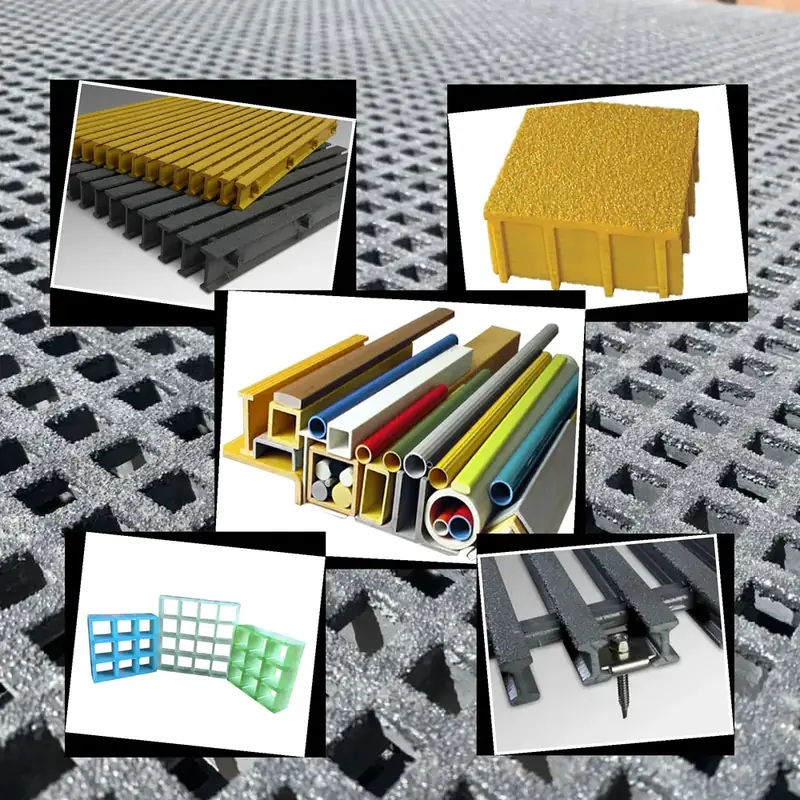
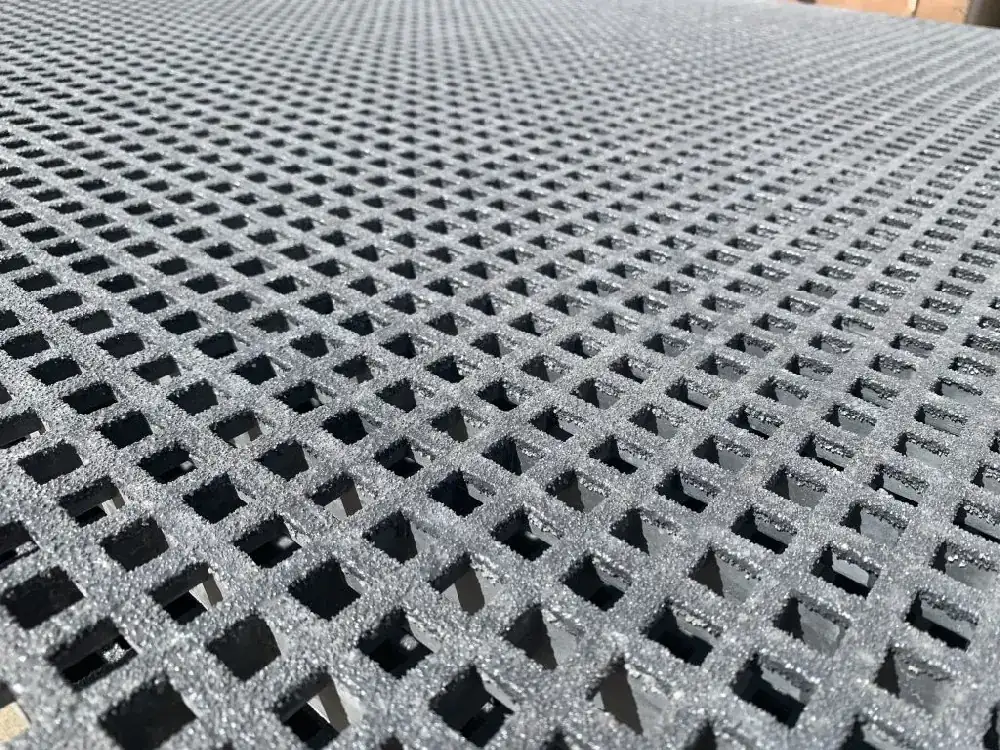
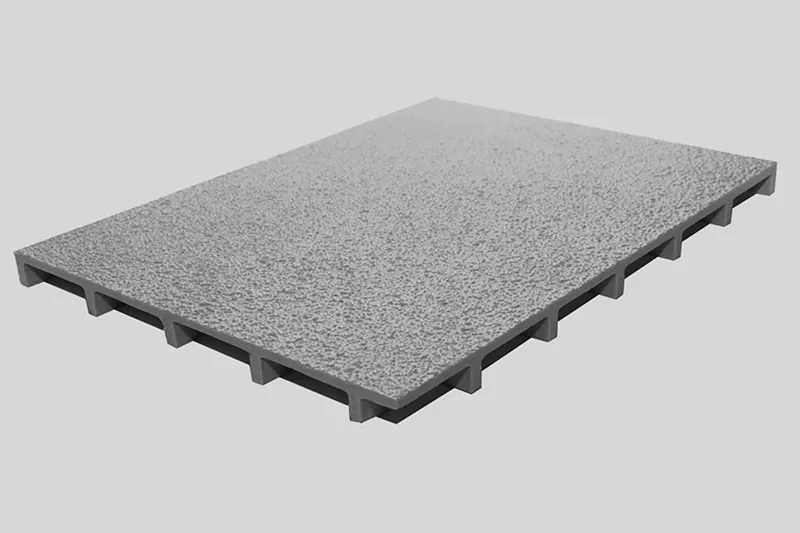
Molded FRP panel densities are fixed by the manufacturing line: 25 mm mesh at 12.5 kg/m2, 30 mm at 15.0 kg/m2, 38 mm at 19.5 kg/m2, 38x40 at 18.0 kg/m2, 50 mm at 27.0 kg/m2 and 65 HD at 38.0 kg/m2. A standard panel is 1220x3660 mm. Because two workers can lift a 38 mm FRP panel, erection on rooftops, cooling towers and marine decks is done without a crane in most cases. Aluminum decks of equal span often need lighter panels but still require more handling care against denting.
| Deck thickness / type | FRP mass (kg/m2) | Note |
|---|---|---|
| Molded 25 mm | 12.5 | 68% resin-rich surface |
| Molded 30 mm | 15.0 | 66% glass |
| Molded 38 mm | 19.5 | 68% glass |
| Molded 38x40 mm | 18.0 | 70% glass |
| Molded 50 mm | 27.0 | 60% glass |
| Molded 65 HD | 38.0 | 56% glass |
| Equivalent aluminum deck | By project condition confirm | Section-dependent; ask supplier |
Load, Stiffness and Deflection
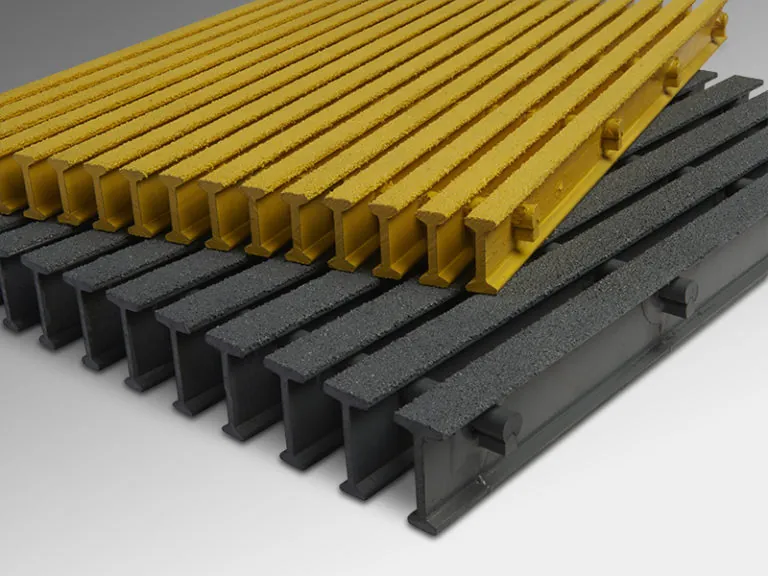
Aluminum is stiffer per unit volume than FRP. A 70 GPa modulus means an aluminum extrusion deflects less than an FRP pultrusion of the same cross-section. But FRP pultruded profiles are engineered with deep I-bars and T-bars, and the grating itself spans between supports, not as a solid plate. Load tables are therefore the only fair comparison.
For pultruded FRP at L/200 simply supported, the panel carries 35 kN/m2 at 600 mm span, 18 kN/m2 at 900 mm and 9 kN/m2 at 1200 mm (p38). At p50 the numbers are 48/26/14 kN/m2 and at p65 62/35/20. These are published engineering values; 1 kN/m2 equals about 20.9 lb/ft2. Aluminum load capacity depends on extruded section and alloy temper, and must come from the aluminum supplier's span table for the exact profile.
| Pultruded FRP type | 600 mm span | 900 mm span | 1200 mm span (kN/m2, L/200) |
|---|---|---|---|
| p38 | 35 | 18 | 9 |
| p50 | 48 | 26 | 14 |
| p65 | 62 | 35 | 20 |
| Aluminum equivalent | By project condition confirm | By project condition confirm | By project condition confirm |
The deflection choice matters more than ultimate strength. Walkways for people are normally checked at L/200; floors carrying sensitive equipment or long pipe runs are often specified at L/360. Aluminum reaches L/360 more easily because of its modulus; FRP reaches it by going to a deeper profile or shorter support spacing. That spacing change is what actually drives the steel support count and the installed cost.
Chemical Resistance Boundaries
Aluminum resists neutral and mildly alkaline environments through its oxide film. It fails in strong acids, in strong alkalis, and in chlorides where pitting starts under a damaged coating. FRP resistance is set entirely by the resin: polyester for mild service, isophthalic for better acid resistance, vinyl ester for strong acids and solvents, phenolic for low-smoke fire service.
| Environment | Aluminum | Polyester FRP | Vinyl ester FRP |
|---|---|---|---|
| Neutral water / freshwater | Good | Good | Good |
| Chloride / coastal air | Pitting risk | Good | Good |
| Strong acid (e.g. HCl) | Poor | Conditional | Good |
| Strong alkali (NaOH) | Poor | Poor | Conditional |
| Solvents / hydrocarbons | Attacked | Poor | Good |
| Oxidizing bleach / hypochlorite | Poor | Poor | Good, confirm concentration |
Note: Chemical compatibility is concentration- and temperature-dependent. The chart above is a selection starting point; every acid or alkali exposure must be confirmed against the resin manufacturer's chemical-resistance table before ordering.
Grounding, Bonding and Code
This is where the two materials diverge most in practice. Aluminum walkways in a substation, on an offshore module or near cathodically protected piping are part of the electrical system. They need bonding jumpers at every support, a measured continuity, and inspection after every panel replacement. The designer must also watch stray-current and cathodic-protection interaction: an aluminum structure bonded to a steel pipeline can become a galvanic cell.
Standard FRP needs no grounding and introduces no continuity path. It is the reason utilities specify FRP for decks over live equipment and why it appears on solar rooftops where the frame is bonded separately. The code caveat is flammable-vapor areas: an insulating deck can build static from foot traffic or conveying equipment, so an anti-static or conductive FRP variant is specified, with its own controlled resistance band. ASTM F3059 covers pedestrian surface requirements for FRP grating; our third-party report 211122012SHF-001 covers the grating itself, not profiles or handrails.
| Code / scenario | Aluminum requirement | FRP requirement |
|---|---|---|
| Substation deck | Bond to ground grid | No bonding; frame bonded separately |
| Flammable vapor area | Bond + ESD controls | Specify conductive/ESD FRP |
| Rooftop over live PV | Bond required | Insulating; preferred |
| Near cathodic protection | Isolate to avoid cell | No interaction |
| Pedestrian surface | By local code | ASTM F3059; report 211122012SHF-001 |
Thermal Movement and Fire
Both materials expand with temperature, and both need expansion clearance at supports. Aluminum expands roughly 23 × 10⁻⁶ per K; FRP expands in the range 20-30 × 10⁻⁶ per K depending on resin and fiber orientation. In practice the FRP anisotropy means the longitudinal (fiber) direction moves less than the transverse direction, which is why panel layout always runs the strong direction along the span and clips are placed to allow slip.
Fire behavior is a sharper difference. Aluminum softens and melts around 600 C and drips; it does not burn but loses structural strength early. FRP does not melt; it chars and burns, releasing smoke. Standard polyester FRP meets typical Class flame-spread requirements under ASTM E84; phenolic FRP is the low-smoke option for enclosed walkways and escape routes. Neither material is a fire-rated assembly on its own; fire approval is always for a tested system.
| Behavior | Aluminum | Standard polyester FRP | Phenolic FRP |
|---|---|---|---|
| Softening / melt | ~600 C, drips | Chars, no melt | Chars, low smoke |
| Smoke | None | Moderate | Low |
| Flame spread (ASTM E84) | Non-combustible | Class per system test | Low-smoke system |
| Post-fire structural | Lost when melted | Charred panel; replace | Lowest collapse risk |
Lifecycle Cost Drivers
We deliberately avoid repeating the per-square-meter purchase numbers from the FRP-vs-steel pages. The FRP-vs-aluminum decision is won or lost on maintenance tasks that do not appear on the price sheet. Aluminum drives an ongoing coating and inspection cycle: anodizing damage, paint chipping at edges, fastener isolation renewal, and re-bonding after panel changes. FRP drives almost no surface maintenance, but it does drive clip inspection and periodic Barcol hardness checks on aged installations.
| Cost driver | Aluminum deck | FRP deck |
|---|---|---|
| Surface coating cycle | Anodize / paint touch-ups | None on resin-rich surface |
| Fastener isolation | Renew gaskets at contact | Standard SS clips; no isolation |
| Grounding inspection | Continuity test each cycle | No bonding to test |
| Repair | Weld/dent repair; replacement | Cut out panel; clip new one |
| Spare panel lead time | By supplier | 12-36 working days, MOQ 10 m2 |
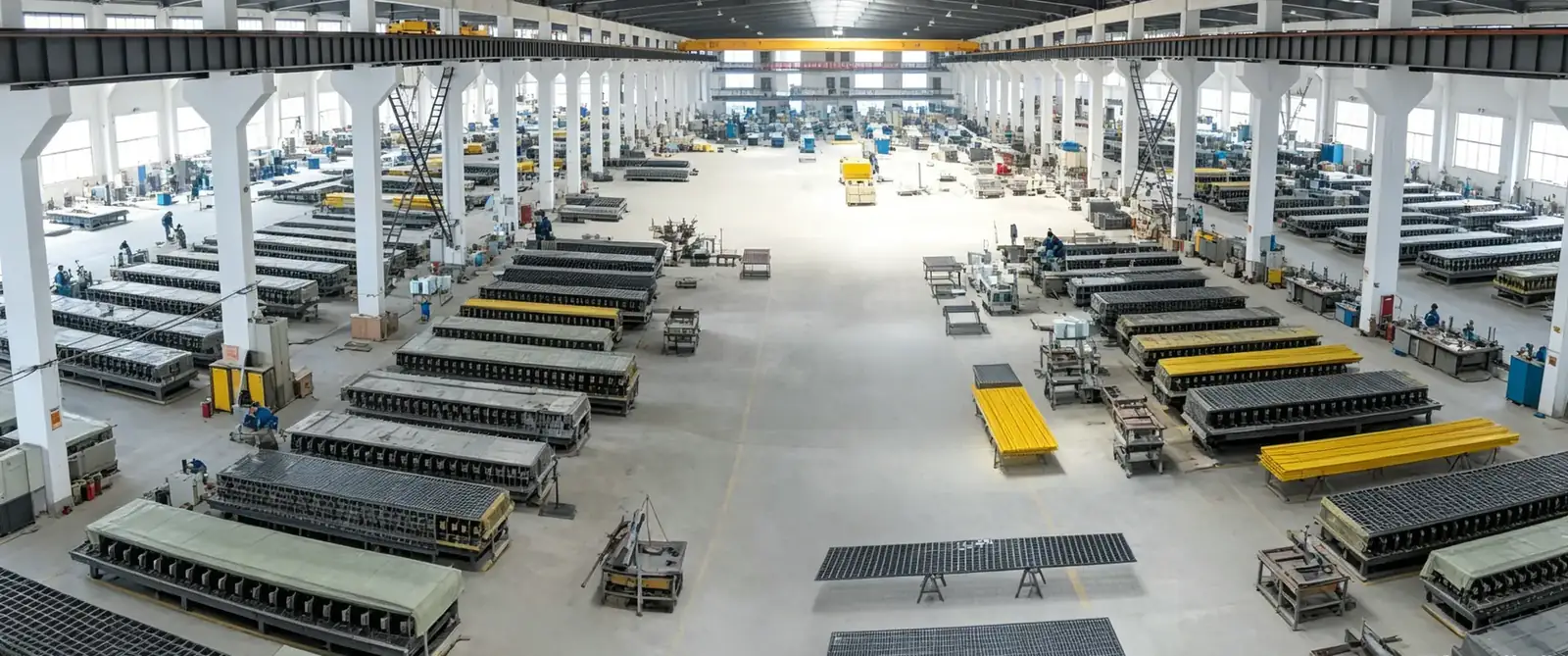
| Factory scale | - | 20,000+ m2 site, 200+ staff, since 2004 |
Where aluminum still wins on lifecycle: heavy-duty vehicle decks, high-temperature platforms above ~120 C continuous, and areas where the structural frame itself is aluminum and a common material reduces the thermal and galvanic interface. Where FRP wins: corrosive chemicals, coastal chloride service, electrical isolation, and any deck that two people must install without lifting equipment.
Selection Matrix
Use this matrix as a first-cut filter, then confirm with load tables and chemical compatibility. The matrix is intentionally conservative; when in doubt, the deck that can be specified without a bonding design is usually the lower-risk choice for a non-structural access walkway.
| If your project is... | Choose aluminum | Choose FRP |
|---|---|---|
| Over live electrical equipment | No | Yes, standard panel |
| Coastal / salt spray | Conditional, isolate | Yes |
| Strong acid or solvent deck | No | Yes, vinyl ester |
| Continuous >120 C | By project confirm | No, check resin limit |
| Needs to be part of ground grid | Yes | No |
| Flammable vapor area | Bond + ESD | Conductive/ESD FRP |
| Rooftop, hand-installed | Possible | Preferred |
| MRI / RF screened room | No | Yes, non-magnetic |
Specifying the Right Panel
Specify FRP when the job is access, corrosion resistance, electrical isolation or light erection. Specify aluminum when the job is a structural metal deck that must conduct, carry vehicle load or survive continuous high temperature. In both cases, ask for the span table at your exact deflection limit, the chemical-resistance confirmation for your worst service, and the bonding or ESD classification before you issue the purchase order.
- Confirm span, deflection limit (L/200 or L/360) and live load before picking thickness.
- Confirm resin against the worst chemical concentration and temperature.
- Confirm electrical classification: insulator, anti-static, or bonded conductor.
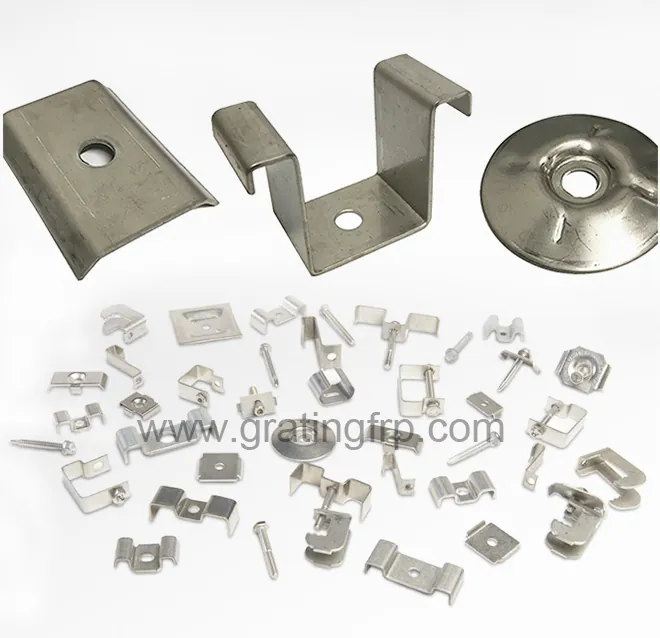
- Confirm fastener material: SS304 inland, SS316 coastal; isolation gaskets for aluminum contacts.
- Spare panels: MOQ 10 m2, lead time 12-36 working days; standard panel 1220x3660 mm.
Note: ASTM F3059 governs pedestrian surface performance; our third-party report 211122012SHF-001 covers grating only, not pultruded profiles or handrail. Certification GB/T19001-2000 idt ISO9001:2000, register 01708Q11888R0S, valid to 2028-12-30.
Frequently Asked Questions
Is FRP grating non-conductive compared with aluminum?
Standard molded and pultruded FRP is an electrical insulator with resistivity typically above 10¹² Ω·m. Aluminum is a good conductor around 3.5 × 10⁻⁸ Ω·m. If a controlled anti-static resistance is needed, specify the conductive FRP variant; the standard panel will not meet it.
Can FRP grating touch aluminum or stainless steel?
Yes. FRP has no galvanic activity, so it does not corrode and cannot corrode another metal. Aluminum touching stainless or copper in wet chloride conditions does corrode at the contact, which is why isolation gaskets are used on aluminum decks but not on FRP.
How much lighter is FRP than aluminum per square meter?
Molded FRP panels run 12.5 to 38.0 kg/m2 depending on thickness (25 to 65 mm). FRP density is 1.5-2.0 g/cm3 versus about 2.7 g/cm3 for aluminum. The fair comparison is at equal span and deflection, where the exact aluminum section must come from the supplier's span table.
Does aluminum grating need grounding or bonding?
On substations, offshore modules and near cathodic protection, aluminum walkways are part of the electrical system and must be bonded with measured continuity. Standard FRP needs no grounding; if the area has flammable vapors, specify conductive/anti-static FRP instead.
Which lasts longer in coastal or chemical service?
In coastal chloride or acid service, FRP (especially vinyl ester) outlasts painted or anodized aluminum because aluminum pits at fasteners and coatings. In continuous high temperature or where the deck must conduct, aluminum is the better choice. Confirm every exposure against the resin chemical-resistance table.