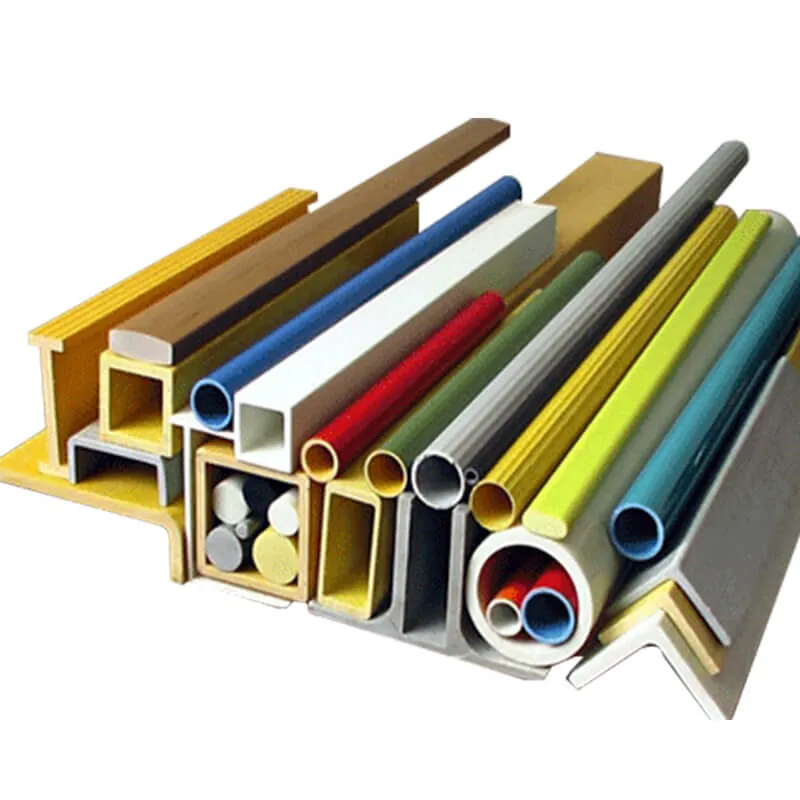
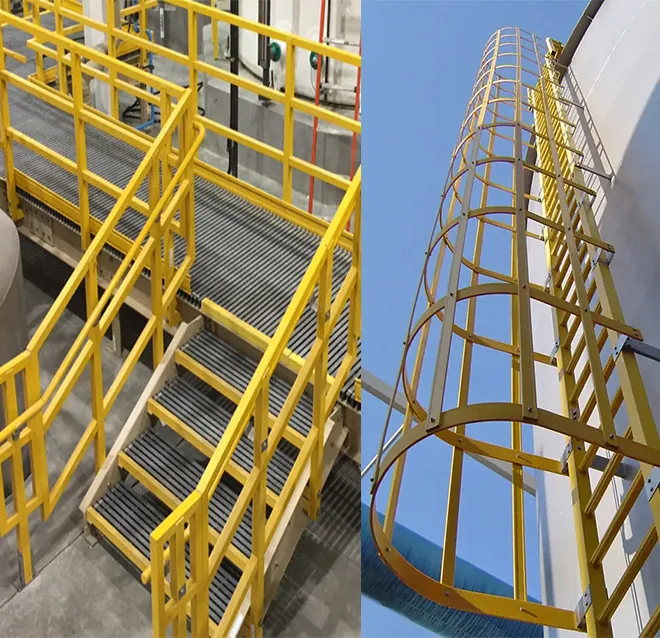
A handrail is a rail designed to be gripped by the hand for support on stairs, ramps and narrow walkways. A guardrail (guard) is a barrier along an open edge that prevents a person from falling from a platform, pit, trench or hole. The two terms are often used loosely, but their functions are different: one assists balance and travel, the other stops a fall. FRP rail systems are supplied as handrail sets for stairs and as guardrail sets for open edges.
- Function: handrail gives hand support for balance and movement; guardrail blocks a fall over an open edge.
- Where used: handrail on stairs, ramps and inclined routes; guardrail along platform edges, pits, trenches and roof openings.
- Composition: a handrail is mainly a graspable rail; a guardrail typically has a top rail, intermediate rail, posts and sometimes a toe board.
- Load and height: both follow local fall-protection codes for height, spacing and applied load; values are set by the jurisdiction.
- Material: FRP, steel and aluminum are all used; FRP is chosen where corrosion resistance, non-conduction and light erection matter.
What Is a Handrail?
A handrail is a rail you hold onto. Its job is to give a stable handhold on an inclined or stepped route: stair flights, ramps, narrow walkways and access ladders where a person needs balance while moving. A good handrail is graspable along its full length, firmly fixed to posts or wall brackets, and continuous around landings so the grip is never interrupted.
On a stair the handrail follows the pitch of the flight; on a ramp it follows the ramp slope. It may be mounted to a wall with brackets or carried on independent posts. Its primary design driver is grip, consistency and firm fixing, not stopping a fall into open air.
What Is a Guardrail?
A guardrail — also called a guard, edge protection or fall barrier — runs along an open edge to prevent a person from walking or slipping off a platform, mezzanine, dock, trench, pit, roof opening or stair landing. It forms a physical barrier, not a handhold alone.
A typical guardrail assembly combines upright posts, a top rail at the barrier height, an intermediate (mid) rail so the opening between rails cannot admit a person, and sometimes a toe board to stop tools or loose material rolling off the edge. The assembly must resist the lateral load expected at the top rail without pulling out of the support.
Where the Two Terms Get Mixed Up
In everyday drawings and site talk the words overlap. A single rail on a platform edge may be called a handrail even when its real duty is fall protection; conversely a stair rail may be listed under guardrail schedules. The mix-up matters because the two duties are checked against different requirements, and a rail chosen only as a grip may not meet the barrier load expected of a guard.
When reviewing a takeoff, classify the rail by its duty rather than its name: does it support a person traveling up or down (handrail), or does it close an open edge (guardrail)? Some locations need both — a stair flight has a handrail for grip, while the stair landing edge needs a guardrail.
Height, Spacing and Load
Required rail height, post spacing, mid-rail opening and applied lateral load are set by the fall-protection codes in force at the project location. Heights are commonly in the roughly one metre range above the walking surface, but the exact value, the maximum opening between rails and the design load must be read from the local code for that jurisdiction rather than assumed from another country's standard.
| Aspect | Handrail | Guardrail |
|---|---|---|
| Primary duty | Grip and balance on movement | Barrier against falling over an edge |
| Typical location | Stairs, ramps, inclined routes | Platforms, pits, trenches, roofs, openings |
| Key members | Graspable rail, brackets or posts | Posts, top rail, mid rail, optional toe board |
| Check against | Grip continuity, fixing, code height | Barrier height, rail spacing, lateral load, fixing pull-out |
| Shared features | Continuous rail, corrosion-resistant finish, secure fittings | Same; modular FRP sets supply both duties |
Material Options: Steel, Aluminum and FRP
Steel guardrails are strong and rigid but need corrosion protection in wet or chemical service. Aluminum is lighter and non-rusting but conductive and prone to galvanic contact corrosion. FRP (GRP) rails are non-conductive, non-magnetic, immune to galvanic activity and supplied as modular posts, rails and fittings that assemble mechanically without welding.
FRP is commonly chosen for chemical plants, wastewater decks, coastal and marine structures, substation walkways, cooling towers and car wash floors. It is not a substitute where a structural metal frame must carry vehicle or heavy equipment loads; in those cases the surrounding structure is steel or aluminum and the rail infill can be FRP.
Specifying the Correct Rail
- Mark every run by duty: handrail for stairs and ramps, guardrail for open edges; keep both where a landing needs them.
- Read the local fall-protection code for height, post spacing, rail opening and lateral load before sizing sections.
- Select resin against the worst chemical concentration and temperature: polyester, isophthalic, vinyl ester or phenolic.
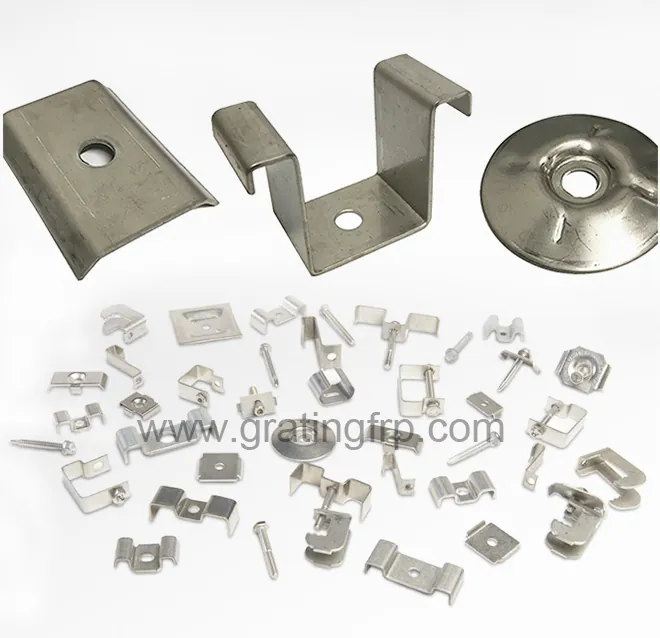
- Match fastener to exposure: SS304 inland, SS316 coastal; use isolation gaskets only where dissimilar metals touch.
- Order modular sets with spare fittings; MOQ 10 m², lead time 12–36 working days.
See the FRP handrail and guardrail system and the handrail system guide for post spacing, stair rails and fitting layout.
Frequently Asked Questions
What is the main difference between a handrail and a guardrail?
A handrail is gripped for support on stairs, ramps and narrow walkways. A guardrail is a barrier along an open edge that prevents a person falling from a platform, pit, trench or hole. One assists travel; the other stops a fall.
Can the same rail serve as both?
Not always. A platform-edge rail chosen only for grip may not meet the barrier load expected of a guardrail. Some locations need two rails: a handrail on the stair flight and a guardrail on the open landing edge.
What height should a rail be?
Height, post spacing, opening between rails and lateral load are set by the local fall-protection codes for the project jurisdiction. Read the applicable code rather than copying a value from another country's standard.
Is FRP suitable for both handrails and guardrails?
Yes. Modular FRP sets are supplied as handrail posts and rails for stairs and as guardrail posts, top rails, mid rails and toe boards for open edges. FRP is preferred where corrosion resistance, non-conduction and light erection matter.
When should I choose steel or aluminum instead of FRP?
Choose steel or aluminum where the frame must carry vehicle or heavy equipment loads, or where the rail must conduct fault current. For corrosive, wet, coastal or electrical-isolation service, FRP is usually the lower-maintenance choice.