FRP and aluminum handrails both resist rust, but they behave differently in corrosive, wet or electrical service. Aluminum conducts and can couple galvanic corrosion at contacts; FRP is an insulating composite that needs no grounding and will not corrode another metal. Choose aluminum where a conductive, rigid metal rail is required; choose FRP where corrosion resistance, electrical isolation and light hand erection dominate.
- Material: aluminum is a conductive non-ferrous metal; standard FRP is an insulating composite.
- Galvanic risk: aluminum touching stainless, copper or steel in wet electrolyte corrodes at the fastener; FRP has no galvanic activity.
- Weight: FRP pultruded rails are lighter per metre and can be cut and installed by hand without welding.
- Electrical: aluminum railing in classified areas must be bonded; standard FRP needs no grounding.
- Maintenance: aluminum drives coating and isolation renewal cycles; FRP surface maintenance is minimal, with periodic clip and edge inspection.
Why FRP and Aluminum Handrails Get Compared
Engineers specify aluminum railing for a rust-proof, non-magnetic metal rail that is lighter than steel, and they reach for FRP (fiber-reinforced polymer) handrail for the same reason in corrosive service. The two look interchangeable on a layout; they are not. Aluminum is a conductive metal, while FRP is a glass-fiber-and-resin composite that behaves differently under wet exposure, contact with other metals, electrical fault conditions and ongoing maintenance.
This comparison stays on the rail system itself — posts, rails, fittings and stair rails — and does not repeat the deck-plate narrative owned by the FRP-vs-steel grating pages.
Material and Electrical Behavior
Aluminum is a good conductor. On a substation deck, over live busbar or near cathodically protected piping, that conductivity is either a benefit (one bonded metal plane) or a hazard (a fallen conductor energizes every fitting). The code response is bonding: clamps, jumpers and a verified continuity to earth.
Standard FRP handrail is an insulator and does not energize when a conductor falls across it, which is why utilities specify composite rails for decks over live equipment. FRP cannot carry fault current, so the surrounding steel frame is bonded on its own. Conductive or static-dissipating FRP variants exist for flammable-vapor areas but are a separate product, not the standard rail.
Galvanic Corrosion at Contacts
Aluminum corrodes fastest not from air, but from contact with a nobler metal in the presence of an electrolyte. Stainless-steel brackets, copper fittings and steel supports all sit higher in the galvanic series. When rain or process water bridges the contact, aluminum becomes the anode and corrodes at the fastener.
FRP has no galvanic activity: it will not corrode another metal and cannot be galvanically corroded itself. The only contact issue with FRP is mechanical — stainless clips bearing on a glass-rich edge can wear a groove over years, which is a fit problem, not a corrosion problem. In coastal and chloride service this is the largest reason engineers switch from aluminum to FRP.
Weight, Handling and Erection
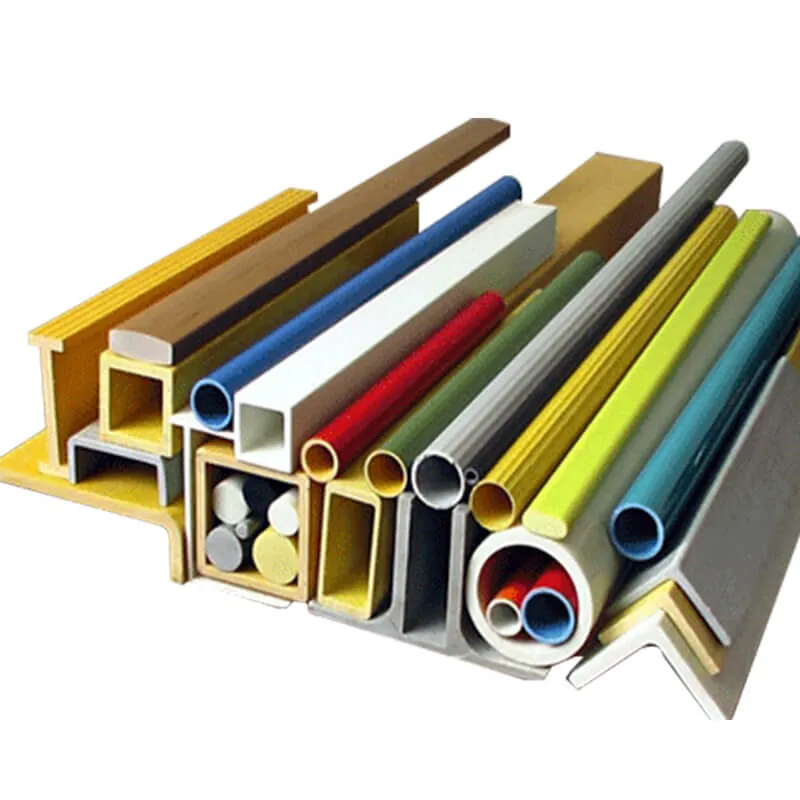
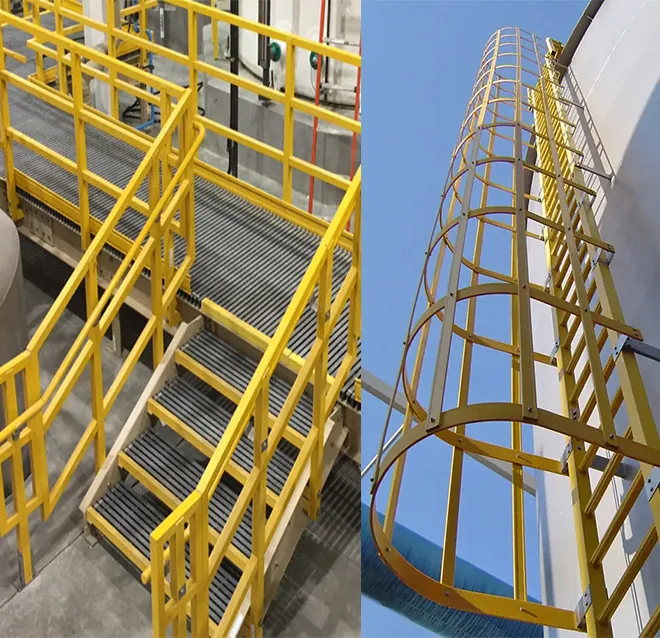
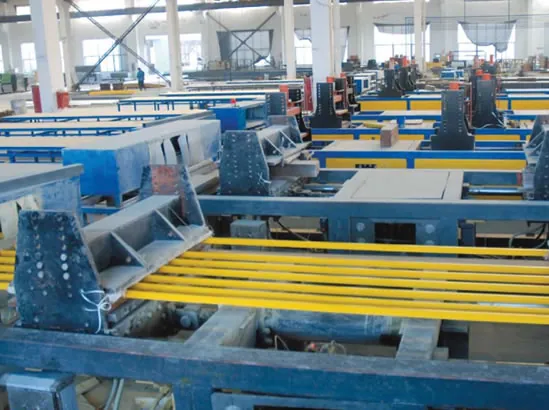
FRP pultruded handrail sections are lighter than an equal-stiffness aluminum rail and are supplied as a modular system: posts, top rails, mid rails, brackets and stair fittings cut to length and assembled with mechanical connectors. No welding is required on site. Two workers can erect a platform run on rooftops, cooling towers, marine decks and chemical walkways without a crane or hot-work permit.
Aluminum rails are also lightweight, but dent and bend more readily against impact, and fittings often need drilling, tapping or welding on site. The fair comparison is weight per metre at the same post spacing and the same rail load; exact aluminum section data must come from the aluminum supplier's catalogue for the chosen profile.
Chemical and Coastal Resistance
Aluminum resists neutral and mildly alkaline environments through its oxide film. It fails in strong acids, strong alkalis, and in chlorides where pitting starts under a damaged coating. FRP resistance is set by the resin: polyester for mild service, isophthalic for better acid resistance, vinyl ester for strong acids and solvents, phenolic for low-smoke fire service.
| Environment | Aluminum rail | FRP rail (standard) | Note |
|---|---|---|---|
| Freshwater / neutral washdown | Good | Good | Both suitable |
| Chloride / coastal air | Pitting risk | Good | FRP preferred |
| Strong acid (e.g. HCl) | Poor | Conditional / vinyl ester | Confirm resin |
| Strong alkali (NaOH) | Poor | Conditional | Confirm concentration |
| Solvents / hydrocarbons | Attacked | Vinyl ester | Confirm exposure |
Note: Chemical compatibility is concentration- and temperature-dependent. The chart is a selection starting point; every exposure must be confirmed against the resin manufacturer's chemical-resistance table before ordering.
Maintenance and Lifecycle
Aluminum drives an ongoing coating and inspection cycle: anodizing damage, paint chipping at edges, fastener isolation renewal, and re-bonding after rail replacements. FRP drives almost no surface maintenance, but it does drive clip and fitting inspection and periodic Barcol hardness checks on aged installations.
Where aluminum still wins: a structural metal rail that must conduct fault current, high-temperature platforms above the resin limit, and frames already aluminum where a common material reduces the thermal and galvanic interface. Where FRP wins: corrosive chemicals, coastal chloride service, electrical isolation, and any rail that two people must install without lifting equipment.
Specifying the Right Handrail
- Confirm whether the rail must conduct or bond to the ground system; if isolation is required, standard FRP is the lower-risk choice.
- Confirm the worst chemical concentration and temperature, then select polyester, isophthalic, vinyl ester or phenolic resin.
- Confirm fastener material: SS304 inland, SS316 coastal; isolation gaskets where aluminum meets dissimilar metal.
- Confirm post spacing, rail height and load against the local fall-protection codes for your jurisdiction.
- Spare fittings and replacement rails: MOQ 10 m², lead time 12–36 working days; standard sections cut to order.
Browse the FRP handrail and stair system for the modular post, rail and fitting range; see the handrail system guide for post spacing and installation detail.
Frequently Asked Questions
Is FRP handrail non-conductive compared with aluminum?
Standard molded and pultruded FRP handrail is an electrical insulator; aluminum is a good conductor. If a controlled anti-static resistance is required, specify the conductive FRP variant; the standard rail will not meet that requirement.
Can FRP handrail touch aluminum or stainless steel?
Yes. FRP has no galvanic activity, so it does not corrode and cannot corrode another metal. Aluminum touching stainless or copper in wet chloride conditions corrodes at the contact, which is why isolation gaskets are used on aluminum rails but not on FRP.
Which is lighter, FRP or aluminum railing?
FRP pultruded sections are lighter per metre and assemble mechanically without welding. The fair comparison is at equal post spacing and rail load; exact aluminum section weight must come from the supplier's catalogue for the chosen profile.
Does aluminum handrail need grounding or bonding?
On substations, offshore modules and near cathodic protection, aluminum rails are part of the electrical system and must be bonded with measured continuity. Standard FRP needs no grounding; in flammable-vapor areas specify conductive/anti-static FRP instead.
Which lasts longer in coastal or chemical service?
In coastal chloride or acid service, FRP (especially vinyl ester) outlasts painted or anodized aluminum because aluminum pits at fasteners and coatings. In continuous high temperature or where the rail must conduct, aluminum is the better choice. Confirm every exposure against the resin chemical-resistance table.