
FRP Grating — Fiberglass Reinforced Plastic (FRP) Grating Panels
Molded & Pultruded FRP Grating · Vinyl Ester · Custom Sizes · Engineering Support — ISO 9001 certified factory with 20+ years experience, exported to the USA, Australia and 45+ countries.
What Is FRP Grating?
FRP (Fiberglass Reinforced Plastic) grating — also known as fiberglass grating, fibreglass grating or GRP grating — is a lightweight, high-strength composite flooring panel made from glass fiber reinforcement and corrosion-resistant thermoset resin. It is the most widely used term across North America, and the standard solution for industrial walkways, platforms and access flooring.
FRP grating combines the strength of glass fiber with the corrosion resistance of resin, giving you a flooring, walkway and platform solution that will not rust, rot or corrode — even in aggressive chemical, marine and wastewater environments. Unlike steel, FRP grating is non-conductive, low-maintenance and weighs only about one-quarter of equivalent steel panels, making it dramatically easier to handle and install.
FRP vs GRP vs Fiberglass: They are the same material. FRP (Fiberglass Reinforced Plastic) is the term most used in the US and global industrial markets; GRP (Glass Reinforced Plastic) is common in the UK and Commonwealth; fiberglass grating is the plain-English name. FRP Grating Master supplies all three, in molded and pultruded construction.
FRP Grate: Same Product, Different Word
FRP grate and FRP grating are interchangeable spellings for the same product in the composites industry. A grate is simply the anti-slip, open-mesh fiberglass reinforced plastic panel described on this page. If your drawing, quotation or specification says "FRP grate", it refers to this FRP grating — the open, grid-like FRP composite flooring we manufacture and export.Molded and Pultruded FRP Grating
Molded FRP Grating
Continuous glass fiber mat and resin compression-molded into a strong, uniform open-mesh panel. Ideal for general walkways, platforms and heavy pedestrian and light vehicle traffic. Grit-top anti-slip surface available.
Pultruded FRP Grating
High-strength I-bar and T-bar pultruded construction for large spans and heavy industrial loads. Excellent for offshore, chemical plant and long-span platforms.
FRP Grating Clips
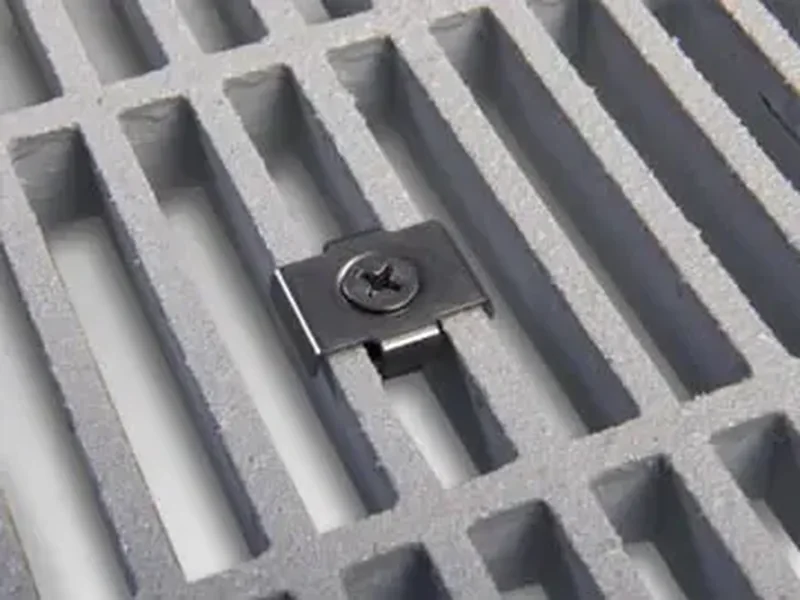
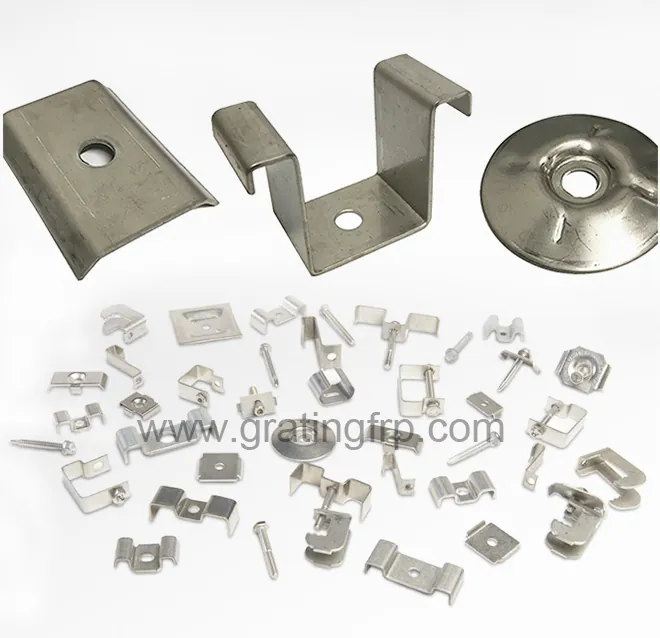
Stainless steel M, C, L and Z clips to secure FRP grating panels quickly and safely, available in SS304 and SS316.
Why Choose FRP Grating?
Corrosion Resistant
Impervious to rust, rot and chemical attack. Ideal for wastewater, chemical plants, marine and offshore.
Anti-Slip Surface
Grit-top and concave surfaces give reliable slip resistance in wet, oily and greasy conditions.
Lightweight
About a quarter the weight of steel — faster, cheaper installation with no heavy lifting equipment.
Non-Conductive
Electrically insulating and non-magnetic — safe for electrical rooms and live-plant environments.
Fire Retardant
Fire-retardant resin grades meet relevant flame-spread ratings for industrial safety.
UV Stable
UV-stabilized resin systems resist sunlight degradation for long outdoor service life.
Lightweight FRP Grating
Lightweight FRP grating weighs roughly one quarter of steel, so a single installer can carry full panels on site and freight and crane costs drop on every project.
FRP Grating Specifications
FRP Grating Applications
Trusted by engineers, contractors and distributors across the USA, Australia, the Middle East and beyond for corrosion-proof flooring and access systems.
Walkways & Platforms
Industrial walkway and platform grating for plants, refineries and factories.
Trench & Drain Covers
FRP trench cover grating and drainage grating for municipal and industrial works.
Stair Treads
Anti-slip FRP stair tread grating for safe vertical access.
Marine & Offshore
Dock, deck and offshore FRP grating in corrosive salt environments.
Water & Wastewater
Treatment plant walkways and covers that never corrode.
Food & Beverage
Food-grade, easy-to-clean FRP flooring for processing areas.
Car Wash FRP Grating
Car wash FRP grating keeps detergent- and chemical-soaked bays drained and slip-safe, with a gritted top that survives daily vehicle traffic.
Direct Manufacturer, First-Class Quality, Competitive Price
FRP Grating Master is a real FRP grating factory — not a trading company. In-house molding and pultrusion give us full control over quality, pricing and lead times, so you get first-class FRP grating at factory-direct prices.
Factory Direct Pricing
Buy straight from the manufacturer — no middleman markup.
Full Quality Control
Incoming material inspection, in-process checks, load testing and traceable records.
Custom Engineering
Custom sizes, colors, surface treatments and tooling from CAD to production.
Global Shipping
FOB, CIF or DDP worldwide with full documentation: COA, MSDS and load test reports.
Fire Rating & Class A Flame Spread
Our molded and pultruded FRP grating is engineered with flame-retardant resin systems that meet ASTM E84 Class A flame-spread requirements for public, commercial and industrial interiors.
See the full technical guide: FRP Grating Fire Rating & ASTM E84 Flame Spread.
FRP Grating FAQ
Request Your FRP Grating Quote
Manufacturer & Certifications
Manufactured by NANTONG ZEALL NEW MATERIALS CO., LTD. in Nantong, Jiangsu, China. Contact our export team at [email protected] or +86 513 6681 9918. Every panel is produced under an ISO 9001 quality system, CE marked, fire-rated to ASTM E-84 Class B, and independently tested to Intertek and ABS standards. We supply direct from our own production factory to customers in 45+ countries.Keyword Reference: English, Español, Deutsch, Français
- FRP grate = ES: rejilla FRP (grate) · DE: FRP-Rost (grate) · FR: grille FRP (grate)
- FRP trench cover grating = ES: rejilla para cubierta de zanja de FRP · DE: FRP-Kanalabdeckungsrost · FR: caillebotis FRP pour couvercle de tranchée
Looking for GRP Grating (glass reinforced plastic grating)? GRP grating is the same composite product as FRP grating — explore our dedicated GRP grating page for moulded and pultruded GRP panels, anti-slip surfaces and heavy-duty applications.
Specifications
| Parameter | Value |
|---|---|
| Thickness | 25 / 30 / 38 / 50 mm |
| Mesh size | 38×38 mm / 19×19 mm / 12×12 mm |
| Panel size | 1220×3660 mm (standard) |
| Surface options | Grit-top / Concave / Smooth / Covered |
| Resin system | Isophthalic / Vinyl Ester / Phenolic |
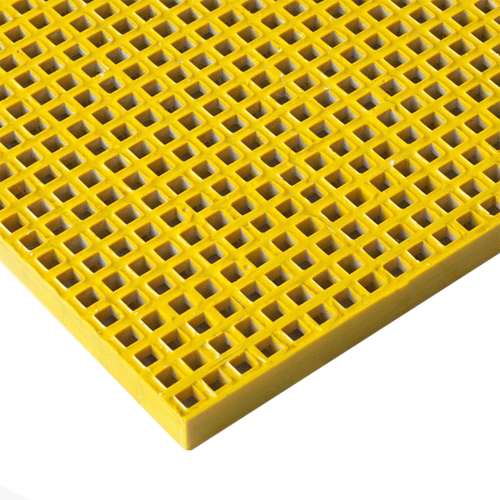
| Color | Grey / Green / Yellow / Custom |
Installation & Selection Guide
Step 1: Choose your application. Walkways, platforms, trench covers, stair treads, and marine jetties each require different panel thickness and surface finish. Anti-slip gritted surface is recommended for wet or oily environments; smooth surface for light-duty walkways.
Step 2: Select mesh and thickness. 25mm thickness suits pedestrian walkways; 38–50mm for heavy-duty vehicle or long-span applications. 38×38mm mesh is standard; 19×19mm for small-part containment or anti-fall protection.
Step 3: Pick the right resin. Isophthalic resin for general industrial use; vinyl ester for chemical plants and offshore; phenolic for fire-rated environments.
FRP vs Steel vs Aluminum
| Feature | FRP Grating | Steel Grating | Aluminum |
|---|---|---|---|
| Weight | Light (1/4 of steel) | Heavy | Medium |
| Corrosion | Never rusts | Rusts without paint | Resists oxidation |
| Electrical | Insulating, non-magnetic | Conductive | Conductive |
| Maintenance | Zero painting | Paint / galvanize | Low |
| Cost | Medium (long-term ROI) | Low upfront | High |
FAQ
What is FRP Grating — Fiberglass Reinforced Plastic (FRP) Grating Panels?
FRP Grating — Fiberglass Reinforced Plastic (FRP) Grating Panels is a fiberglass-reinforced composite panel used for walkways, platforms, trench covers and anti-slip flooring. It is lightweight, corrosion-proof and electrically insulating.
How strong is FRP Grating — Fiberglass Reinforced Plastic (FRP) Grating Panels compared to steel?
FRP grating panels compete with steel on load-bearing while weighing about 75% less, reducing structural and installation cost. Heavy-duty pultruded panels match steel for long spans.
Can FRP Grating — Fiberglass Reinforced Plastic (FRP) Grating Panels be cut to size?
Yes. FRP panels are cut on-site with standard power tools. Custom sizes, openings and notches are available factory-direct.
What surface finish is best for outdoor use?
Grit-top (anti-slip) surface is recommended for outdoor walkways, stair treads and wet areas. UV-stabilized resin prevents fading in direct sunlight.
How long does FRP grating last?
Typical service life is 20+ years in industrial environments with no painting or maintenance. ISO 9001 manufacturing ensures consistent quality.
Is FRP Grating — Fiberglass Reinforced Plastic (FRP) Grating Panels fire-resistant?
Phenolic resin panels achieve fire-rated performance for enclosed plant rooms. Standard isophthalic and vinyl ester resins are self-extinguishing.
Buyer's Checklist
- Application: walkway / platform / trench / stair / marine
- Required thickness (25 / 38 / 50 mm)
- Mesh size (38×38 / 19×19 mm)
- Surface finish (grit-top / smooth / concave)
- Resin system (iso / vinyl ester / phenolic)
- Color and custom dimensions
- Clips and fixing hardware (M / C / L / Z type)
FRP Grating Resin Systems: How to Choose the Right One
The glass reinforcement provides strength, while the resin matrix determines corrosion resistance, temperature performance and fire behavior. Selecting the correct resin is the key engineering decision for the operating environment.
Orthophthalic (General Purpose)
The standard economy resin for mild, non-corrosive settings such as pedestrian walkways and light industrial platforms where chemical exposure is limited.
Isophthalic (Corrosion Resistant)
Offers better corrosion and moisture resistance and is the common choice for wastewater, marine, chemical processing and outdoor environments with intermittent exposure.
Vinyl Ester (High Chemical Resistance)
Provides superior resistance to acids, alkalis and solvents, and is specified for aggressive chemical plants, pulp and paper, and continuous immersion service.
Phenolic (Fire and Low Smoke)
Selected where low flame spread and low smoke emission are critical, including offshore platforms, transit and enclosed infrastructure; it is often used for fire-retardant specifications.
Understanding Span, Load and Deflection
FRP grating load tables relate three variables: the clear span between supports, the applied uniform or concentrated load, and the resulting deflection. For safe design, the panel span is kept short enough that deflection stays within the limit set by the applicable standard while retaining a safety factor against the ultimate load.
- Bearing bars should run perpendicular to the supporting members so loads transfer directly onto the supports.
- Uniform load is expressed over an area; concentrated (point) loads such as a wheel or foot require a separate check.
- Increasing panel thickness or reducing the support spacing lowers deflection for the same load.
- Always confirm the design against the project standard (ASTM, OSHA, BS EN ISO or equivalent) and the published load table for the selected panel.
FRP Grating Standards Across Major Markets
FRP grating projects around the world reference different national and international standards. The table below summarizes the frameworks most commonly specified in each market; the underlying performance requirements for access and walkway systems are closely aligned.
| Market | Commonly Referenced Standards |
|---|---|
| United States | ASTM, OSHA, ANSI, NFPA (including ASTM E84 and FRP grating load standards) |
| United Kingdom | BS EN ISO 14122, BS 4592, EN 13501, UKCA |
| Germany / EU | DIN, EN, ISO, CE |
| Australia | AS, EN |
| Canada | CSA, ASTM, NBC |
| Middle East | ISO, ASTM, local civil defense fire rules |
| Singapore | SS, ISO, ASTM, CE |
See the dedicated standards reference and specifications hub for detailed technical guidance.
Care, Maintenance and Service Life
FRP grating requires minimal maintenance compared with steel, which must be painted or galvanized to prevent rust. A few simple practices keep panels safe and extend service life.
- Clean surfaces periodically with water and a mild detergent to remove buildup that could reduce slip resistance; high-pressure washing is generally acceptable.
- Inspect clips and fixings after installation and at routine intervals, retightening or replacing any that are loose or damaged.
- Check panels after impact or overload events for cracks or delamination and replace affected sections rather than loading them further.
- Keep weld or heat work away from the resin surface, as prolonged high temperature can damage FRP even though it performs well in normal operating heat.
With correct resin selection and basic care, fiberglass grating commonly delivers decades of corrosion-free service, with no ongoing painting or rust treatment.
FRP Grating for Germany, France, Spain, Sweden and Norway
Across Western Europe and the Nordics, access and walkway requirements are closely aligned through EN and ISO standards, while each market keeps its own national references and marking rules.
Germany
German projects commonly reference DIN, EN and ISO standards with CE marking for access and walkway systems. Panels are shipped through major ports such as Hamburg and Bremerhaven. See the Germany supplier guide and the markets hub.
France
French specifications use NF EN ISO 14122 for access systems and EN standards, with CE marking and REACH material requirements. Delivery typically routes through Le Havre and Marseille-Fos. See the France supplier guide and the markets hub.
Spain
Spanish projects reference UNE and EN standards with CE marking. FRP grating is widely used in coastal and chemical plants, with shipments via Valencia and Algeciras. See the markets overview and the markets hub.
Sweden
Swedish industrial and marine projects apply SS and EN standards with CE marking, often in corrosive coastal and pulp-and-paper environments. Goods commonly enter through Gothenburg. See the Sweden supplier guide and the markets hub.
Norway
Norwegian offshore and process projects follow NS/EN and ISO standards; CE-marked FRP is widely accepted even though Norway is outside the EU. The non-conductive, low-smoke properties suit North Sea platforms, with shipping via Oslo and Bergen. See the Norway offshore guide and the markets hub.
FRP Grating for the United Kingdom: Standards and Compliance
Our FRP grating is supplied to UK industrial, marine, offshore and construction projects and is engineered to align with the British and European standards commonly specified across the country. For access platforms, walkways and stair systems, UK buyers typically reference BS EN ISO 14122 and BS 4592, together with EN 13501 for fire classification. Products can be supplied with the UKCA marking and supporting CE documentation on request.
Corrosion-resistant fiberglass grating is widely used in coastal and chemical environments where steel would rust, including water treatment, offshore platforms, chemical plants and port infrastructure. Consignments to the UK are commonly routed through the major container ports of Felixstowe and Southampton, with inland delivery arranged to the final site.
- Standards: BS EN ISO 14122, BS 4592, EN 13501, with UKCA and CE support
- Resin options: isophthalic, vinyl ester and phenolic, including fire-retardant systems
- Panel thickness: 25 / 38 / 50 mm with molded and pultruded constructions
- Surface options: grit-top anti-slip, concave and smooth finishes
See our United Kingdom market overview for local applications, standards and shipping details, or contact us for a project-specific FRP grating quotation.
Explore FRP Grating by Topic
By Type
- Molded FRP Grating
- Pultruded FRP Grating
- Mini Mesh Grating
- Heavy Duty Grating
- Anti-Slip Grating
- Phenolic Grating
- Composite Grating
- Covered Grating
- Chequered Plate Grating
- Boardwalk Plank
- Transparent Grating
- Conductive Grating
- Custom Grating
- Grating Panels
By Application
- Walkway Grating
- Platform Grating
- Stair Tread Grating
- Trench Cover Grating
- Marine Grating
- Oil & Gas Grating
- Food & Beverage Grating
- Cooling Tower Grating
- Mining Grating
- Power Plant Grating
- Solar Grating
- Rooftop Safety
Related Systems
- FRP Handrail
- FRP Ladder
- Grating Clips
- Structural Profiles
- FRP Fence
- Manhole Cover
- Crossover Stairs
- Grating Price
Resources
Related Pages
FRP Grating · GRP Grating · GRP Grating Manufacturer · Fiberglass Grating · FRP Grille · FRP Grating Clips · Anti-slip FRP Grating · Molded FRP Grating · Pultruded FRP Grating
High strength composite grating for Industrial fiberglass flooring grating
Where a factory floor has to carry pallet trucks, drum handling and occasional foot traffic—and at the same time resist oils, acids, wash-down water and stray electrical current—High strength composite grating replaces chequer plate, bar grating and even concrete screed. As Industrial fiberglass flooring grating, the panels are laid over steel or FRP supports at 30–60 cm centres, grit-top surface up, and bolted down with standard clips. They drain through the mesh, grip wet boots, and never need painting or anti-slip re-coating.
The load case that drives the choice is a 5 t pallet truck wheel or a 250 kg pedestrian point load over a 60 cm span. Pultruded T-bar grating in 38 mm depth carries 35 kN/m² at p38 and 48 kN/m² at p50, comfortably above plant floor duty. Because the material is non-conductive, the same panel works around substations, battery-charge rooms and welding bays without isolation mats. See how it pairs with FRP structural profiles for support frames, and the pultruded grating product family for heavy-duty spans.
Industrial fiberglass flooring grating vs steel plate flooring
Steel chequer plate is cheap to buy but heavy, slippery when wet, and begins to rust the moment the paint is scratched. Composite grating, by contrast, weighs about one quarter of a steel plate of the same span, drains through the mesh so oil and water do not pool, and keeps a grit-top that does not wear smooth. On chemical-plant floors and wash-down bays the non-conductive, corrosion-proof behaviour removes the two maintenance items—rust and isolation matting—that plague steel floors. Standard FRP grating panels ship in 1220×3660 sheets and cut to fit.
Factory floor pultruded composite grating—span, load and lifetime
A Factory floor pultruded composite grating installation is engineered, not stocked. The depth (25 / 38 / 50 mm), the bar profile (T-bar or I-bar), the mesh opening (38×38, 38×152 or bespoke) and the resin system (iso-polyester, vinyl ester, phenolic) are chosen against the actual wheel loads, chemical exposure and required span. Pultruded bars carry the load along their depth; cross rods tie them together; the whole panel behaves as a one-way slab, which is why load tables are quoted per metre of bar length rather than per square metre.
In food and beverage plants, dairy halls and brewery wash-down areas, iso-polyester panels with a grit-top are the default; vinyl ester steps in where caustic CIP chemicals, chlorine or hot fats are present. The panels clip onto FRP or steel supports with FRP clips, never welded, so changes to the line layout are quick and do not damage the resin skin. MOQ is 10 m², lead time 12–36 working days, standard 1220×3660 sheets—a 38 mm panel weighs about 87 kg and fits on a standard pallet.
Factory floor pultruded composite grating in food and chemical plants
Food-grade floors demand non-absorbent, cleanable, non-chipping surfaces. FRP grating meets all three: the resin skin does not harbour bacteria, the open mesh lets wash-down water fall through to the drain, and the grit top does not shed metal particles the way worn steel plate can. In chemical plants the same logic extends to acid and alkali resistance; vinyl ester grade handles 30 % sulfuric and caustic soda at elevated temperatures. For the supplier-side engineering pack, see our FRP grating supplier page.
Industrial FRP Grating: Frequently Asked Questions
What load does High strength composite grating carry on a 60 cm span?
Pultruded T-bar p38 (38 mm depth) carries 35 kN/m² uniformly distributed, p50 carries 48 kN/m², p65 carries 62 kN/m². Deflection at these loads is below span/200. For pallet-truck point loads the bar depth is upsized to 50 or 65 mm. Exact numbers depend on the resin, the grit top and the edge condition; send the drawing and we will quote the section.
Is Industrial fiberglass flooring grating non-slip when wet?
Yes. The standard grit-top is a layer of coarse quartz or carborundum bonded into the resin skin before cure; it is moulded in, not painted on, so it does not peel. On wash-down bays, dairy floors and coastal boardwalks it keeps a wet-static coefficient of friction above 0.6 for the life of the panel.
What is the MOQ and lead time for Factory floor pultruded composite grating?
MOQ 10 m², lead time 12–36 working days. Standard iso-poly 1220×3660 panels ship fastest; vinyl ester, phenolic and cut-to-size sit at the longer end. NANTONG ZEALL has been manufacturing since 2004 on a 20,000 m² plant, ISO 9001 01708Q11888R0S and ASTM F3059 211122012SHF-001. No unit prices are published; send the layout for a quotation.
Fiberglass Grate, FRP Drainage Grating and Non-conductive Grating: The Names Buyers Use
Fiberglass grate, fiberglass grating and fiberglass reinforced plastic grating — one product, three names
A fiberglass grate and a fiberglass grating are the same article: a load-bearing mesh of glass-reinforced polymer bars, moulded or pultruded, laid over supports. The longer form, fiberglass reinforced plastic grating, appears in specifications and tender documents where the material has to be spelled out rather than abbreviated; it describes exactly the same panel as FRP grating or GRP grating. Buyers who search for a grate usually want the trench-cover or tree-pit product, while grating tends to mean walkway and platform flooring, but the catalogue item, the resin systems and the load tables do not change with the word.
Because the term varies by market and by specifier, we quote against drawings rather than against a keyword. Tell us the span, the bar depth (25/38/50/65 mm), the resin (isophthalic, vinyl ester, phenolic) and the fixing, and the quotation comes back in the terminology your project uses. See the panel family on our FRP grating panels page and the fixing range on FRP clips.
FRP drainage grating and non conductive FRP grating: what the two phrases actually describe
FRP drainage grating is not a separate product line — it is ordinary open-mesh grating specified for the job it does: 65–75 % open area so rain, wash-down water, oils and fire-suppression water fall straight through to the drain below. The phrase turns up in car-wash bays, food plants, cooling-tower decks and bunded chemical areas, where a solid plate would pond water and a steel grate would corrode at the drain lip. Bar depth and mesh pitch are chosen from the drainage duty and the wheel load, not from the label.
Non conductive FRP grating is the same panel described by its electrical behaviour: e-glass and a thermoset matrix carry no stray current and are non-magnetic, which is why they are the default floor inside substations, battery-charge rooms, third-rail zones and MRI suites. Dielectric strength typically exceeds 10 kV/mm, and there is no metal rebar or embedded fastener to become a step-potential path. Both descriptions point to the same catalogue item — see the resin and standards detail on the FRP grating overview and the support frames on FRP structural profiles.
Frequently asked questions
Industry applications
- FRP Grating by Industry: Where Corrosion, Load, Insulation and Hygiene Decide the Grade
- FRP Grating for Aquaculture: Walkways, Platforms and RAS Flooring
- FRP Grating for Agriculture and Livestock Housing: Walkways and Slatted Floors
- FRP Grating for Telecom Towers and Utility Access Platforms
- FRP Panels and Grating for Truck, Trailer and Freight Bodies
Technical downloads
Allowable uniform load table for moulded and pultruded FRP grating (L/200, simply supported single span, 600 / 900 / 1200 mm), with panel weights and unit conversions. Indicative figures — confirm against a stamped project calculation.
Span, Load and Deflection: How to Select the Right Panel Grade, With a Worked Example
Selecting a moulded grating panel is a three-variable problem: the span between supports, the live load the walkway must carry, and the deflection limit the structural engineer has specified. Pick any two and the third is determined by the datasheet. The mistake most specifiers make is holding only span and load in their head and forgetting the deflection limit — which is why a 38 mm panel that easily carries 25 kN/m² at 900 mm span on a breaking-load basis can still be the wrong panel for a walkway designed to L/360.
The datasheet table is already the working-load number, after the 2.5 safety factor. At 900 mm span, the M 38 moulded grade carries 12 kN/m²; the M 38–50 grade carries 10 kN/m²; the pultruded P 38 carries 18 kN/m². These are the numbers you read directly; do not double them for a safety factor, because the 2.5 is already baked in. If your internal spec demands an additional 1.5 factor, apply that 1.5 to our published number, not to the breaking load.
Worked example: a pedestrian walkway in a coastal water-treatment plant, 900 mm support span, design live load 5 kN/m², deflection limit L/200. The structural engineer wants to know whether M 38 moulded is adequate. Step one: read the table at 900 mm span — M 38 carries 12 kN/m² working load. Step two: compare with the design load of 5 kN/m² — 12 is comfortably above 5, so the load condition is met. Step three: check the deflection. At 900 mm span, L/200 means the panel may deflect up to 4.5 mm under the 5 kN/m² load. Our datasheet deflection figure for M 38 at 900 mm span under 5 kN/m² is well within the 4.5 mm window. Step four: apply the creep check. The walkway will see sustained outdoor load for twenty years; the ten-year deflection under sustained load is roughly double the day-one deflection. If the day-one deflection is 2.5 mm, the ten-year deflection will be around 5 mm — which exceeds L/200 (4.5 mm) at the end of design life. The correct selection is therefore M 38–50, not M 38, even though the load condition alone would have allowed M 38.
This example is the reason we ask for the deflection limit before quoting. A buyer who sends only span and load will get a quote for M 38; the same buyer who sends span, load and deflection limit L/200 for a coastal outdoor walkway will get a quote for M 38–50. The difference is 15 percent in panel cost, and it is the difference between a walkway that stays within spec for twenty years and one that needs replacement at year ten.
For pallet-truck decks, the design live load jumps to 10 kN/m² or higher, and the pultruded profiles (P 38, P 50, P 65) are usually the correct choice rather than the moulded panels. At 900 mm span, P 38 carries 18 kN/m², P 50 carries 26 kN/m², and P 65 carries 35 kN/m². The pultruded profiles have longitudinal glass rovings running the full length, which gives them higher stiffness per kilogram than the random-fibre moulded panels; the trade-off is that pultruded panels are directional — they must be laid with the pultrusion direction perpendicular to the supports.
L/200 Versus L/360: Choosing the Deflection Limit, and Why Creep Is the Hidden Factor
The deflection limit on a walkway is set by the structural engineer, not by the grating supplier. L/200 and L/360 are the two values that come up on 90 percent of our enquiries. L/200 means a 900 mm span may deflect up to 4.5 mm under design load; L/360 tightens that to 2.5 mm. The choice is driven by what sits on the walkway: a pedestrian boardwalk with no handrail accessories can run L/200; a walkway that carries sensitive instrumentation, or that has glass handrails bolted to it, or that forms part of a production line where a perceptible bounce would alarm operators, will be specified L/360. The supplier does not decide; the supplier sizes the panel to whatever limit the engineer writes on the drawings.
Here is the trap. A 38 mm moulded panel at 900 mm span meets L/200 comfortably. The same 38 mm panel at the same span does not meet L/360 — not because it is weaker, but because stiffness, not strength, is the limiting factor. Stepping up from M 38 to M 50 adds thickness, which adds stiffness, which brings the deflection down into the L/360 window. The breaking load does not change proportionally; the 50 mm panel is not twice as strong as the 38 mm panel, it is stiffer. On a load-only comparison, both panels would do the job; on a deflection comparison, only the 50 mm panel satisfies the L/360 requirement. This is why the datasheet table lists kN/m² at a given span, not at a given strength grade — the span-and-deflection combination is the design driver, not the grade label.
Long-term creep is the factor that most often catches engineers who are new to GRP. A fresh panel on day one deflects a certain amount under load. After ten years of sustained outdoor load, the same panel deflects roughly twice as much under the same load. That doubling is creep, and it is the reason our 2.5 safety factor is not optional. The 2.5 breaks down into three multipliers: a creep allowance of 1.6 (covering the ten-year doubling), a batch-scatter allowance of 1.2 (covering normal production variation between press runs), and a construction-tolerance allowance of 1.3 (covering slightly short supports or slightly over-torqued clips on site). Multiply those three and you get 2.5. When an engineer runs a hand calc and gets a deflection that is half of ours, he is comparing his day-one coupon number against our ten-year working number; the gap is the creep headroom, not a data error.
For indoor, climate-controlled installations with no sustained point load, the creep factor is smaller, and an engineer can sometimes step down a grade. For outdoor coastal walkways with pallet trucks running twice a day, the full 1.6 creep factor applies, and the datasheet table is the correct starting point. We do not recompute creep per project; we publish the conservative number and let the engineer decide whether his indoor application deserves a relaxation. The cost of over-specifying a grade on an indoor walkway is about 15 percent in panel cost; the cost of under-specifying on a coastal walkway is a replacement at year ten.
One final note on safety factors. If your internal engineering spec demands a 1.5 factor on every structure, do not stack it on top of our 2.5. Our 2.5 is already the design factor for GRP, which includes creep, batch scatter and construction tolerance. Applying an additional 1.5 gives an effective 3.75, which would push you from M 38 to M 50 on every walkway at 40 percent higher panel cost — an unnecessary uplift. The correct reading is: our table is already the ten-year working load. If your spec demands a total design factor of 3.75, apply your 1.5 to our published number; do not ask us to lower the table.
Fibreglass Grating for UK and Commonwealth Projects
Specifiers in the United Kingdom, Australia, New Zealand and Ireland very often write fibreglass grating, while US and global buyers write fiberglass grating, FRP grating or GRP grating. All four names point at one panel: a composite grid of E-glass reinforcement in a thermoset resin, moulded or pultruded into a load-bearing floor. The old /fibreglass-grating/ address is retained as a permanent redirect so bookmarked links and tender documents still land on this page.
Fibreglass, GRP and FRP: one panel, three spellings
Spelling differences do not change the product data. A fibreglass grating panel in a UK specification has the same 25 mm, 30 mm, 38 mm, 38 × 40 mm, 50 mm and 65 mm heavy-duty depths, the same 1220 × 3660 mm standard sheet, and the same Barcol hardness and density figures as the sheet quoted to a US engineer as molded fiberglass grating. Where a specification mixes the two, we quote the same line item twice rather than substitute a different product.
UK specifications: BS EN 13706 profiles and kN/m2 load tables
British and European enquiries usually arrive with loads in kN/m2 rather than lb/ft2, and with pultruded profiles referenced to BS EN 13706. We work in both systems: 1 kN/m2 ≈ 20.9 lb/ft2 and 1 kg/m2 = 0.2048 lb/ft2, so a deflection limit of L/200 or L/360 can be checked against the metric load table without conversion loss. For projects that call for BS EN 13706 pultruded profiles, we quote against that standard and issue the mechanical property sheets the structural engineer needs for the calculation.
Shipments to UK and Commonwealth ports leave with COA, MSDS and load test reports, production runs 12–36 working days from drawing approval, and freight is quoted per Incoterm so the delivered cost is visible before the order is placed.
FRP Grating: The Search Terms Behind the Acronym
FRP grating is searched under more spellings than any other name for this product. The four that matter are fiberglass reinforced grating, fibreglass reinforced grating, glass fiber reinforced grating and glass fibre reinforced grating — two spellings of fiber plus two word orders, all pointing at one composite grid. FRP itself stands for fiberglass reinforced plastic, so each short form is the long name with the resin word dropped.
Whichever term your procurement system uses, the delivered item is identical: moulded or pultruded FRP grating to ASTM F3059, with the same corrosion resistance, anti-slip surface and non-conductive rating.
One Panel, Four Spellings: Fiberglass Reinforced Grating in Purchase Orders
Purchase orders and drawing title blocks reach us written as fiberglass reinforced grating, fibreglass reinforced grating, glass fiber reinforced grating or glass fibre reinforced grating. The first two are the short forms of fiberglass reinforced plastic grating with the word plastic dropped; the second pair puts the reinforcement before the resin, which is the same order used by GFRP. Two spellings of fiber and two word orders, four labels, one delivered item: molded or pultruded glass-fibre grid to ASTM F3059, quoted from the span, bar depth and resin on your drawing rather than from the wording of the email.
| Term | Where buyers use it | What it means |
|---|---|---|
| FRP grating | US catalogues, datasheets, RFQs | Fibre-reinforced plastic grating — the moulded or pultruded panel itself |
| Fiberglass grating | US search terms and email enquiries | Short form of fiberglass reinforced grating |
| fiberglass reinforced grating | US drawings and purchase orders | Full form: glass fibres laid in a resin matrix, plastic omitted from the phrase |
| Fibreglass grating | UK, Ireland, Australia, India | British spelling of fiberglass grating |
| fibreglass reinforced grating | UK and Commonwealth tender documents | British spelling of fiberglass reinforced grating |
| Glass fiber reinforced grating | US engineering specifications | fibre placed before resin — same construction, same load table |
| glass fibre reinforced grating | UK and EU engineering specifications | British spelling of glass fiber reinforced grating |
| Glass reinforced plastic grating | ISO-style specifications | The spelled-out GRP; identical panel to FRP grating |
| GRP grating | UK, EU and Asia catalogues | Acronym of glass reinforced plastic grating |
| GFRP grating | Some US spec sheets | glass fibre reinforced plastic — the same product under a fourth acronym |
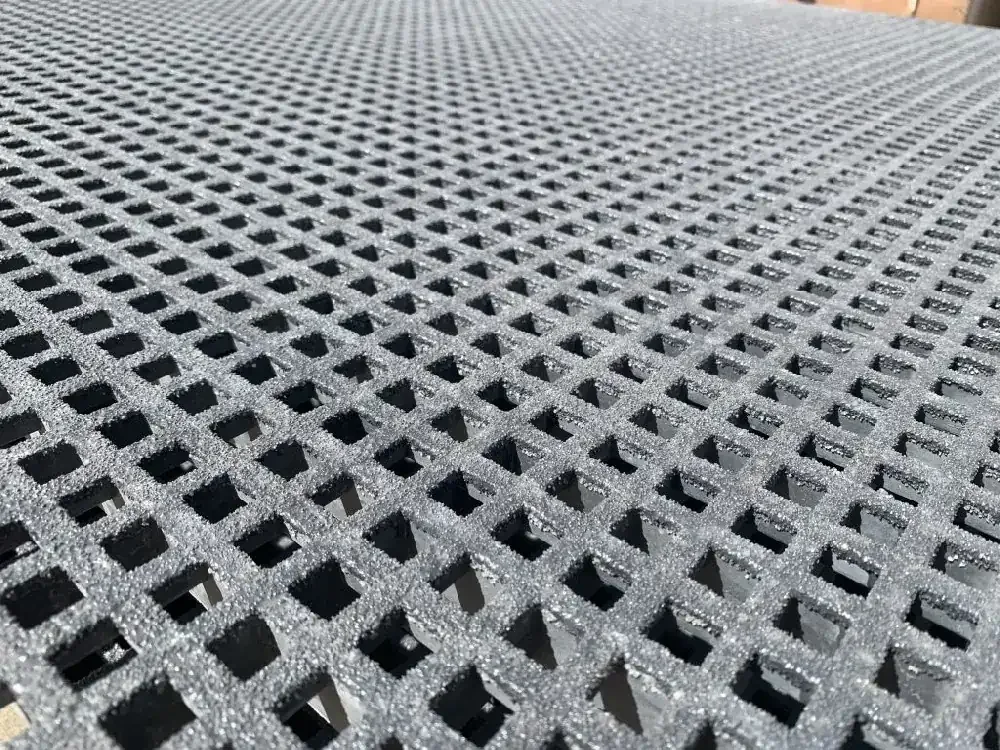
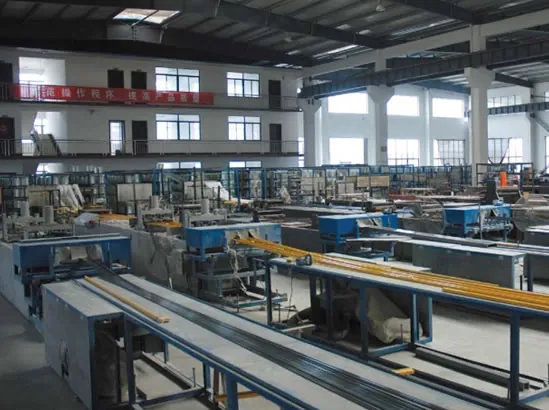
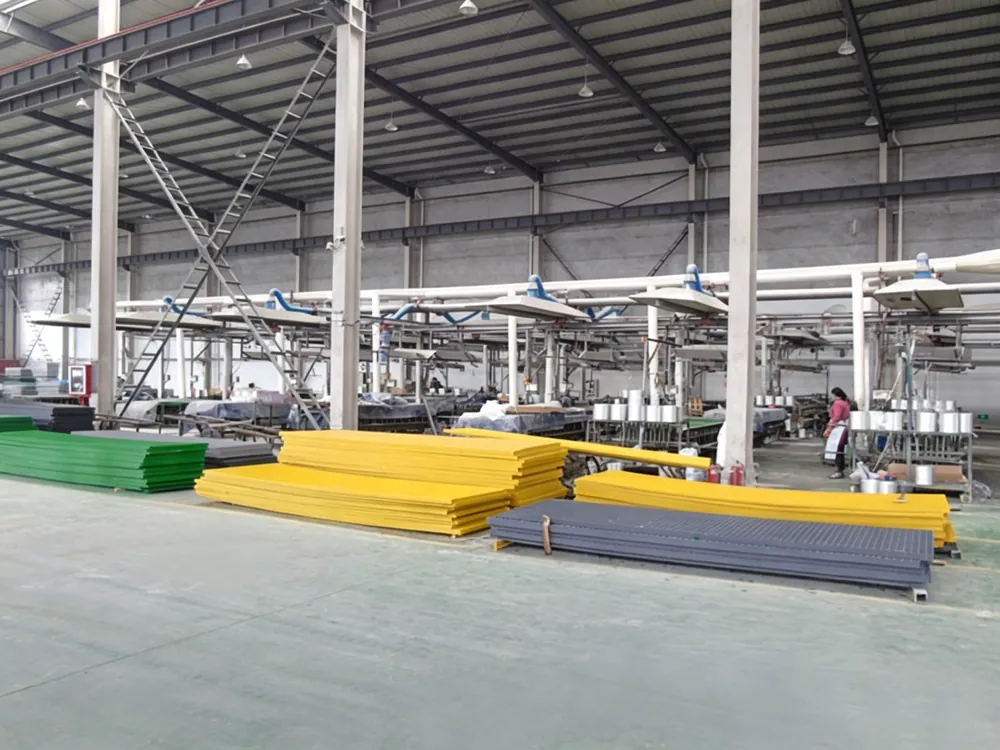
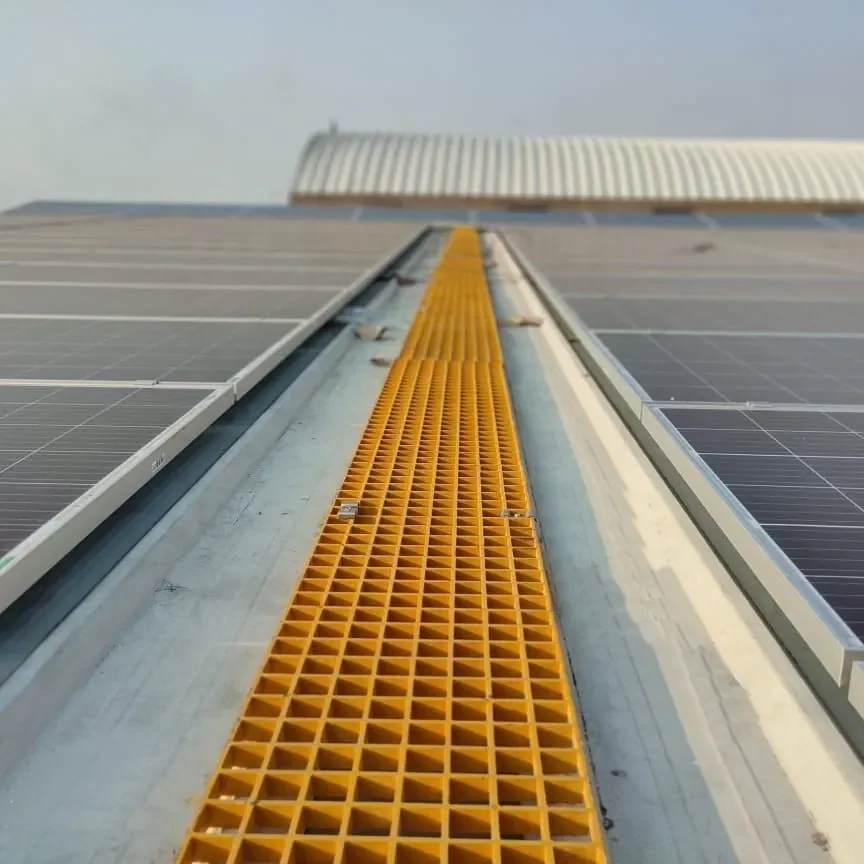
Product and factory gallery
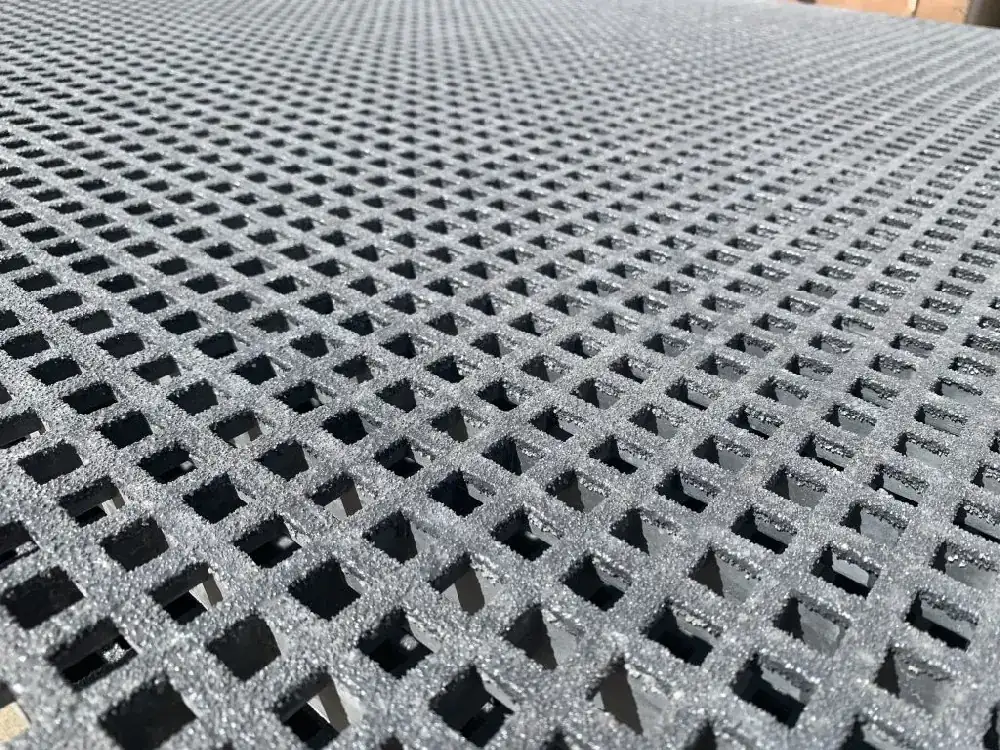
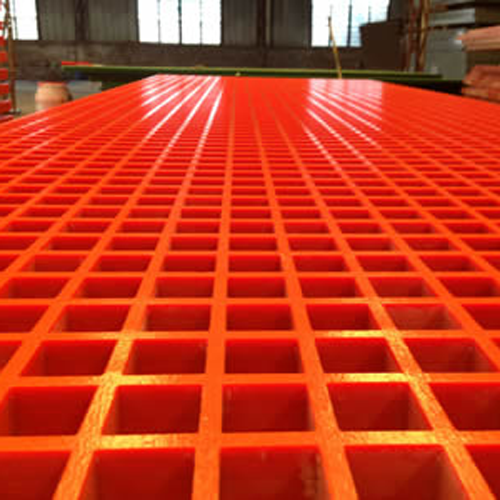
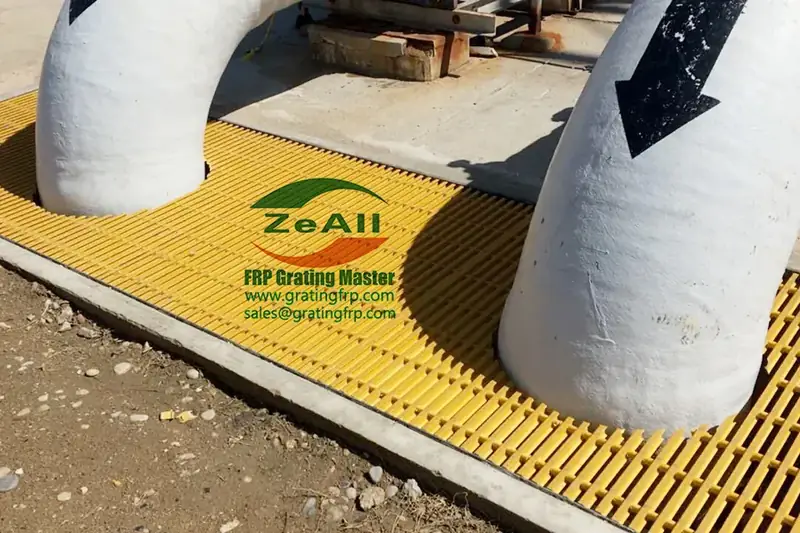
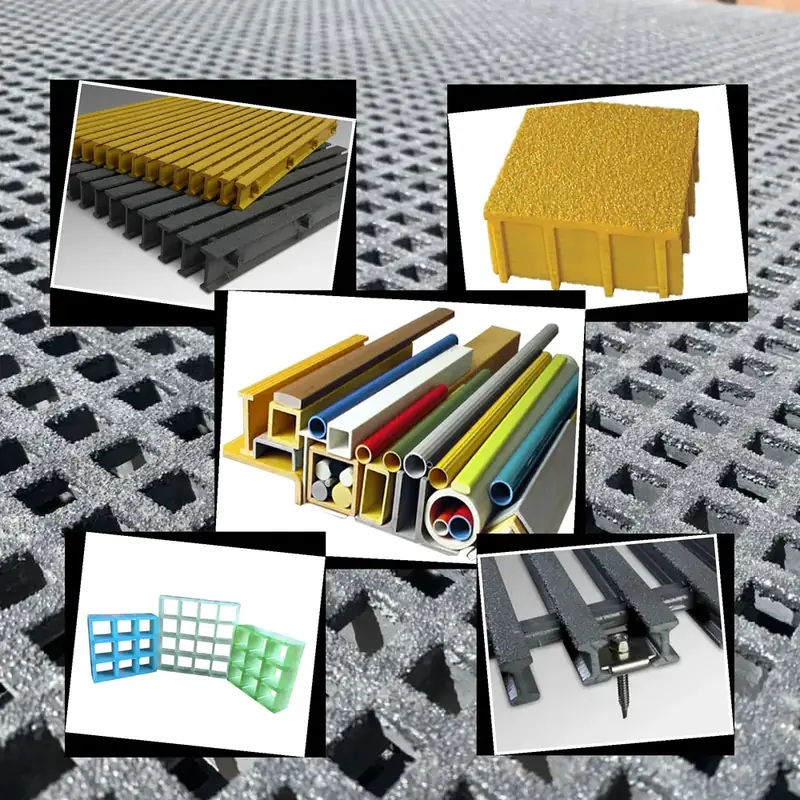
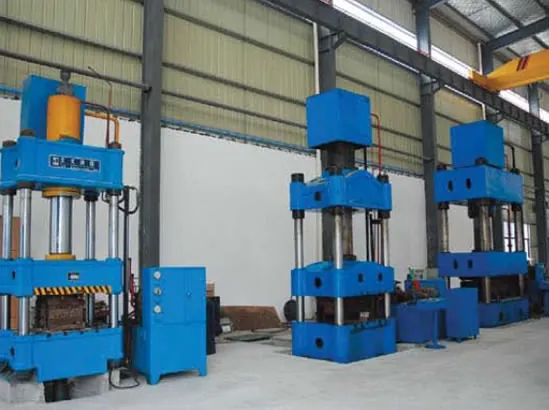
Buyer feedback — 4.9 / 5 from 541 verified buyers
“Planted 480 m² of moulded grating on our acid tank platform — no corrosion after two winters of service.”
“We replaced the steel walkway covers on the quay; the crew was walking on the new panels the same week they arrived.”
“Cut-to-size panels fitted our trench covers exactly, so there was no site trimming and no wasted material.”
“The gritted surface still grips in wet weather, and our safety auditors signed off on the walkway.”
“Easy to wash down between production runs — that was the main reason we moved from steel to FRP.”
“The quotation with drawings came back in a day, and the phenolic panels met our low-smoke specification.”
FRP Grating for Canada: Shipping, Standards & Cold-Weather Service
Canadian buyers can source FRP grating factory-direct with delivery to every province. Most orders sail from Shanghai or Ningbo to the Port of Vancouver (typically about 15–22 days port-to-port) and continue by intermodal rail to Ontario and the interior, or use east-coast ports such as Montreal and Halifax. Standard sizes are produced in 15–25 days within an overall 12–36 working-day window, with a 10 m² minimum order.
Our gratings are tested to ASTM E-84 and ASTM F3059 under an ISO 9001 system; Canadian engineers commonly reference CSA S806 and CSA S807 for structural design. Grit-top, UV-stabilized panels resist de-icing salt and freeze-thaw cycling without rusting. Explore the dedicated guides: FRP grating Toronto, FRP grating Vancouver and the Canada supplier overview.