
FRP grating is made of glass fibre reinforcement, a thermoset resin, inorganic filler and small amounts of additives, moulded into an open mesh panel; the resin system decides chemical and fire performance.
- Best for: specifying by property rather than by name
- Resin options: isophthalic, vinyl ester, phenolic
- Key spec: glass content 25-40%, resin type, fire class, UV package
Glass fibre reinforcement bonded in a thermoset resin — molded into a one-piece panel, or pultruded into bars and assembled. The resin decides the environment it survives; the glass decides the strength.
What Is FRP Grating Made Of, Exactly?
FRP grating is made of glass fibre reinforcement, a thermoset resin, inorganic filler and small amounts of additives, moulded into an open mesh panel; the resin system decides chemical and fire performance. Glass fibre reinforcement bonded in a thermoset resin, molded into a one-piece panel, or pultruded into bars and assembled. The resin decides the environment it survives; the glass decides the strength.
Both descriptions are used. The material is a glass-fibre reinforced thermoset plastic, so it is a fibreglass composite rather than a thermoplastic. GRP (glass reinforced plastic) and FRP (fibre reinforced plastic) describe the same material; the two terms are used in different markets and sometimes in the same document. The panel itself does not contain metal; the fixings usually do, because clips and bolts are stainless steel, typically SS304 or SS316, and the grade should match the environment. Specify by property rather than by name: state the resin, the glass content, the fire class and the UV package, and the supplier will deliver a panel that meets the service. A buyer who only writes "FRP grating, corrosion resistant" has not specified anything, and the cheapest resin that could plausibly survive is what arrives.
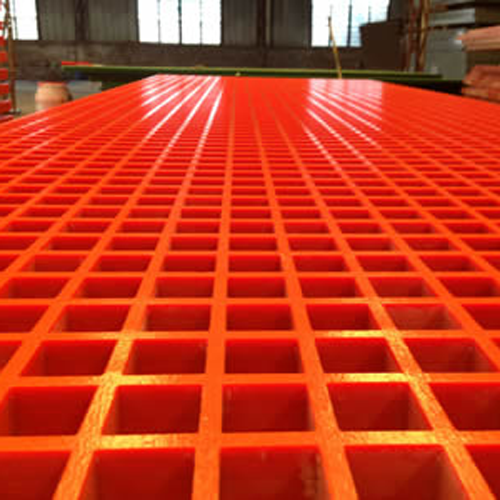
The Four Ingredients by Weight
The reinforcement is glass fibre: chopped strand mat and roving in molded grating, continuous roving in pultruded grating. The matrix is a thermoset resin, most often isophthalic polyester, vinyl ester or phenolic. Neither material alone would work: the glass carries load, the resin protects the glass and holds the shape. That is why the same panel geometry can behave very differently in service. The shape comes from the mold or the die; the durability comes from the resin.
The table below gives the typical share of each ingredient by weight. Treat the percentages as ranges, not as a single recipe: a chemical-grade vinyl ester panel carries more resin and less filler than a general-purpose isophthalic panel, and a fire-rated phenolic panel carries its own additive package. The point of the table is to show which ingredient does which job, not to price your project. When two suppliers quote the same section at different prices, the difference is usually in the glass content and the resin grade, not in the mould or the mesh.
| Component | Share by weight | Function |
|---|---|---|
| Glass fibre reinforcement | 25-40% | Strength and stiffness |
| Thermoset resin | 35-50% | Corrosion resistance, binding |
| Inorganic filler | 10-25% | Dimensional stability, cost |
| Additives and pigment | 1-5% | UV stability, fire retardance, colour |
Why the Resin, Not the Glass, Decides the Service Life
Isophthalic polyester covers water, neutral salts and general weathering. Vinyl ester is the specification for acids, hypochlorite, solvents and chloride-rich marine air. Phenolic is used where a fire performance class is required, such as offshore modules and enclosed transport areas. Buyers often specify "FRP grating, corrosion resistant" and receive the cheapest resin that could plausibly survive. Naming the chemical, its concentration and the temperature is what turns a material description into a specification.
The glass fibre is inert: it does not burn, it does not rust, and it does not react with most chemicals. What fails in service is almost always the resin phase. A panel in the wrong resin looks identical on arrival and fails years later, on the far side of the warranty. UV stabilisers slow chalking on exposed decks; pigment sets the colour and usually a minimum order quantity; surface additives produce the concave, grit or smooth finish. Fire retardant additives are added where a class is required. Each of these is a line in the price, and each is easier to specify in the enquiry than to add after the panels are molded.
Molded Versus Pultruded: Two Construction Methods
Molded grating is cast as one piece with a meniscus joint where the bars cross, so the panel is a single structure with no fasteners at the intersections. It is the usual choice for trenches, walkways and general platforms, and the 38 mm molded panel is the default in most specifications. Pultruded grating is drawn through a die as continuous bars in T or I section, then assembled with cross rods and mechanically locked. It carries more load for the same depth and spans further, which is why it appears on long platforms, jetty walkways and structural decks.
The choice between the two is a load and span decision, not a preference. A 38 mm molded panel at 19.5 kg/m2 carries 25 kN/m2 at 600 mm span under L/200, and 12 kN/m2 at 900 mm. A 50 mm pultruded panel carries 48 kN/m2 at 600 mm and 26 kN/m2 at 900 mm, which is why long spans move to pultruded. Standard panel size is 1220 x 3660 mm, and a 38 mm molded panel of that size weighs about 87 kg, which is a two-person lift. State the molded or pultruded type, the depth and the pitch in the RFQ, because "38 mm grating" is ambiguous between three products.
Standards, Testing and Documentation
Because FRP grating is a composite rather than a metal, its properties are checked by resin batch, glass content and cured performance rather than by alloy grade. We manufacture under ISO 9001 registration 01708Q11888R0S, valid to 2028-12-30, and we hold the Intertek ASTM F3059 report 211122012SHF-001 covering the grating product family. Fire performance is judged by ASTM E-84 for flame spread and smoke, by EN 13501-1 in Europe, and by the IMO FTP Code for marine work; the resin system decides which class a panel reaches, not the geometry.
Ask for the resin batch certificate covering the production window of the order, the glass reinforcement specification, the load table for the supplied section, and the fire test report for the resin system. A generic datasheet is not evidence that the vinyl ester quoted is the vinyl ester used. We send all four documents with the certificate pack on request, and we will name the resin of every component in the load path on the drawing, so the panel you ordered is the panel that arrives.
Cutting, Fixing and On-Site Reality
FRP cuts with ordinary power tools: a carbide-tipped circular saw for straight runs, an abrasive disc for short cuts and notches, a jigsaw for curves. No hot work permit is needed, and no weld touch-up is required after a cut. Cut edges and drilled holes must be sealed with matching resin putty or edge trim before handover, because an unsealed edge is where water enters the glass and turns a ten-year deck into a five-year deck.
The panel does not contain metal, but the fixings usually do: stainless clips and bolts, SS304 inland, SS316 on coastal or chloride service. A 1220 x 3660 mm panel at 38 mm weighs about 87 kg and is a two-person lift. On site, keep the approved sample panel so the installer can compare colour, grit and bar geometry. Walk the deck before handover: a cured panel feels hard, does not smell of styrene, and grit does not rub off into a hand. Thermoset composites are difficult to recycle into new composite, and most end-of-life material is downcycled or landfilled; that is one reason service life, not first cost, drives the environmental case.
Cost, MOQ and Lead Time for the Panel You Specify
The ex-works price moves with the four ingredients: vinyl ester costs more than isophthalic polyester, a 50 mm pultruded bar costs more per square metre than a 38 mm one because there is more glass and resin in it, grit surface adds a process step, and a 200 m2 order carries setup and colour costs that a 2,000 m2 order spreads across more panels. Open area is the quiet variable: going from 40% to 60% open removes material, so the panel gets lighter and cheaper per square metre while carrying less load.
We manufacture at a 20,000 m2+ plant with 200+ staff, export to 40+ countries, hold MOQ 10 m2 and a 12-36 working day lead time from a confirmed drawing. Oversized panels, custom colours, new moulds and specialty resins are quoted with a separately confirmed schedule. We will quote the unit weight and the load table for the exact section you specify, not a catalogue range, and we will name the resin system, the glass content, the fire class and the UV package on the drawing. Send us the chemical, the concentration, the temperature and the span, and we will come back with the recipe, not a slogan.
