
Yes. FRP grating is cut on site with a carbide-tipped circular saw, an abrasive disc or a jigsaw; no hot work permit is needed, and a cut edge only needs resin sealing.
- Best tool: carbide-tipped circular saw, cut from the grit side
- Never: remove or notch a bearing bar without re-checking the load table
- Key spec: seal every cut edge with resin putty or edge trim before handover
Yes. It cuts with ordinary power tools, but two rules decide whether the result lasts: dust control for the operator, and resin sealing for every cut edge.
Can FRP grating be cut on site?
Yes. FRP grating is cut on site with a carbide-tipped circular saw, an abrasive disc or a jigsaw; no hot work permit is needed, and a cut edge only needs resin sealing. It cuts with ordinary power tools, but two rules decide whether the result lasts: dust control for the operator, and resin sealing for every cut edge.
A carbide-tipped circular saw with 40-60 teeth gives the cleanest, lowest-dust edge on straight runs. An angle grinder with an abrasive or diamond disc handles short cuts, notches and trims, and a jigsaw with a carbide or grit blade is the slowest but the only practical option for curves and small openings.
Factory pre-cut panels are normally sealed before dispatch; site cuts are not. That one fact, more than the tool choice, is why site-cut decks age differently from factory-cut decks. Plan the cuts you cannot avoid, and let the factory handle the rest.
The tool is the easy part. The two hard parts are dust control for the operator and resin sealing for the cut edge. Get both right and the site-cut deck ages like a factory-cut one; skip either and the panel shows it within the first few years of service.
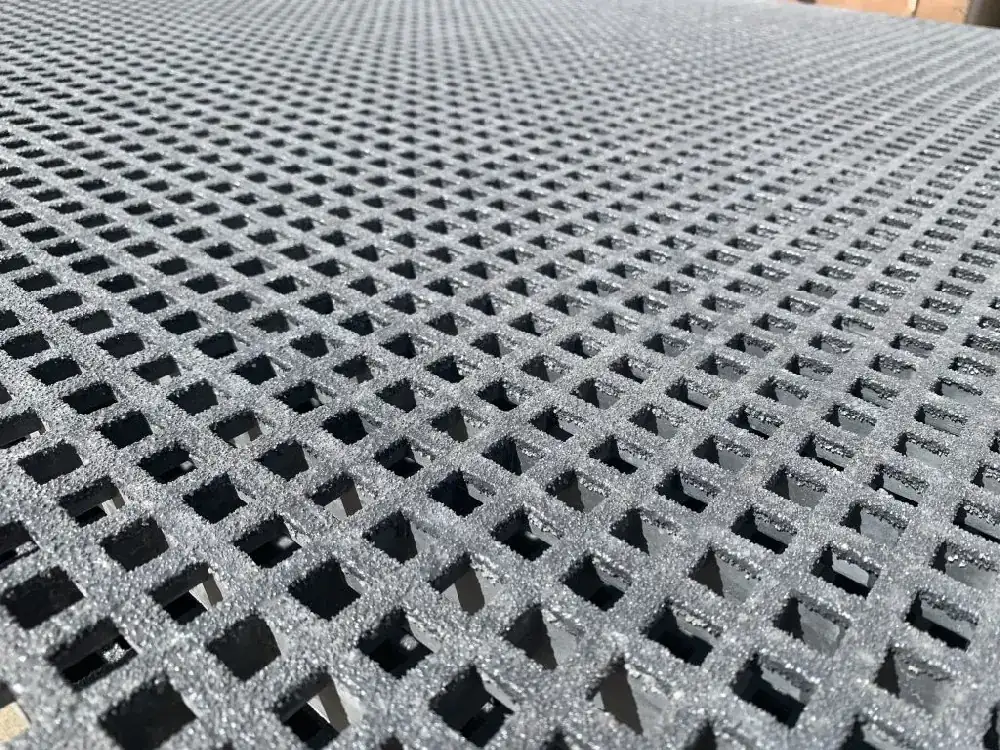
Tools, blades and edge quality
The table below matches each method to the blade, the edge quality it produces and the job it is best for. Choose the method by the cut geometry, not by the tool you happen to have on the truck.
For repetitive parts and large decks, factory CNC or waterjet cutting is still the best value: sealed edges, accurate openings, and no glass dust in a live plant. Reserve site cutting for the last 5% of adjustments that only become visible once the frame is built.
Read the table by cut geometry. Straight runs on panel sheets go to the circular saw, because it is the fastest and gives the cleanest edge. Short cuts, notches and trims go to the angle grinder, which is the tool already on most trucks. Curves and small openings go to the jigsaw, accepting that it will be slow.
Factory pre-cut is the fourth option and the one most projects under-use. CNC and waterjet cutting produce sealed, accurate openings that arrive ready to lay, with no glass dust in a live plant. On repetitive parts and large decks, factory pre-cut usually wins on total installed cost once site dust control and edge sealing are priced in.
A carbide-tipped circular saw, an angle grinder with a diamond or abrasive disc, or a reciprocating saw for small openings. Pultruded bars cut cleanly with a metal-cutting blade; molded panels are easier with a coarse carbide blade because the resin will clog a fine tooth.
| Method | Blade or disc | Edge quality | Best for |
|---|---|---|---|
| Circular saw, carbide blade | Carbide-tipped 40-60 T | Clean, low dust | Straight runs, panel sheets |
| Angle grinder | Abrasive or diamond disc | Good, more dust | Short cuts, notches, trims |
| Jigsaw | Carbide or grit blade | Fair, slowest | Curves, small openings |
| Factory pre-cut | CNC / waterjet | Best, sealed | Large decks, repetitive parts |
Why FRP cuts the way it does
FRP is glass fibre in a thermoset resin. The glass is hard and abrasive; the resin is soft and heat-sensitive. A fine-tooth blade intended for timber clogs with softened resin, heats up, smears and the cut edge closes over, which then has to be ground back.
A coarse carbide tooth shears the glass and chips the resin rather than melting it, which is why coarse works and fine fails. Pultruded bars, packed with unidirectional roving, cut cleanly with a metal-cutting blade; molded panels, with their random chopped strand, need the coarser carbide.
That is also why dust is unavoidable on a molded cut. The glass that comes off the edge is fine fibre, not powder from a saw blade, and it is the operator hazard in this job rather than a structural one.
Do not use a worm-drive saw set up for timber with a fine finish blade. The resin heats, smears and the cut edge closes over, which then has to be ground back.
What to specify before the cut list
Do not drill or cut with a blade that has been used on steel without cleaning, because ferrous particles embed in the cut and rust spots appear. Do not leave a cutout unsupported: an opening weakens the panel locally, so bearers or a frame usually need to move.
Do not cut structural pultruded bars to length in the field without confirming the cross-rod positions, because the mechanical lock depends on them. Never remove or notch a bearing bar without re-checking the load table for the new section.
Send us the opening dimensions and the panel section before the site team cuts. We will mark the bearer positions, confirm whether a notch is allowed, and return a revised cut list. The 10 minutes this costs is the difference between a sealed opening and a delaminating one in five years.
Before the site team cuts, photograph the frame and send the opening dimensions back to us. We will mark the bearer positions on the panel drawing, confirm whether a notch is allowed on the section you ordered, and return a revised cut list. The 10 minutes of coordination this costs is the difference between a sealed opening and a delaminating one in five years.
And do not cut structural pultruded bars to length in the field without confirming the cross-rod positions, because the mechanical lock depends on them.
Dust, PPE and the standards that apply
Cutting produces fine glass dust, and it is the operator hazard in this job. Use respiratory protection rated for particulates, eye protection, and cut outside or with extraction. Gloves and long sleeves prevent fibre irritation on forearms.
Wet cutting reduces dust substantially and is often the practical answer on a live site where extraction is not available. Feed water along the cut line, keep the disc wet, and mop up the slurry before it dries; dried glass dust on a floor is a slip hazard in addition to a respiratory one.
No hot work permit is needed, because there is no flame. That is one of the practical reasons FRP wins on retrofit decks inside operating plants. We can supply a one-page site-cutting sheet covering PPE, dust control and edge sealing to hand to the contractor.
Wet cutting is the practical answer on a live site where extraction is not available. Feed water along the cut line, keep the disc wet, and mop up the slurry before it dries. Dried glass dust on a floor is a slip hazard in addition to a respiratory one, so treat the cut area as a housekeeping zone as well as a PPE zone.
Sealing the cut edge: the step most often skipped
A cut exposes fibre. Water enters along the fibre, and in a chloride or chemical environment that is where the panel starts to fail years later. Seal the cut with a matching resin, vinyl ester for vinyl ester panels, and let it cure before installation.
Brush the resin into the exposed glass, work it in with a small stiff brush, and leave a thin film over the cut face and the first 10 mm of the mesh. Edge trim, pushed over the cured edge, is the preferred finish on walkways because it protects toes and seals the face at the same time.
This is the maintenance step most often skipped on site, and it is the cheapest one to do properly. A 200 g tin of matching resin covers dozens of linear metres of cut edge. Seal every cut and every drilled hole, and the deck behaves like a factory-cut one.
Keep a small tin of matching resin and a brush on site for the handover walk. Any cut edge missed on the first pass is sealed before the contractor leaves, and the seal is still wet enough to inspect. That one habit removes the most common warranty claim on a site-cut deck.
Cost: site cutting vs factory pre-cut
Factory pre-cut panels cost a little more per square metre because they use CNC time, but they arrive sealed, dimensioned and ready to lay. Site cutting saves on the unit price and pays back in dust, PPE, rework and failed edges within the first year.
MOQ is 10 m2 and lead time is 12-36 working days from a confirmed drawing. Oversized panels, custom colours, new moulds and specialty resins are quoted with a separately confirmed schedule. Send us the frame dimensions, the openings and the clip layout before the order goes into production, and we will cut and seal everything in the factory. Our plant is 20,000+ m2 with 200+ staff and 40+ export countries, so even cut-to-size export orders run through the same QC line as standard panels.
On a typical retrofit, factory pre-cut wins on total installed cost once site dust control and sealing are priced in. Reserve the site saw for the adjustments that only become visible once the frame is plumbed.
On a typical retrofit, factory pre-cut wins on total installed cost. Site cutting saves on the unit price and pays back in dust, PPE, rework and failed edges within the first year. Reserve the site saw for the last 5% of adjustments that only become visible once the frame is plumbed and the openings are measured in place.