
Choose an FRP grating supplier on capability and evidence before price: own moulds, engineering drawings, an ISO 9001 registration and third-party test reports. The cheapest quote usually buys a broker, not a factory.
- Best for: repeat industrial buyers and EPC packages
- Red flags: no drawing service, no test report number, price far below the market
- Key spec: ISO 9001, 200+ staff, 40+ export countries, MOQ 10 m2
Not a checklist of certificates. Eight questions whose answers separate a manufacturer from a trader with a catalogue.
How Do You Choose the Right FRP Grating Supplier?
Choose an FRP grating supplier on capability and evidence before price: own moulds, engineering drawings, an ISO 9001 registration and third-party test reports. The cheapest quote usually buys a broker, not a factory. Not a checklist of certificates. Eight questions whose answers separate a manufacturer from a trader with a catalogue.
In this guide: own production, resin and glass control, section range, load data, fixing and fabrication, inspection and documentation, references, lead time and after-sales. Every test is the same question in a different form: can this supplier answer with a number, a document or a specific past case, rather than with a claim. Manufacturers answer with numbers because the numbers are in their process. Traders answer with adjectives because the numbers are somewhere else. Choose on that pattern, then negotiate on price. A quotation from a supplier who passed the eight tests is a quotation you can compare; one from a supplier who failed them is a number with unknown content, and the unknown content is what shows up as a defect, a delay or a resin substitution six months after the container lands.
The Six Criteria That Separate a Factory from a Trader
Ask which part of the process happens inside their own plant. A manufacturer pultrudes its own bars or molds its own panels and can tell you the line, the cure method and the tooling. A trader cannot answer without asking someone else, and the delay in the answer is usually visible. This is not about size. A small molder that controls its own cure is a better partner for a molded order than a large trader who has never seen the tool.
The table below weights the six criteria buyers actually use. Manufacturing capability, engineering support and the quality system carry the most weight; export experience, price and lead time are medium. The right-hand column is what good looks like, and it is the column that separates a manufacturer from a catalogue. A supplier that lists forty sections but can only ship three is describing a catalogue, not a factory. If the answer to any of the six criteria has to come back after a delay, treat the delay as data: it means the number lives somewhere else.
| Criterion | Weight | What good looks like |
|---|---|---|
| Manufacturing capability | High | Own moulds and presses, 20,000 m2+ plant |
| Engineering support | High | Drawings, load checks, cut lists |
| Quality system | High | ISO 9001 registration, third-party reports |
| Export experience | Medium | 40+ countries, packing and documents |
| Price | Medium | Explained cost breakdown, not the lowest number |
| Lead time | Medium | 12-36 working days, stated in writing. Oversized panels, custom colours, new moulds and specialty resins are quoted with a separately confirmed schedule. |
Resin, Glass and the Section Range They Can Actually Ship
Ask for the resin batch certificate for a specific recent order, then ask what happens if the batch is out of specification. A supplier that controls incoming material will describe a hold or a rejection. A supplier that does not will describe the datasheet. The same question applies to glass: roving type, tex, and whether the reinforcement is from a qualified supplier. Vinyl ester on unknown glass is an expensive way to buy a short-life deck.
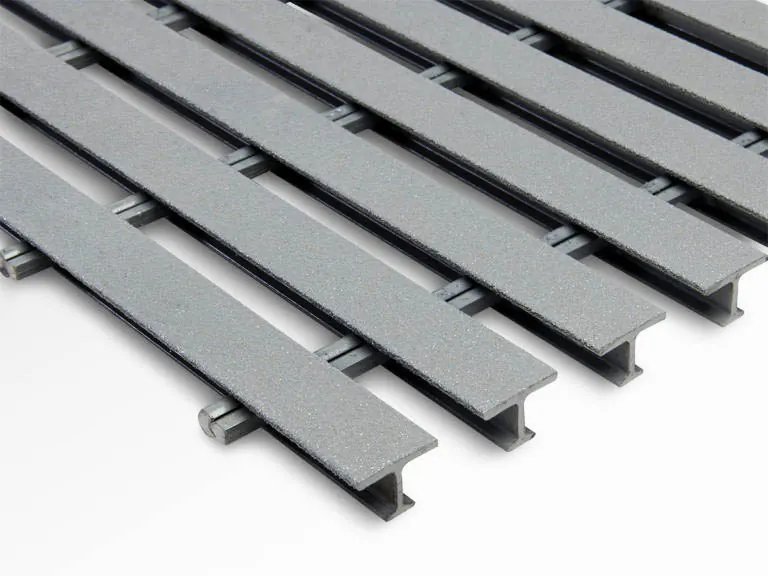
Ask for the depth and pitch combinations that can actually be produced, and for the unit weight of each. A genuine range answers consistently: 25, 30, 38, 50 and 65 mm molded sections at 12.5, 15.0, 19.5, 27.0 and 38.0 kg/m2, plus pultruded 38, 50 and 65 mm I-bar sections, with a weight figure for each. Inconsistent answers mean the numbers came from different documents. We mold our own panels and pultrude our own bars at a 20,000 m2+ plant with 200+ staff, and we will quote the unit weight for the exact section you specify, not a catalogue range.
A genuine range answers consistently: 25, 38, 50 and 76 mm bars, 38 mm pitch, molded 19x19, 38x38, 50x50 and mini mesh, with a weight figure for each. Inconsistent answers mean the numbers came from different documents.
Load Data, Fixing and Fabrication Detail
Ask for the allowable uniform load at three spans for the section you are considering, with the deflection limit stated. Then ask which standard the figures follow. A supplier with a load table answers immediately; one without answers with adjectives. Treat the numbers as indicative until a certified table for the supplied section arrives with the order. A supplier who says so is more credible than one who presents every figure as absolute. For a 38 mm molded panel the table should read 25 / 12 / 6.5 kN/m2 at 600 / 900 / 1200 mm span under L/200; for a 50 mm pultruded panel it should read 48 / 26 / 14.
Send a drawing with three cutouts and a handrail post and see what comes back. A manufacturer returns a panel schedule, a clip count and a fixing layout. A trader returns a price and a question. The clip layout is the tell. It depends on span and uplift, so a supplier who quotes clips by rule of thumb has not read the deck. Ask for the clip count per panel edge and the clip grade: SS304 inland, SS316 on coastal or chloride service. A supplier who cannot name the clip grade has not priced the corrosion environment.
Inspection, Documentation and Traceability
Ask what documents ship with a container, unprompted. The list should include a packing list with bundle markings, resin certificates, the load table for the supplied section and an inspection record. If the answer has to be assembled question by question, the file will be thin when you need it. Ask also whether they will accept a third-party inspection and at which stages. A supplier who welcomes inspection at pre-production and packing is usually a supplier with a stable process.
We manufacture under ISO 9001 registration 01708Q11888R0S, valid to 2028-12-30, and we hold the Intertek ASTM F3059 report 211122012SHF-001 covering the grating product family. Both documents are sent with the certificate pack on request, together with the resin batch certificates for the production window. Ask for two projects of similar application and environment, with the country, the year and the section supplied. Then ask what went wrong on one of them. Every real project has something, and the answer tells you how the supplier behaves after the order. A reference that cannot be described in specifics is a logo, not a reference.
On-Site Handling and What Happens After Delivery
A 1220 x 3660 mm panel at 38 mm weighs about 87 kg and is a two-person lift; confirm the supplier ships crated with corner protection so the panels arrive undamaged. Cut edges and drilled holes are sealed with matching resin putty or edge trim before handover, and stainless clips are fixed at every edge. On site, keep the approved sample panel so the installer can compare colour, grit and bar geometry, and walk the deck before handover: a cured panel feels hard, does not smell of styrene, and grit does not rub off into a hand.
Ask what the supplier does if panels arrive damaged: repair on site, replacement panel, or a credit. The after-sales answer decides the real cost of a defect. A supplier who sends a replacement panel into the next container is solving the problem; one who negotiates a discount is transferring it to you. We will send pre-shipment photos of the loaded container with the seal number visible, and we will name the resin of every component in the load path on the drawing, so the deck you ordered is the deck that arrives.
Lead Time, Price and the Sourcing Decision
Ask for the lead time in production days and the shipping window separately, because a single "30 days" hides which half is which. Then ask what the supplier does if panels arrive damaged. The after-sales answer decides the real cost of a defect. A supplier who sends a replacement panel into the next container is solving the problem; one who negotiates a discount is transferring it to you. Price is medium weight: an explained cost breakdown, not the lowest number, is what good looks like. A price far below the market usually buys a broker, a thinner glass content or a resin substitution that shows up in year three.
We manufacture at a 20,000 m2+ plant with 200+ staff, export to 40+ countries, hold MOQ 10 m2 and a 12-36 working day lead time from a confirmed drawing. We will quote a landed-cost table with every line separated, and we will name deviations rather than re-interpret your RFQ. Send us the eight questions above and the answers will tell you whether you are talking to a factory or a trader before you spend a negotiation cycle on the price.
