
FRP grating costs 1.5-2.5 times steel up front but usually wins on a 20-year basis, because steel needs re-galvanising every 5-8 years and replacement at 8-12 years while FRP runs 20-30 years without coating.
- Where FRP wins: corrosive, coastal, chemical and remote sites with high labour cost
- Where steel wins: dry indoor spans above 1.5 m with heavy point loads
- Key spec: compare landed cost and 20-year maintenance, not unit price
Steel is usually cheaper to buy. FRP is usually cheaper to own in corrosive service. Which one wins depends on how often the steel would need re-coating and what access costs to do it.
Which Costs Less: FRP or Steel Grating?
FRP grating costs 1.5-2.5 times steel up front but usually wins on a 20-year basis, because steel needs re-galvanising every 5-8 years and replacement at 8-12 years while FRP runs 20-30 years without coating. Steel is usually cheaper to buy. FRP is usually cheaper to own in corrosive service. Which one wins depends on how often the steel would need re-coating and what access costs to do it.
The mistake to avoid is comparing a first price in a corrosive site with a lifecycle argument in a dry one. Pick the environment first, then the cost comparison follows. On a coastal, chemical or remote deck with high labour cost, FRP wins on total cost; on a dry indoor span above 1.5 m with heavy point loads, steel still wins. The answer is never the same for every project, and a supplier who gives you a single number without asking about environment, span and access has given you a slogan, not a comparison. The right answer always comes from four inputs: exposure, span, load and the cost of getting a crew onto the deck.
The Five Cost Lines Across 20 Years
Per square metre at the factory gate, galvanised steel grating is generally cheaper than FRP for the same load duty, and stainless steel is more expensive. That ranking is stable enough to plan around. What is not stable is the delivered comparison, because FRP is bulky and freight-sensitive while steel is dense. On a long sea route the freight difference can narrow the gap, and on a short inland delivery steel usually stays ahead on first cost.
The table below separates the five lines that decide the 20-year answer. Read the fourth column as the long-run consequence, not as a marketing claim: a steel deck in chloride air carries a recurring coating cycle that an FRP deck simply does not have, and that recurring cycle is where the FRP premium is earned back. The first three lines are paid once. The last two are paid for as long as the deck is in service, and they are where most buyers under-price the steel option.
| Cost line | Steel grating | FRP grating | 20-year note |
|---|---|---|---|
| Material purchase | Base | 1.5-2.5x base | Higher entry price |
| Installation labour | Hot work, heavy lifts | No hot work, lighter | 10-30% lower install cost |
| Coating / galvanising | Required | Not required | Recurring every 5-8 years |
| Replacement cycle | 8-12 years | 20-30 years | One FRP deck vs two steel decks |
| Maintenance labour | Inspection and repaint | Wash down only | Largest 20-year difference |
Why the Weight Difference Moves the Install Cost
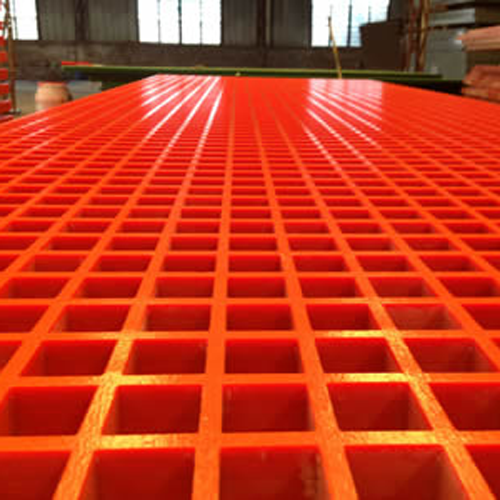
FRP is roughly a quarter of the weight of steel, so panels are lifted by two people instead of a machine on many jobs. On a roof, a jetty or a plant where access is the expensive part, that difference can exceed the material difference. A 38 mm molded FRP panel at 19.5 kg/m2 weighs about 87 kg per standard 1220 x 3660 mm sheet, which is a two-person lift; an equivalent steel panel on the same span needs a hoist, a spreader bar and a rigging crew, and the rigging crew is on the critical path of the shutdown.
Cutting and fitting on site also favours FRP: it cuts with ordinary power tools rather than needing fabrication shop work. There is no hot work permit for welding, no galvanising touch-up after a cut, and no spark risk in a hydrocarbon or dust atmosphere. On a turnaround plant where shutdown days are priced by the hour, the install saving is not a rounding error: it is often 10-30% of the installed cost, and it lands on the same line as the material premium.
When Steel Is Still the Right Answer
High temperature, heavy vehicle loads on tight spans, and dry indoor environments where nothing corrodes. In those cases the FRP premium buys protection that is not needed. Steel also wins on spans above roughly 1.5 m where a pultruded FRP section would need to step up to 50 mm or 65 mm depth, and on decks carrying repeated wheeled traffic that outlasts the L/200 deflection limit of even the strongest molded panel. Continuous high temperature above the resin's service ceiling is another case where steel remains the honest answer.
The right question is not "FRP or steel?" but "what is the environment, the span, the load and the access cost?" A dry indoor catwalk where steel will not see chloride for 30 years is a steel deck. A coastal walkway in de-icing salt, a wastewater deck in H2S, or a rooftop where a crane would cost more than the grating is an FRP deck. Compare the two on the same four inputs and the answer is usually obvious; compare them on unit price alone and the answer is usually wrong, because the cheapest first number omits the lines that decide the 20-year total.
Lifecycle Cost: Where the Argument Is Decided
Steel needs re-coating on a cycle that depends on the environment: faster in chloride air, slower indoors and dry. Every cycle carries access, preparation, coating and downtime. FRP has no coating cycle, so its annual cost curve is close to flat after installation. The break-even point is reached when the accumulated coating cost exceeds the material premium. In a coastal plant that can be a small number of cycles; in a dry indoor plant it may never be reached.
Over a 20-year horizon the arithmetic is unforgiving for steel: one galvanising cycle at access cost, then a second, then replacement of the deck itself at 8-12 years, which means two steel decks bought and installed where one FRP deck runs. Add the inspection and repaint labour that FRP does not need, and the largest 20-year difference is not the panel purchase at all, it is the maintenance line. FRP may chalk and fade under UV, which is cosmetic rather than protective, and it never needs a brush. For a remote site, an offshore platform or a plant where a shutdown day is priced by the hour, the downtime alone can close the gap before the first coating cycle.
Installation, Handling and Site Reality
FRP panels are light enough for two people but stiff enough to flex if over-spanned, so they should be supported on the bearer centres the load table specifies and clipped at every edge. Stainless clips are standard: SS304 inland, SS316 on coastal or chloride service, because a steel clip that corroded would undo the whole corrosion argument. Cut edges and drilled holes are sealed with matching resin putty or edge trim before handover, which is a cheap step that prevents water entering the glass over the 20-year life.
On site, FRP cuts with ordinary power tools and needs no hot work, which is why it is preferred on revamp projects inside operating plants. Steel arrives as pre-fabricated panels and any field modification means a weld, a spark permit and a touch-up of the galvanising. Keep the approved sample panel on site so the installer can compare colour, grit and bar geometry, and walk the deck before handover: a cured FRP panel feels hard, does not smell of styrene, and grit does not rub off into a hand.
How to Compare Quotes Without Being Fooled
Compare landed cost and 20-year maintenance, not unit price. Ask every supplier for the same breakdown: FOB panel price, freight, duty, inland transport, clips and accessories, and documentation. Because FRP is bulky, freight is volume-driven, and a small order can look disproportionately expensive per square metre; using standard 1220 x 3660 mm panels where the deck allows, and filling the container, is the single biggest lever on the FRP side. Clips and edge trim are a hidden 2-5% line that is often left out of the first quote and air-freighted later at a multiple of the panel cost.
We manufacture at a 20,000 m2+ plant with 200+ staff, export to 40+ countries, hold MOQ 10 m2 and a 12-36 working day lead time from a confirmed drawing. Oversized panels, custom colours, new moulds and specialty resins are quoted with a separately confirmed schedule. We will quote a landed-cost table rather than a single FOB number, and we will not describe a steel deck that needs two re-galvanising cycles as cheaper than an FRP deck that runs 20-30 years without coating. The honest comparison is on the same lines, at the same delivered point, over the same 20 years. Send us the environment, the span and the load, and we will come back with the line-by-line comparison rather than a slogan.
