
FRP Driveway Markers and Snow Plowable Post Markers
FRP driveway markers are slender pultruded glass-reinforced polyester rods that mark a driveway edge, a culvert, a utility line or a construction layout line through the winter snow. They bend when the plow hits them and spring back upright, instead of breaking or rusting like steel.
We pull continuous E-glass rovings through an isophthalic polyester bath and cure them in a heated die, on the same pultrusion line as our structural profiles. The reflective band is applied as a self-adhesive engineering-grade film after cure; rod diameter, overall height, band width and tip type are fixed on the approved drawing. UK and Irish buyers commonly write GRP on their drawings and purchase orders, while North American buyers write FRP or GFRP — the product itself is identical.
All heights, diameters, band widths and material values on this page are typical commercial ranges for pultruded GFRP marker posts, not a certified test report. Final figures are confirmed by our engineering team and fixed on the approved order drawing.
What a FRP driveway marker is, and what it is not
A driveway marker is a thin, slender rod driven into the ground to hold a visual line through snow, dust or vegetation. It is not a guardrail, not a bollard and not a permanent delineator in the highway sense. Its job is to be seen from a vehicle at low speed and to survive a glancing blow from a plow blade or a grader edge without becoming a projectile.
Pultruded GFRP is well suited to this because the continuous glass rovings along the axis give it a springy, elastic behaviour: the rod bends far beyond its visible deflection and returns to vertical once the load is removed. It does not rust at the soil line, does not rot, and does not leave a steel spike in the ground to be picked up by a magnet or a mower.
Heights, rod diameters and reflective band
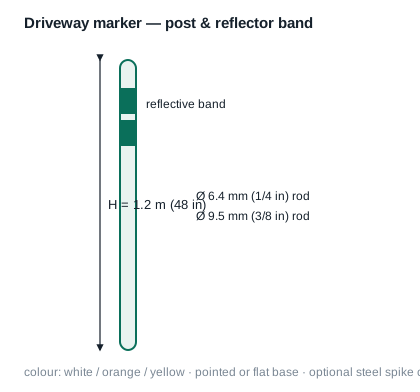
The two heights we normally pultrude are 1.2 m (48 in) for light snow country and 1.5 m (60 in) where plowed drifts run higher. The rod diameter is chosen by wind exposure and by how stiff the customer wants the marker to feel.
| Overall height | Rod Ø | Reflective band | Typical colours | Tip type |
|---|---|---|---|---|
| 1.2 m (48 in) | 6.4 mm (1/4 in) | 50 – 75 mm wide | White / orange | Tapered, drive direct |
| 1.2 m (48 in) | 9.5 mm (3/8 in) | 50 – 100 mm wide | White / orange / yellow | Tapered or steel-core spike |
| 1.5 m (60 in) | 9.5 mm (3/8 in) | 75 – 100 mm wide | White / orange / yellow | Tapered or steel-core spike |
| 1.5 m (60 in) | 12.7 mm (1/2 in) | 75 – 100 mm wide | Orange / yellow | Steel-core spike or pre-drilled flat base |
Reflective film is engineering-grade, applied after cure. Grade, band width and band position are set on the drawing; we do not supply certified retroreflectivity numbers for a specific lot.
Bend, impact and spring-back behaviour
The reason buyers switch from steel to GFRP is the blow test: a plow blade or a grader edge glances the marker at driving speed. A steel marker either bends permanently or snaps and becomes a flying bar. A GFRP marker bends, flexes past 90 degrees in extreme cases, and springs back to vertical once the blade has passed.
| Property | Typical value | Field consequence |
|---|---|---|
| Axial tensile strength | 600 – 900 MPa | Rod will not snap under normal bending |
| Flexural strength | 600 – 900 MPa | Rod bends elastically and returns upright |
| Density | 1.7 – 2.0 g/cm³ | ≈ one quarter of steel by volume, light to carry |
| Corrosion at soil line | None | No rust staining, no replacement after 3 years |
| Electrical | Non-conductive | Safe near buried utility and irrigation lines |
We do not publish lot-specific impact or retroreflectivity numbers. The bend-and-return behaviour is a system property of the pultruded section, the resin and the rod diameter; confirm the diameter against your expected plow speed and snow depth in the RFQ.
Resin, glass and UV resistance
The matrix is isophthalic polyester, chosen because it handles freeze-thaw cycling, road salt and wet-dry exposure better than general-purpose resin. The outer layer is pigmented — orange, yellow or white — and loaded with UV stabiliser so that a marker standing in a road shoulder for five winters does not chalk and lose surface resin.
The reinforcement is continuous E-glass roving along the axis, sized for polyester. We do not use chopped or recycled fibre in marker rods, because chopped fibre does not give the elastic spring-back the product is sold for.
- Matrix: isophthalic polyester, UV-stabilised outer layer.
- Reinforcement: continuous E-glass roving along the axis.
- Standard colours: white, orange, yellow, pigmented through the rod.
- Reflective film: engineering-grade, self-adhesive, applied after cure.
- Optional steel-core spike pressed into the tapered end for hard, dry or stony soils.
Driving, band position and installation practice
Markers are driven into the ground with a rubber mallet or a slide hammer, or installed into a pre-drilled hole where the soil is compacted or frozen. The reflective band is positioned so that it sits above the expected snow line; this is the single most common installation mistake.
- Drive 150 – 250 mm into firm soil; deeper in sandy or exposed sites.
- Position the reflective band above the typical plowed snow depth, not at the base.
- Use a rubber mallet or driving cap; never strike the top end with a steel hammer.
- In compacted or frozen ground, drill a pilot hole slightly smaller than the rod.
- Steel-core spike option: for stony soils where a tapered tip would blunt.
- Space markers by sightline — typically 3 – 6 m on a curve, 6 – 12 m on a straight driveway.
Spacing and band height are typical field practice. They are adjusted for snow depth, road speed and sightline on your layout.
FRP and GRP are the same material — which name applies to your order
You will see two acronyms on drawings and purchase orders for the posts on this page. FRP — fibre- or fiber-reinforced polymer — is the general engineering name for any polymer reinforced with continuous fibres. GRP — glass-reinforced plastic — is the name used across the UK, Ireland and much of the Commonwealth for the same family of products when the reinforcement is E-glass.
On a pultruded rod such as this GRP driveway marker the two words point at the identical laminate: continuous E-glass rovings in an isophthalic-polyester matrix, pulled through the same die on the same line. The overall height, the rod diameter, the engineering-grade reflective band and the spring-back behaviour are unchanged by which acronym the specifier writes. A GRP driveway marker quote and an FRP driveway marker quote for the same marker schedule are the same product.
The difference is purely editorial. British and Commonwealth standards tend to write GRP; North American standards and buyers tend to write FRP or GFRP. When a UK contractor sends a GRP delineator post specification and a US snow-plow contractor sends an FRP marker specification for the same height, we pultrude them on the same line and quote them on the same basis. Treat the name on the purchase order as a convention, not as a specification choice.
Where FRP markers earn their cost
The case for GFRP over steel or plastic is again ten-year cost in the ground. Steel markers rust at the soil line and need pulling and replacing. Solid plastic markers snap in a cold January wind. GFRP flexes and returns, and a crew can walk a row of them in one pass because each rod is light.
- Residential and private driveways, both snow-belt and dust-belt marking.
- Road shoulders, culvert edges and ditch lines on municipal and private roads.
- Buried utility marking: water, gas, fibre and irrigation routes.
- Construction site layout lines and fence-corner delineation.
- Marina and dock edge markers where salt water would corrode steel.
- Temporary event fencing and perimeter delineation.
- Parking lot edges, fire lanes and loading bay corners.
Reflective band and winter visibility
The band is engineering-grade retroreflective film, self-adhesive, applied after the rod is cured and cut. Widths run 50, 75 and 100 mm depending on rod diameter and customer preference. We do not claim a specific retroreflectivity number or a certified visibility distance; those values depend on the film supplier, the headlamp geometry and the viewing angle, and they should be confirmed with the film manufacturer's datasheet for the grade we apply.
Packing, lead time and what ships in a bundle
Markers are bundled by height and rod diameter, strapped with PET banding, and marked with the size, colour and production lot. Because the rods are long and thin, bundles are loaded flat and secured against bending. Standard production lead time is 12 to 36 working days depending on diameter mix, colour and whether steel-core spikes are fitted. Oversized panels, custom colours, new moulds and specialty resins are quoted with a separately confirmed schedule.
Our factory has produced pultrusions since 2004, runs a floor of more than 20,000 m² with 200+ staff, and exports to 40+ countries. We hold GB/T 19001-2000 idt ISO 9001:2000 (certificate 01708Q11888R0S, valid 2025-03-31 to 2028-12-30). We do not hold ABS or SGS certification, and the ASTM F3059 report we hold covers grating, not marker posts.
What we cannot tell you from this page
We want to be explicit. The heights, diameters, band widths and material values on this page are typical industry ranges for pultruded GFRP marker posts. They are not factory-measured values for a specific lot, and they are not a certified impact test or a certified retroreflectivity reading. We have not published lot-by-lot bend tests, because markers are sold as a consumable rather than as a certified safety device.
If your specification requires a guaranteed bending moment, a guaranteed pull-out resistance in your soil, or a certified retroreflectivity grade, send us the specification and the drawing. We will either quote a small test programme with our lab, or tell you honestly that the value you need is not one we can certify. We will not put a number on a certificate that we have not measured.
Why a grating factory pultrudes markers
Markers, stakes, rebar and structural profiles come off the same pultrusion line with the same resin kitchen. The advantage for a buyer who also needs walkway grating, cable tray or anti-slip tread — a works yard, a depot, a marina — is that the markers, the profiles and the grating can be sourced against one drawing standard, one resin specification and one shipment.
Send us the marker schedule (height, rod diameter, colour, band width, tip type) and any profiles or grating that the same project needs. We will answer with a drawing, a mass calculation and a lead time.
FRP driveway markers — frequently asked questions
Do FRP driveway markers really spring back after a plow hits them?
What height do I need for my snow depth?
Which rod diameter should I choose?
Is the reflective band certified to a specific distance?
Can I install them in frozen or stony soil?
What is the lead time and minimum order?
Is a GRP driveway marker the same as an FRP driveway marker?
Related pages
- Pultruded FRP profiles — the same line, different section
- Fiberglass plant stakes — the same rod, agricultural use
- Fiberglass structural profiles and load tables
- Applications by industry
- Contact us with your marker schedule
Send the marker schedule, not a catalogue number
Give us heights, rod diameters, colours, band widths and tip type. We answer with a drawing, a mass calculation and a lead time.