
Fiberglass Plant Stakes and Vineyard Trellis Posts
Fiberglass plant stakes are pultruded glass-reinforced polyester rods used to tie up vines, tomatoes, peppers, berries and nursery stock where steel would rust at the soil line and wood would rot. The same rod, supplied in longer lengths with a pointed end, becomes the in-row post of a vineyard or hop trellis.
We pull continuous glass rovings through an isophthalic polyester resin bath and cure them in a heated die, on the same line that produces our structural profiles and rebar. Diameter, cut length, colour and whether one end is tapered are fixed on the approved drawing before production. UK and Irish buyers commonly write GRP on their drawings and purchase orders, while North American buyers write FRP or GFRP — the product itself is identical.
All dimensions, tensile values and weights on this page are typical commercial ranges for pultruded GFRP stakes, not a test certificate for a specific lot. Final figures are confirmed by our engineering team and fixed on the approved order drawing.
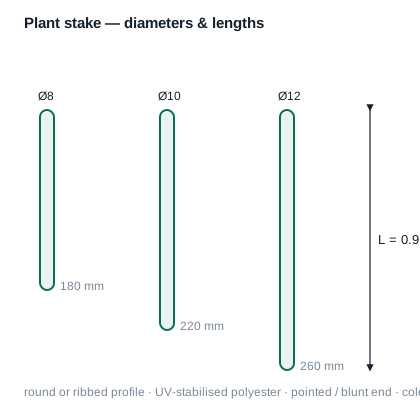
What a fiberglass plant stake is, and what it is not
A plant stake is a slender, axially loaded rod. The grower drives one end into the ground, ties the vine or the trellis wire against the other, and expects the rod to stay vertical for a decade or more without maintenance. Pultruded GFRP does this because the glass fibres run along the full length of the rod and carry the tensile load, while the polyester resin protects them from water, soil chemistry and UV.
It is not a fence post and it is not a structural column. A 2.4 m vineyard post will deflect under wind and crop load, and the trellis design has to allow for that deflection through wire tension and end-anchor design. Buyers who expect the stiffness of steel or concrete will be disappointed; buyers who expect a rod that never rusts at the soil line, never splinters, and weighs about a quarter of a steel bar of the same diameter will not.
Diameter series, lengths and typical mass
The rod is circular in section, smooth or lightly ribbed, and is cut to length before the driving end is ground or moulded to a point. The table below lists the series we normally pultrude; non-standard diameters are tooled against a minimum order and a drawing.
| Nominal Ø | Typical use | Stock length range | Typical mass (per m) | Standard colours |
|---|---|---|---|---|
| 6 mm | Tomato, pepper, nursery tie | 0.9 – 1.5 m | ≈ 0.03 kg/m | Green / black |
| 8 mm | Flower, small shrub, bean | 1.2 – 1.8 m | ≈ 0.05 kg/m | Green / black |
| 10 mm | Berry, hop, young vine | 1.5 – 2.4 m | ≈ 0.08 kg/m | Green / black / yellow |
| 11 mm | Vineyard in-row post (light) | 2.0 – 2.6 m | ≈ 0.10 kg/m | Green / black |
| 12 mm | Vineyard in-row post (standard) | 2.0 – 3.0 m | ≈ 0.12 kg/m | Green / black / grey |
| 16 mm | End post, hop, heavy crop | 2.4 – 3.0 m | ≈ 0.20 kg/m | Black / grey |
Mass is computed at a laminate density of about 1.8 g/cm³ and varies with glass content. A 2.4 m Ø10–12 mm post weighs roughly 1 kg, which is why a two-person crew can carry a full row's worth on a shoulder strap.
Axial strength and what it actually means in the field
The rod is strongest along its axis, where the fibres are continuous. The values below are typical for isophthalic-polyester GFRP with a standard E-glass roving content; they are not lot-specific test results and should not be used as a structural design value without our confirmation.
| Property | Typical value | Field consequence |
|---|---|---|
| Axial tensile strength | 600 – 900 MPa | Rod will not snap under normal trellis wire tension |
| Axial tensile modulus | 40 – 55 GPa | Lighter and more flexible than steel; design wire tension accordingly |
| Density | 1.7 – 2.0 g/cm³ | ≈ one quarter of steel by volume |
| Flexural strength | 600 – 900 MPa | Rod bends under wind and springs back rather than buckling |
| Electrical | Non-conductive | Safe near overhead lines and near irrigation electronics |
We do not publish lot-by-lot load-test certificates for stakes because they are agricultural consumables, not structural reinforcement. If your project requires a tested value, send the drawing and we will quote a test programme separately.
Resin, glass and UV protection
The resin decides what the rod survives in the ground. We use isophthalic polyester as the standard matrix, because it handles moisture, mild soil chemistry and wet-dry cycling better than general-purpose orthophthalic resin. The outer layer is pigmented and loaded with a UV stabiliser so that rods left standing in a vineyard for ten summers do not chalk the way unprotected GFRP does.
The glass is E-glass roving, sized for polyester compatibility. We do not use recycled or chopped fibre in these rods — chopped fibre cannot carry axial load the way continuous roving can, and it is the difference between a stake that lasts a decade and one that snaps in its second winter.
- Matrix: isophthalic polyester, UV-stabilised outer layer.
- Reinforcement: continuous E-glass roving along the axis.
- Standard colours: green, black, grey; yellow on request for visibility.
- Colour is mixed into the resin, not painted on, so it does not chip.
- Custom diameters and ribbed surface quoted against a drawing.
Driving, tying and installation practice
The pointed end is driven into the soil; the rod must not be hammered directly with a steel hammer, because the top end will fray. Use a rubber mallet, a driving cap, or a pilot hole where the ground is compacted. A typical driving depth is 300 to 400 mm for a 2.4 m vineyard post, which leaves about 2.0 m above grade for the trellis wire.
- Drive to 300 – 400 mm depth in normal soil; deeper in sandy or exposed sites.
- In-row spacing in vineyards is typically 1.2 – 1.5 m, set by row length and wire tension.
- Use a rubber mallet or driving cap; never strike the top with a steel hammer.
- Tie with soft twine, plastic tape or trellis clips — do not wire directly against the rod.
- Cut to length with an abrasive saw; shears crush the end and leave loose fibre.
- Store flat off the ground; black rods in direct sun can get hot enough to soften resin if stacked.
Driving depth and spacing are typical orchard practice. They are adjusted for soil type, wind load and trellis height on your layout drawing.
FRP and GRP are the same material — which name applies to your order
You will see two acronyms on drawings and purchase orders for the rods on this page. FRP — fibre- or fiber-reinforced polymer — is the general engineering name for any polymer reinforced with continuous fibres. GRP — glass-reinforced plastic — is the name used across the UK, Ireland and much of the Commonwealth for the same family of products when the reinforcement is E-glass.
On a pultruded rod such as this GRP plant stake the two words point at the identical laminate: continuous E-glass rovings in an isophthalic-polyester matrix, pulled through the same die on the same line. The diameter, the cut length, the UV-stabilised outer layer and the driving-end treatment are unchanged by which acronym the grower or the specifier writes. A GRP plant stake order and an FRP plant stake order for the same rod schedule are the same product.
The difference is purely editorial. British and Commonwealth standards tend to write GRP; North American standards and buyers tend to write FRP or GFRP. When a UK vineyard sends a GRP trellis post specification and a US nursery sends an FRP stake specification for the same rod, we pultrude them on the same line and quote them on the same basis. Treat the name on the purchase order as a convention, not as a specification choice.
Where fiberglass stakes earn their cost
The case for GFRP is not price per unit — treated wood is cheaper, plain steel is cheaper — it is ten-year cost in the ground. Steel posts rust through at the soil line and need replacement in four to seven years in wet or coastal sites. Treated wood leaches, splinters and pulls out of alignment. GFRP does neither, and it weighs a fraction of either, so installation is faster.
- Vineyard and winery trellis rows, both vertical shoot positioning and Geneva double curtain.
- Orchard support for apple, pear, cherry and peach where branches need a tie-back.
- Tomato, pepper and berry crops in greenhouse and open field.
- Hop yards, where the high trellis demands a long, light, rot-resistant in-row post.
- Nursery stock staking, tree whips and standard fruit tree support.
- Frost-protection and hail-net support lines, where wire runs over the orchard.
- Garden and landscaping stakes for roses, clematis and other climbing ornamentals.
Colours and field identification
Colour is mixed into the resin before pultrusion, so a scratched rod still shows the same colour. Many growers ask us to colour-code by diameter — green for 8 mm, black for 10 mm, yellow for 12 mm — so that a crew walking a row can see which post goes where without calipers. We can supply this under your own colour schedule; send the mapping with the purchase order.
Packing, lead time and what ships in a bundle
Rods are bundled by diameter and cut length, strapped with PET banding, and marked with the rod size, length and production lot. Bundles are loaded flat; long 3 m posts need a spreader rather than a single sling point. Standard production lead time is 12 to 36 working days depending on the diameter mix, colour and whether tapered ends are required. Oversized panels, custom colours, new moulds and specialty resins are quoted with a separately confirmed schedule.
Our factory has produced pultrusions since 2004, runs a floor of more than 20,000 m² with 200+ staff, and exports to 40+ countries. We hold GB/T 19001-2000 idt ISO 9001:2000 (certificate 01708Q11888R0S, valid 2025-03-31 to 2028-12-30). We do not hold ABS or SGS certification, and the ASTM F3059 report we hold covers grating, not stakes.
What we cannot tell you from this page
We want to be explicit. The tensile values, weights and driving depths on this page are typical industry ranges for pultruded GFRP agricultural rods. They are not factory-measured values for a specific diameter lot, and they are not a certified load test. We have not run field trials on every soil type, and we have not published lot-by-lot bending tests, because stakes are sold as a consumable rather than as a structural member.
If your design needs a guaranteed axial value, a guaranteed bending moment, or a guaranteed pull-out resistance in your specific soil, send us the drawing and the soil description. We will either quote a small test programme with our lab, or tell you honestly that the value you need is not one we can certify. We will not put a number on a certificate that we have not measured.
Why a grating factory pultrudes stakes
Stakes, rebar and structural profiles come off the same pultrusion line with the same resin kitchen. The advantage for a buyer who also needs walkways, cable trays or anti-slip grating — a winery processing line, a greenhouse bench, a farm service yard — is that the rods, the profiles and the grating can be sourced against one drawing standard, one resin specification and one shipment.
Send us the rod schedule (diameter, length, colour, point or flat end) and any profiles or grating that the same project needs. We will answer with a drawing, a mass calculation and a lead time.
Fiberglass plant stakes — frequently asked questions
How long do fiberglass stakes last in the ground?
What diameter do I need for a 2.4 m vineyard trellis post?
Can I drive a GFRP stake directly with a steel hammer?
Are these stakes conductive? Can they go near irrigation wires?
Do you supply custom colours or colour-coded diameters?
What is the lead time and minimum order?
Is a GRP plant stake the same as an FRP plant stake?
Related pages
- Pultruded FRP profiles — the same line, different section
- Fiberglass rebar — the same GFRP system, structural grade
- Fiberglass structural profiles and load tables
- Applications by industry
- Contact us with your rod schedule
Send the rod schedule, not a catalogue number
Give us diameters, cut lengths, colour, tapered or flat ends, and the crop the rods will support. We answer with a drawing, a mass calculation and a lead time.