Fiberglass Roving and Glass Reinforcement for Pultrusion
The strength of a pultruded FRP beam, a grating bar or a GFRP rebar starts with the glass fibre that goes in. This page explains how direct roving and chopped strand mat are specified, how the sizing is matched to the resin, and how incoming reinforcement is accepted on a real pultrusion line. Read it to judge whether a supplier actually controls its raw material.
Important: we are a pultruder and a moulder of finished FRP products, not a glass-fibre producer. Our lines consume direct roving and chopped strand mat supplied by specialist glass factories, and we accept each lot by tex, sizing compatibility and moisture content. We do not spin our own roving.
Figures on this page are typical values from published glass-fibre and composite-material practice, not a mill certificate for a specific lot. Exact tex, sizing family and availability are confirmed with the glass factory and on the order.
What this page is — and what it is not
This is a raw-materials topic, not a product catalogue for glass fibre. Our pultrusion lines and our moulding stations consume direct roving and chopped strand mat made by specialist glass-fibre manufacturers. We buy it, we handle it, we check it, and we turn it into profiles, grating, rebar and plates.
We do not produce glass-fibre roving ourselves, and this page will not claim that we do. Its value to a buyer is practical: it tells you which questions to ask about the yarn inside a pultruded section, so that you can tell a supplier who controls its reinforcement from one who simply buys commodity stock.
Direct roving basics: tex, filament diameter, density
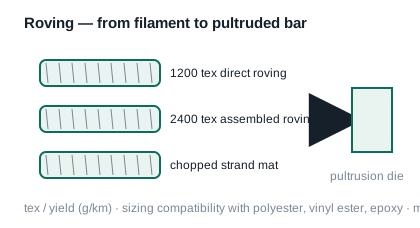
Direct roving is a continuous bundle of hundreds to thousands of glass filaments wound into a cheese. The two numbers that describe it are the tex (mass per 1,000 metres of yarn) and the single-filament diameter. The most common rovings drawn into pultrusion lines sit at 1,200 and 2,400 tex.
| Property | Typical | Unit | Note |
|---|---|---|---|
| Tex | 1,200 / 2,400 | tex | Grams per 1,000 m of yarn |
| Single-filament diameter | 13 - 24 | um | Smaller filaments = more wet-out area |
| Glass type | E-glass | - | Density about 2.5 g/cm3 |
| As-drawn filament tensile | about 3,000 | MPa | Order of magnitude only |
| Moisture on delivery | 0.1 or less | % | Measured on the accepted lot |
The 3,000 MPa figure belongs to a fresh, dry filament in ideal conditions. In a cured laminate the effective fibre strength is far lower because of resin wet-out, fibre volume fraction and orientation — never quote bare-filament numbers as product strength.
How roving is used on a pultrusion line
On a pultrusion line, hundreds of roving ends are pulled from creels through a resin bath, gathered in a pre-former and pulled through a heated steel die where the resin cures. The fibres run along the axis of the profile and carry nearly all of the axial tension and bending. Chopped strand mat or continuous mat is added around the rovings to give transverse strength and a good surface.
This is why two pultruders using the same nominal resin can produce sections with very different stiffness: the fibre volume fraction, the wet-out and the tension control at the creel decide what actually comes out of the die.
Sizing must match the resin system
Every glass filament leaves the spinnerette with a chemical coating called sizing: a coupling agent that bonds glass to resin, plus a film former that protects the bundle. Sizing is not generic. A roving sized for polyester will not perform well in epoxy, and a mismatch shows up as dry spots, poor interlaminar strength and surface fuzz.
We verify sizing compatibility for each incoming lot against the resin system it will meet on our line. If a project changes resin from polyester to vinyl ester, the roving grade has to be confirmed again — it is not a free swap.
| Resin system | Sizing requirement | Comment |
|---|---|---|
| Unsaturated polyester | Polyester-compatible sizing | Our general-purpose pultrusion grade |
| Vinyl ester | Vinyl-ester-compatible sizing | Confirm per lot for coastal / acid service |
| Epoxy | Epoxy-compatible sizing | Different film former, not interchangeable |
Sizing compatibility is checked lot by lot. A roving that works in polyester is not automatically approved for vinyl ester or epoxy.
Chopped strand mat as the secondary reinforcement
Where roving carries the axial load, chopped strand mat (CSM) supplies the transverse strength and the surface coverage that rovings alone cannot give. CSM is a blanket of short glass strands held together by a binder that dissolves in the resin bath. Common weights are 300, 450 and 600 g per square metre.
CSM is the reason an FRP plate or a wide profile has a smooth, resin-rich face and resists tearing across its width. It is laid up with the roving in the pre-former, not applied by hand on the pultrusion line.
How we accept incoming reinforcement
Reinforcement is the one raw material where a single bad lot can run through an entire day's production before it is noticed. The checks below are the routine acceptance steps on our line.
- Tex verified against the supplier's delivery note for the lot.
- Moisture content kept at 0.1 % or less before the resin bath.
- Sizing compatibility confirmed against the resin system on the line.
- Visual check: no broken or fused ends, no contamination from packaging.
- Storage off the floor, in a dry area, away from direct sun.
- Issued first-in first-out so no package sits long enough to pick up moisture.
A roving package that has absorbed moisture will show as fuzzy, poorly wetted profiles and weak laminates. Storage discipline is part of the process, not a warehouse preference.
FRP and GRP are the same material — which name applies to your order
Because this glass goes into finished parts, you will meet the end products called FRP profiles and GRP profiles interchangeably, and the two names are not two materials. FRP stands for fibre-reinforced polymer, the general engineering term. GRP stands for glass-reinforced plastic, the term used across the UK and the Commonwealth for the same family when the reinforcement is E-glass. The roving and mat on our lines feed both wordings; they are the same E-glass in a polyester or vinyl ester matrix.
The naming difference never touches the yarn. A roving bought to build GRP grating and the roving bought to build FRP profiles are specified by the same tex, the same filament diameter and the same sizing family. Whether the finished beam is labelled GRP or FRP, its glass content, resin system and mechanical values are set by the ply and the resin, not by the acronym on the drawing.
North American documentation most often writes FRP or GFRP, while UK, Irish, Australian and many European documents write GRP. If a tender asks for GRP reinforcement and your drawings specify FRP, the reinforcement inside is the same: quote the same tex and sizing against one specification. We do not treat the two names as separate yarn grades.
Why reading the yarn helps you judge a supplier
Ask a pultruder three questions: which tex and which sizing family run on your line, what moisture do you accept on incoming roving, and how is the stock stored. If the answer is a shrug, you are buying from someone who buys commodity yarn and hopes the die will sort it out. If the answer names a tex, a sizing family and a moisture limit, you are talking to a process-controlled supplier.
The follow-up is whether they can tell you the glass content of a typical section. That number, not a catalogue picture, is what decides whether a beam will deflect as calculated.
Where reinforcement choice shows up in our products
Every pultruded or moulded item we ship relies on the same incoming reinforcement checks. The visible result differs by product.
- Pultruded load-bearing beams, angles and rectangular tubes.
- Moulded grating mesh bars and bearing bars.
- GFRP rebar bars, where the axial roving is the whole product.
- FRP plates and panels, where CSM gives the flat resin-rich face.
- FRP decking boards and planks, where ribs carry bending.
- Handrail tubes and structural framing profiles.
Can you supply roving together with your profiles?
We do not spin glass, so we cannot offer our own-brand roving. If a fabricator wants matching reinforcement shipped alongside a profile order, we can quote direct roving and CSM by lot and grade, subject to what the glass factory can supply at that time. Treat it as a matching-materials request, not as a glass-fibre product line from us.
For scale: our plant was established in 2004, covers more than 20,000 m2, employs over 200 people and exports to more than 40 countries. We hold ISO 9001 (certificate 01708Q11888R0S). Our ASTM F3059 report applies to moulded grating; we hold no third-party product certification for glass fibre and do not claim one. Typical lead time for our pultruded products is 12 to 36 working days. Oversized panels, custom colours, new moulds and specialty resins are quoted with a separately confirmed schedule. If your purchase documents use GRP rather than FRP for the finished parts, it is the same material and the same reinforcement — quote it under whichever name your specification carries.
Fiberglass roving and reinforcement — frequently asked questions
Do you manufacture fiberglass roving yourself?
What tex of direct roving do you typically use?
What is sizing and why does it matter?
How dry must the roving be?
What is chopped strand mat used for?
What documents come with an order?
Is GRP roving the same as FRP roving?
Related pages
- Pultruded FRP profiles — where the roving ends up
- Fiberglass structural profiles and load tables
- FRP structural profiles by section
- FRP plate — where CSM gives the flat face
- FRP grating — moulded mesh made from the same reinforcement
Tell us what you are pultruding
Give us the section or product, the resin system and the exposure. We will answer with the tex and sizing logic behind the section, a lead time, and whether matching reinforcement can be quoted alongside.