
Fiberglass Rebar (GFRP Rebar)
Fiberglass rebar is a pultruded glass-fibre composite bar used where steel would corrode: seawalls, marine decks, chemical floors, water treatment structures and electromagnetic-sensitive rooms. This page gives the size range, typical mechanical values, the design points that actually decide a section, and how bars are bent and lapped on site.
The bars are produced on the same pultrusion line as our structural profiles, in vinyl ester or isophthalic polyester, with a sand-coated or helically wrapped surface for bond. Diameters, grades and cut lengths are fixed on an approved drawing before production. UK and Irish buyers commonly write GRP on their drawings and purchase orders, while North American buyers write FRP or GFRP — the product itself is identical.
Values on this page are typical ranges taken from published GFRP rebar standards (ASTM D7957 / CSA S807 grading, ACI 440.1R design practice) and normal commercial supply. They are not a test report for a specific lot — final figures are fixed on the approved drawing and the order confirmation.
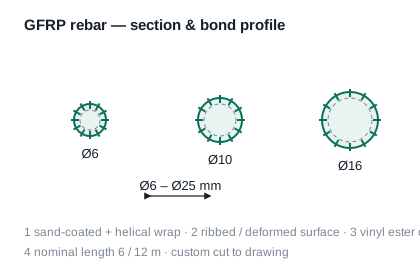
What fiberglass rebar is, and what it is not
GFRP rebar is a continuous bundle of glass filaments pulled through a resin bath and cured in a heated die, so the fibres run along the bar axis and carry the load. The result is a bar with high tensile strength along its length, no electrochemical corrosion, and complete transparency to magnetic fields and radio waves.
It is not a drop-in substitute for steel in every member. The Young's modulus is roughly a third of steel, there is no yielding plateau, and the material is anisotropic: strong along the bar, comparatively weak across it. Design codes such as ACI 440.1R treat GFRP reinforcement as an elastic material to failure and control the section by crack width and deflection rather than by yield.
Bar sizes, section area and nominal mass
Sizes follow the same numbering as steel bars so that drawings can be read across, but the diameter, area and mass are composite values. Mass is computed at a laminate density of about 1.8 g/cm³, against 7.85 g/cm³ for steel — which is where the weight saving comes from.
| Bar size | Nominal Ø | Section area | Mass, GFRP | Mass, steel bar | Typical tensile |
|---|---|---|---|---|---|
| #2 | 6 mm | 28 mm² | ≈ 0.05 kg/m | 0.22 kg/m | 800 – 1,100 MPa |
| #3 | 10 mm | 79 mm² | ≈ 0.14 kg/m | 0.62 kg/m | 800 – 1,100 MPa |
| #4 | 12 mm | 113 mm² | ≈ 0.20 kg/m | 0.89 kg/m | 800 – 1,100 MPa |
| #5 | 16 mm | 201 mm² | ≈ 0.36 kg/m | 1.58 kg/m | 700 – 1,000 MPa |
| #6 | 20 mm | 314 mm² | ≈ 0.57 kg/m | 2.47 kg/m | 700 – 1,000 MPa |
| #8 | 25 mm | 491 mm² | ≈ 0.88 kg/m | 3.85 kg/m | 650 – 950 MPa |
Mass assumes 1.8 g/cm³ laminate density; actual mass depends on the glass content of the approved construction. Standard stock lengths are 6 m and 12 m; other lengths are cut to the drawing.
Typical mechanical values against steel
The comparison below is the one buyers ask for, because it explains both the benefit and the design work it creates. Higher tensile strength does not mean a smaller bar: the lower modulus usually needs more area, and the design is then checked for deflection and crack width.
| Property | GFRP rebar (typical) | Steel rebar (typical) |
|---|---|---|
| Density | 1.7 – 2.0 g/cm³ | 7.85 g/cm³ |
| Tensile strength | 650 – 1,100 MPa | 400 – 500 MPa (mild) |
| Young's modulus | 55 – 65 GPa | 200 GPa |
| Elongation at failure | 1.5 – 2.5 % | > 10 % with yield plateau |
| Coefficient of thermal expansion, axial | 1.5 – 3 × 10⁻⁶ /°C | ≈ 12 × 10⁻⁶ /°C |
| Corrosion | None in chloride and acid service | Requires cover, inhibitor or coating |
| Electrical and magnetic | Non-conductive, non-magnetic | Conductive, magnetic |
| Barcol hardness | ≥ 40 | n/a |
Axial expansion is low; the transverse value is higher and is dominated by the resin. This is why GFRP reinforcement is detailed with temperature and shrinkage reinforcement in the orthogonal direction.
Surface finish and bond behaviour
Bond is the weak link in any composite bar, so the surface is engineered rather than left smooth. Three finishes are normally offered, and all three are produced on the same line by changing the take-off tooling.
Sand coating gives the highest bond in normal concrete and is the default for structural slabs. A helical wrap adds mechanical interlock and is preferred where the bar is subject to vibration or where development length is tight. A ribbed or deformed profile is used where the specification calls for a geometric key rather than a coating.
- Sand-coated: quartz grit bonded in the outer resin layer, best all-round bond.
- Helically wrapped: continuous fibre wrap, mechanical interlock plus abrasion resistance.
- Ribbed / deformed: moulded ribs for specifications that require a shaped surface.
- Smooth: only for non-structural or secondary use, such as dowels and spacers.
Development length is set from the bond data of the specific finish — a sand-coated bar and a smooth bar of the same diameter are not interchangeable in a calculation.
Where deflection, not strength, decides the section
Because the modulus is about 60 GPa, most GFRP-reinforced slabs and beams are governed by serviceability. Two checks do the work: deflection under the design load, and crack width at the calculated service moment.
A practical consequence is that GFRP sections are usually over-reinforced — more bar area than the ultimate moment requires — so that the concrete stays in compression and the failure mode is progressive rather than brittle. Designers who simply convert a steel section bar-for-bar end up with a section that fails the deflection check.
Resin selection by exposure
The resin, not the glass, decides the service environment. Isophthalic polyester is the general-purpose choice for water, mild chemicals and buried service. Vinyl ester is specified for acids, hypochlorite, brine and elevated temperature, and costs more per metre.
If the structure is exposed to UV for years — parapets, open decks, stakes in a field — the bar needs a UV-stabilised outer layer or a pigmented finish, or the top surface must be protected. Unprotected GFRP will chalk and lose surface resin, and while the loss is cosmetic at first, exposed fibre eventually takes up water.
| Exposure | Resin | Comment |
|---|---|---|
| Fresh and sea water, buried | Isophthalic polyester | General purpose, lowest cost |
| Chlorides, de-icing salt | Isophthalic or vinyl ester | Vinyl ester where wet-dry cycling is severe |
| Acids, hypochlorite, brine | Vinyl ester | Confirm concentration and temperature in the RFQ |
| Alkali (fresh concrete) | Vinyl ester | Standard polyester is attacked by high-pH pore water over time |
| Prolonged UV | UV-stabilised surface layer | Or protect the exposed face |
Chemical resistance is a system property of resin, glass sizing and cure. Send the actual concentration and temperature rather than a generic 'chemical plant' description.
FRP and GRP are the same material — which name applies to your order
You will see two acronyms on drawings and datasheets for the bars on this page. FRP — fibre- or fiber-reinforced polymer — is the general engineering name for any polymer reinforced with continuous fibres. GRP — glass-reinforced plastic — is the name used across the UK, Ireland and much of the Commonwealth for the same family of products when the reinforcement is E-glass.
On a pultruded bar such as this GRP rebar the two words point at the identical laminate: E-glass rovings in an isophthalic-polyester or vinyl-ester matrix, pulled through the same die on the same line. The drawing, the resin system, the bar diameter and the characteristic load are unchanged by which acronym the specifier writes. A GRP rebar quote and an FRP rebar quote for the same drawing number are the same product.
The difference is purely editorial. British and Commonwealth standards tend to write GRP; North American standards and buyers tend to write FRP or GFRP. When a UK customer sends a GRP reinforcement specification and a US customer sends an FRP rebar specification for the same member, we build them to the same laminate and quote them on the same basis. Treat the name on the purchase order as a convention, not as a specification choice.
Bending, cutting and site handling
Bent bars are produced on a mandrel at the factory, not bent on site — bending cured GFRP cold will split the outer resin and break filaments. The minimum bend radius is typically three to six bar diameters depending on the finish, and the bend is set on the drawing.
Cutting is done with a diamond or carbide abrasive blade, not a shear. Shearing crushes the bar end and leaves loose fibre. Cutting produces dust, so respiratory protection and eye protection are required, and the cut end should be sealed if the bar sits in wet service.
- Factory bends only; supply the bend schedule with the order.
- Abrasive cut-off saw or diamond blade; never guillotine or shear.
- Dust extraction or wet cutting; P2/P3 respirator and eye protection.
- Do not use GFRP bar as an earth or lightning conductor, and do not substitute it where steel is specified for electrical continuity.
- Store flat, off the ground, out of standing water; black bars in direct sun can exceed the resin's safe surface temperature.
Lap lengths, chairs and cover
Lapped splices are longer than in steel because bond stress is carried by the coating rather than by deformed ribs. A working start is 40 to 60 bar diameters for a sand-coated bar in normal-weight concrete, then verified against the bar supplier's bond data for the actual finish.
Chairs and spacers are non-metallic and are spaced closer than for steel — typically 0.8 to 1.0 m — because the bar is lighter and stiffer in handling terms but has less resistance to being walked on before cure. Cover is set by durability and fire requirements, not by corrosion, which is one of the few places GFRP reinforcement simplifies the detailing.
Lap and chair figures are typical practice. They are confirmed on the approved shop drawing, not taken from a catalogue page.
Standards, and the documents that come with an order
The standards buyers usually name are ASTM D7957 for solid GFRP bars, CSA S807 for the Canadian grading, ISO 10406-1 for test methods, and ACI 440.1R for design. We supply against the grade you name in the RFQ and we say clearly what we hold and what we do not.
Our factory holds GB/T 19001-2000 idt ISO 9001:2000 (certificate 01708Q11888R0S, valid 2025-03-31 to 2028-12-30) and an ASTM F3059 report (211122012SHF-001) for grating, not for rebar. For rebar we do not hold a third-party product certification, and we will not describe one as if we did.
What you receive with a rebar order: the approved drawing, the resin and glass datasheets, a dimensional and mass check sheet per lot, the Barcol hardness reading, and a packing list with cut lengths and bundle marks.
Where fiberglass rebar earns its cost
The economics are not in the bar price — GFRP costs more per kilogram than steel. They are in the service life of structures that would otherwise be repaired every decade: marine deck edges, sea walls, wastewater channels, quay copings, tunnel inverts and chemical plant plinths.
Where electromagnetic transparency matters, GFRP is not an alternative but the only option: MRI rooms, antenna housings, radar-transparent structures and medical imaging floors cannot contain a conductive grid.
- Sea walls, quay walls, breakwater copings and marina deck edges.
- Bridge deck wearing courses and concrete overlays with de-icing salt.
- Wastewater and water treatment tanks, channels and covers.
- Chemical plant flooring, plinths and cable trenches.
- Tunnel inverts and shotcrete linings where access for repair is expensive.
- MRI rooms, RF-transparent panels and non-magnetic equipment bases.
- Vineyard and orchard trellis posts, where steel rusts at the soil line.
Supply, packing and lead time
Bars are bundled by diameter and cut length, strapped with composite or PET banding, and marked with the heat, diameter and length. Bundles are loaded flat; long lengths need a spreader rather than a single sling point.
Typical production lead time is 12 to 36 working days depending on diameter mix and whether bends are required. Oversized panels, custom colours, new moulds and specialty resins are quoted with a separately confirmed schedule. Small trial quantities are accepted so that a contractor can test handling and cutting before committing to a full package.
Why a grating factory also pultrudes rebar
Rebar and structural profile come off the same machine and the same resin kitchen. The value to a buyer is that the reinforcement, the grating that sits on top of it and the pultruded framing that carries it can be sourced against one mill certificate set, one drawing standard and one shipment.
If your project also needs walkways, stair treads or handrail, the rebar enquiry can be combined with the grating schedule, which reduces freight and inspection cost.
Fiberglass rebar — frequently asked questions
Is fiberglass rebar as strong as steel rebar?
Does GFRP rebar corrode in salt water or chlorine?
What bend radius do you need for a hooked bar?
Can fiberglass rebar be used in columns and seismic frames?
What documents are supplied with a rebar order?
What is the lead time and minimum order for GFRP rebar?
Is GRP rebar the same as FRP rebar?
Related pages
- Pultruded FRP profiles — the same line, different section
- Fiberglass structural profiles and load tables
- FRP grating — the walking surface above the reinforcement
- Applications by industry
- Project references
Send the bar schedule, not a catalogue number
Give us diameters, cut lengths, bend schedule, resin and the exposure the bar will see. We answer with a drawing, a mass calculation and a lead time.
Technical downloads
GFRP rebar data sheet (PDF) — diameter series, typical tensile and modulus values, surface options, bending and lap radii, and the standards we design to.