
Carbon Fiber Roller and FRP Composite Roller, Made to Drawing
A carbon-fiber or glass-fiber composite roller is a hollow wound tube fitted with machined journals, used where a steel roll would be too heavy to start, too slow to change speed, or too corrosive for the environment. We do not sell a catalogue of stock rollers: every roll is wound, faced, balanced and machined against an approved drawing you provide.
Our shop runs filament-winding lines for composite tubes and a machine shop for the journals, bearings seats, keyways and surface finishes that the roll needs in service. The tube material, wall schedule, journal material and finish are chosen from the duty on your drawing — web material, line speed, tension, temperature, cleaning chemistry and bearing arrangement.
All numbers on this page are typical industry ranges and order-of-magnitude figures, not a guarantee for any specific roll. The outer diameter, wall, balance grade, journal form and maximum line speed of your roller are fixed on the approved drawing and the order confirmation, after we check the ply schedule against your duty.
What a composite roller is, and what it is not
A composite roller is a hollow tube of continuous carbon or glass filament wet-wound over a mandrel in epoxy or vinyl ester resin, cured, released, then machined at the ends to accept journals, bearing seats, keys or flanges. The fibres carry the bending and torque loads; the resin holds them in place and protects them from the web and the cleaning chemistry.
It is not a stock item from a shelf. There is no standard catalogue size that fits every printing, coating, laminating, slitting, stretching, paper or textile line. Each roll is dimensioned from the equipment it goes into, and the wall and ply angles are chosen for the span, the load and the speed. If a drawing is not yet available, we work back from the machine datasheet and the web width, but the roll cannot be wound until the key dimensions are agreed in writing.
Typical build: wound tube plus machined journals
A working roll is, in its simplest form, a wound tube with a journal at each end. The journal can be machined steel, stainless, or a composite boss bonded and over-wound into the tube end. The tube carries the bending moment from the web tension and the weight of the roll itself; the journal carries the bearing reaction and transmits torque through a key, a spline, a taper or a flange.
Because the tube is anisotropic — strong along the fibre directions, comparatively soft across them — the ply schedule is laid up by the winding machine to match the loads: hoop layers for pressure and ovality, helical layers for bending and torque, and a surface veil for a smooth, resin-rich outer skin. The wall thickness you see on a drawing is the cured, machined result, not a single layer.
Dimension sheet — what the drawing must state
The table below lists the geometry we need before quoting. Typical ranges are given for orientation; the values on your roll are taken from the approved drawing, not from this page. Where a row says 'per drawing' there is no catalogue default.
| Item | Typical range | How it is fixed | Note |
|---|---|---|---|
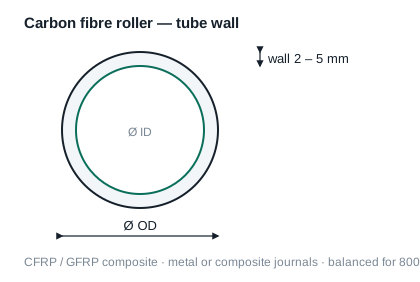
| Outer diameter (OD) | 50 – 300 mm | Per drawing | Set by roll gap, web width and bearing layout |
| Inner diameter (ID) | Derived from OD and wall | Per drawing | Calculated after the wall schedule is chosen |
| Face length | By equipment | Per drawing | Straight or crowned, with or without neck-in |
| Wall thickness | 2 – 5 mm typical | Per drawing | Ply schedule chosen for stiffness, weight and pressure |
| Journal form | Cylindrical, tapered, flange | Per drawing | Steel, stainless or composite, keyed or splined |
| Balance grade | ISO 1940 G grade | Per drawing | The grade is specified by the buyer on the drawing |
| Maximum line speed | Per calculation | Per drawing and duty | Industry order of magnitude 800 – 2,000 m/min |
We do not publish a single rated speed or a single residual-balance figure. The safe line speed of a roll depends on its mass, its span, the bearing system and the balance grade, and it is confirmed by calculation for each project.
Surface finish on the face
The contact face is finished to the job. A bare wound tube is rarely the final surface: it is ground to size, then either polished to a mirror finish, bead or sand blasted for grip, hard chrome plated where wear and cleaning chemistry demand it, or rubber and polyurethane covered where friction against the web is the design requirement.
Each finish changes the roll mass, the thermal behaviour and the maintenance cycle, and each is specified on the drawing. A covered roll, for example, adds a layer that must be re-ground or re-covered in service, and the under-tube is sized with that future regrind allowance in mind.
- Ground and polished mirror face — for film and foil contact where marking must be avoided.
- Bead or sand blasted face — for driven and pull rolls that need friction without a cover.
- Hard chrome plated face — for corrosive cleaning chemistry and abrasive web.
- Rubber or polyurethane covered face — for nip, pull and transport rolls; shore hardness per drawing.
- Plain wound and ground face — for idler and spreader rolls where finish is not critical.
Balance, speed and what the drawing must specify
Dynamic balance is graded against ISO 1940 (now ISO 21940) on a G scale, from G0.4 for precision machine tool spindles up to G40 or looser for general fans and impellers. The grade a roll needs is decided by the process — a high-speed film stretcher and a slow paper guide roll are not in the same category — and it is the buyer who names the grade on the drawing, not the factory that chooses one by default.
Line speed is then checked against the roll mass, the span between bearings, the balance grade and the critical-speed margin. The industry commonly works in the order of 800 to 2,000 metres per minute for medium web rolls, but that is an order of magnitude, not a rating. We will not quote a single maximum RPM or a single residual unbalance number on this page, because either would be wrong for most of the rolls we actually build.
Send the target line speed, the web tension, the bearing centres and the required ISO balance grade. We come back with a wall schedule, a calculated critical-speed margin and a balance tolerance in gram-millimetres for that specific roll.
FRP and GRP are the same material — which name applies to your order
The glass-fibre tube on a composite roller is called an FRP tube and, on UK and Commonwealth drawings, a GRP tube, and the two names are not two materials. FRP stands for fibre-reinforced polymer, the general engineering term. GRP stands for glass-reinforced plastic, the common British term for the same glass-fibre composite. A filament-wound roller body built from E-glass in epoxy or vinyl ester is, under either name, the same wound tube on the same mandrel logic.
The wording does not change the build. A roller quoted as a GRP roller and one quoted as an FRP roller use the same outer diameter, wall schedule, ply angles, journal material and balance grade; the name on the RFQ or the datasheet reflects regional wording, not a different laminate. Carbon-fibre rollers stay carbon-fibre rollers under both names; the GRP / FRP wording only applies when the tube is glass.
North American specifications most often write FRP or GFRP, while UK, Irish, Australian and many European documents write GRP. If your customer asks for a GRP roller and your internal drawing says an FRP composite roller, it is the same glass-fibre wound body: send the same drawing and the same duty list. We do not treat the two names as separate roller grades.
Why composites, when steel would do
A carbon or glass tube weighs a fraction of a solid steel roll of the same outer diameter, and a small fraction of a heavy-wall steel roll. Lower mass means lower polar moment of inertia, which is what the drive feels during acceleration and deceleration: a lighter roll starts faster, stops faster, and draws less motor current during a speed change.
The axial coefficient of thermal expansion of a well-designed carbon tube is close to zero and far below steel, which matters when a roll runs at elevated temperature or passes through an oven and must not grow along its axis and walk on the web. Composite also does not rust in wash-down, seawater, ink, coating chemistry or humid storage, and it is transparent to magnetic fields and RF where that matters.
Installation and mating points
A roll is only as good as the way it is held. Before winding, we need to know how the journals mount in the line: bearing type and bore, whether the roll is driven or an idler, how torque is transmitted (key, spline, taper, shrink fit, timing belt or chain), and how end location is taken up. These details are drawn on the approved drawing and the journal is machined to match.
On site, composite rolls are handled like precision rolls: no dropping, no sideways levering on the journal, and no clamping the face in a vise. Bearings are pressed onto the journal, not hammered on. Storage is horizontal on V-blocks, off the floor, out of direct sun, because a long thin tube left standing vertically can take a set.
- Confirm bearing type, bore and arrangement (pillow, cartridge, journal-outboard).
- Confirm drive method: key, spline, taper, shrink fit, belt, gear or chain.
- Confirm end-location: which side is fixed, which side floats for thermal growth.
- Confirm web edge: chamfer, lead-in, crown or neck-in, and any spiral groove pattern.
- Confirm cleaning chemistry and temperature, so resin and face finish are chosen correctly.
Where these rollers are used
Composite rolls are chosen wherever the roll has to be light, clean, dimensionally stable in heat, or immune to corrosion. The list below is the common set; any of them can be quoted against a drawing.
- Printing press lines — guide, pull-out and dancer rolls, where low inertia helps colour register.
- Laminating and converting lines — nip and pull rolls, where temperature and chemistry meet.
- Slitting and rewinding lines — rider, lay-on and slitter knife rolls.
- Coating and vacuum-metallising lines — feed, back-up and cooling rolls, often mirror-faced.
- Film stretching and tentering frames — high-speed rolls where low CTE and low weight both matter.
- Paper and board machines — guide and spreader rolls in wash-down and humid environments.
- Textile and non-woven lines — feed and transport rolls, where ink, dye and steam meet the roll.
Factory capability, quality and what ships with an order
Our factory has run since 2004, occupies more than 20,000 m², employs over 200 people and exports to more than 40 countries. We hold GB/T 19001-2000 idt ISO 9001:2000 (certificate 01708Q11888R0S). The filament-wound tubes we supply come off the same class of equipment as our grating and pultrusion lines, and the journals are machined in our own shop.
What you receive with a roller order: the approved drawing, the resin and fibre datasheets, a dimensional check sheet (OD, ID, face length, journal diameters, run-out), a balance report with the measured residual unbalance in gram-millimetres against the grade you specified, a surface-finish record, and a packing list. We do not hold ABS PDA or SGS product certification for rollers, and we will not describe one as if we did; ASTM F3059 applies to grating, not to rolls.
Supply, lead time and what to send in the RFQ
Rollers are quoted only against a drawing or a complete specification, because there is no catalogue price. Typical lead time is 12 to 36 working days after drawing approval, depending on the wall schedule, the journal material, the surface finish and whether a dynamic balance to a tight grade is required. Oversized panels, custom colours, new moulds and specialty resins are quoted with a separately confirmed schedule. Pilot and trial quantities are accepted so that a line can test one roll before committing to a set.
Send us: outer diameter, inner diameter or wall, face length, total length over journals, bearing centres, web width, line speed, web tension, the ISO balance grade you want, the cleaning chemistry and temperature, and any surface finish or cover requirement. From that we come back with a drawing, a ply schedule and a lead time. If your purchase order uses the term GRP roller rather than FRP roller for the glass-fibre bodies, it is the same wound tube and the same specification — quote it under whichever name your document carries.
Carbon-fiber and FRP rollers — frequently asked questions
Do you keep carbon-fiber rollers in stock?
What maximum line speed can a composite roller run at?
What balance grade do you recommend?
Can you chrome-plate or rubber-cover the roll face?
What material is better, carbon fibre or glass fibre?
What documents come with a roller order?
Is a GRP roller the same as an FRP roller?
Related pages
- Pultruded FRP profiles — the same composite material, straight sections
- Fiberglass structural profiles and load tables
- FRP grating — the walkway and platform product from the same factory
- Applications by industry
- Send us your roller drawing for a quote
Send the drawing, not a catalogue number
Send us OD, ID, face length, wall, journals, line speed, balance grade and the web or cleaning chemistry. We come back with a drawing, a ply schedule and a lead time.